|
-- Weekly Market Update for the Week Commencing 28th July 2008
Big Picture
View
Here is a summary of our big picture
view of the markets. Note that our short-term views may differ from our
big picture view.
Bonds commenced a secular BEAR market in
June of 2003. (Last
update: 22 August 2005)
The stock market, as represented by the S&P500 Index, commenced
a secular BEAR market during the first quarter of 2000, where "secular
bear market" is defined as a long-term downward trend in valuations
(P/E ratios, etc.) and gold-denominated prices. This secular trend will bottom sometime between 2014 and 2020. (Last update: 22 October 2007)
The Dollar commenced a secular BEAR market during the final quarter of 2000. The
first major downward leg in this bear market ended during the first
quarter of 2005, but a long-term bottom won't occur until 2008-2010. (Last update: 28 March 2005)
Gold commenced a
secular bull market relative to all fiat currencies, the CRB Index,
bonds and most stock market indices during 1999-2001. This secular trend will peak sometime between 2014 and 2020. (Last update: 22 October 2007)
Commodities, as
represented
by the CRB Index, commenced a secular BULL market in 2001. The first
major upward leg in this bull market ended during the second quarter of
2006, but a long-term
peak won't occur until at least 2008-2010. (Last update: 08 January 2007)
Copyright
Reminder
The commentaries that appear at TSI
may not be distributed, in full or in part, without our written permission.
In particular, please note that the posting of extracts from TSI commentaries
at other web sites or providing links to TSI commentaries at other web
sites (for example, at discussion boards) without our written permission
is prohibited.
We reserve the right to immediately
terminate the subscription of any TSI subscriber who distributes the TSI
commentaries without our written permission.
Outlook Summary
Market
|
Short-Term
(0-3 month)
|
Intermediate-Term
(3-12 month)
|
Long-Term
(1-5 Year)
|
Gold
|
Bullish
(30-Jun-08)
|
Bullish
(12-May-08)
|
Bullish
|
US$ (Dollar Index)
|
Bullish
(16-Jun-08)
| Bullish
(31-May-04)
|
Neutral
(19-Sep-07)
|
Bonds (US T-Bond)
|
Neutral
(14-Jul-08)
|
Neutral
(19-May-08)
|
Bearish
|
Stock Market (S&P500)
|
Neutral
(02-Jun-08)
|
Bearish
(12-May-08)
|
Bearish
|
Gold Stocks (HUI)
|
Bullish
(30-Jun-08)
|
Bullish
(12-May-08)
|
Bullish
|
| Oil | Bearish
(21-Jul-08)
| Bearish
(22-Oct-07)
| Bullish
|
Industrial Metals (GYX)
| Neutral
(18-Jun-08)
| Bearish
(09-Jul-07)
| Bullish
|
Notes:
1. In those cases where we have been able to identify the commentary in
which the most recent outlook change occurred we've put the date of the
commentary below the current outlook.
2. "Neutral", in the above table, means that we either don't have a
firm opinion or that we think risk and reward are roughly in balance with respect to the timeframe in question.
3. Long-term views are determined almost completely by fundamentals,
intermediate-term views by giving an approximately equal weighting to
fundmental and technical factors, and short-term views almost
completely by technicals.
Handicapping a currency collapse
We have little doubt that
today's fiat currencies will eventually collapse to the point where
they have no value. The only real question is: when?
Many people in the "hard money" camp believe that there is a high risk
of a US$-led currency collapse occurring before the end of this decade,
but this is not our view. In our opinion, there is almost no chance of
such an event occurring within the next three years, but beyond that is
anyone's guess. Our guess is that the risk of a general currency
collapse happening before the end of the NEXT decade is high enough to
warrant serious consideration.
Before we explain why a currency collapse will almost certainly NOT
occur within the next few years we'll note that the US$ will never
collapse on its own. The US$ is the anchor of today's monetary system,
and the governments of the world -- and their central banks and private
banks -- have a vested interest in keeping the system going for as long
as possible. When combined with economic inter-dependencies, this
shared goal all but guarantees that the monetary policies of the senior
central banks won't diverge for long. The collapse, when it eventually
occurs, will entail ALL the major fiat currencies rapidly losing value
relative to precious metals (gold and silver), not one fiat currency
rapidly losing value relative to other fiat currencies.
Getting back to why a currency collapse has almost no chance of
happening within the next three years, it must be understood that the
only way -- at least, the only way that we know of -- to bring about
the collapse of a free-floating (non-pegged, that is) fiat currency is
to increase its supply at an extremely fast pace over an extended
period. The process that ultimately leads to a total monetary breakdown
usually begins with many years of abnormally-high, but not extreme,
growth in the money supply (inflation), eventually spawning the general
belief that the inflation is endless. In response the people begin to
anticipate the effects of FUTURE inflation, causing prices to rise much
faster than the supply of money. This leads to a perceived SHORTAGE of
money, which the central bank addresses by INCREASING the rate at which
it creates new money. This prompts the people to anticipate an even
more rapid loss of money purchasing power, causing prices to rise even
faster, and so on until the money effectively becomes worthless.
The US experienced abnormally high growth in the money supply during
1998-2004, but the rate of monetary inflation -- when measured properly
-- has since tapered off considerably. In other words, the rate of US$
inflation slowed before the self-reinforcing inflation cycle described
above kicked in. There is evidence that the money-supply growth rate
recently embarked on a new long-term upward trend, but even if this is
the case it will be many years before things reach the point where a
monetary collapse becomes a serious threat.
The Stock
Market
Current Market Situation
On the positive side of the ledger, sentiment indicators remain at
levels that suggest minimal risk of the stock market embarking on a new
intermediate-term decline anytime soon. For example, the percentage of
bearish advisors reported last week by Investors Intelligence was at
its highest level since 1994. Before the market embarks on a decline to
new multi-year lows there will probably have to be a rebound of
sufficient magnitude to foster the general belief that the bear market
is over.
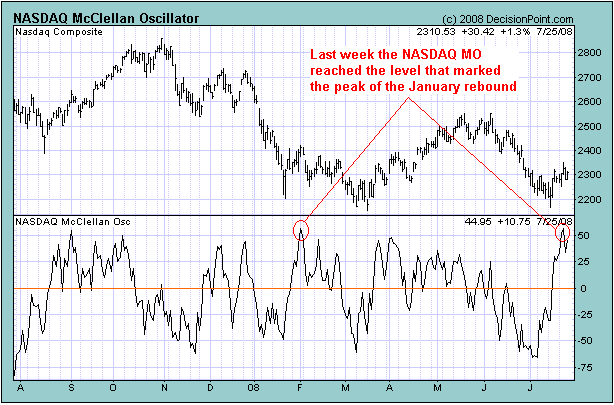
On the negative side of the ledger, the following chart of the NASDAQ
Composite Index and the NASDAQ's McClellan Oscillator (MO) shows that
the MO has just reached the level that capped the initial rebound from
the January low. The 22nd January low was followed by a short rebound,
a pullback to test the low (during February and March), and then a
longer rebound (from mid March through to mid May). We continue to
believe that a similar sequence of events was set in motion at the 15th
July low.
The NASDAQ's MO suggests that the market's initial rebound from its
15th July low is complete. If so, a pullback to test the low should
occur over the next few weeks. If our outlook is close to the mark then
this pullback will be followed by a rally to new multi-month highs, all
within the context of a bear market that will extend well into next
year.
This week's
important US economic events
| Date |
Description |
Monday Jul 28
| No important events scheduled | Tuesday Jul 29
| Consumer Confidence
| | Wednesday Jul 30
| No important events scheduled
| | Thursday Jul 31
| Employment Cost Index
Q2 GDP
Chicago PMI
| | Friday Aug 01
| Monthly Employment Report
ISM Index
|
Gold and
the Dollar
Currency Market Update
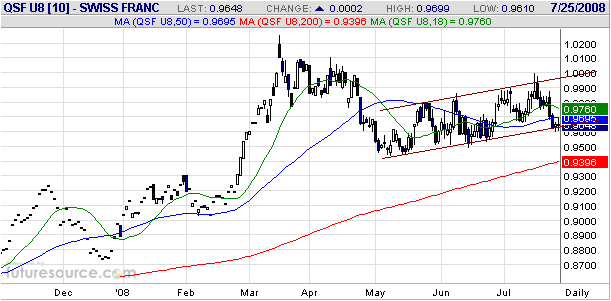
The following daily chart shows that the September Swiss Franc ended
last week in an interesting position -- at the very bottom of its
multi-month price channel. Further weakness from here would clearly
suggest that the SF had commenced the next downward leg in its
intermediate-term correction.
Our expectation is that the SF will eventually break below its channel
bottom and move well below its early-May low, but we don't have an
opinion as to whether the breakdown will occur immediately or after yet
another move to the channel top.
Gold
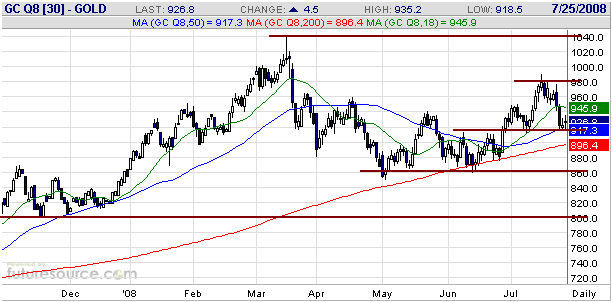
The horizontal lines drawn on the following daily chart of August gold
futures mark resistance and support levels. These 'technical' levels
happen to be spaced at $60 intervals beginning with resistance at $1040
and ending with support at $800.
Gold might have bottomed late last week when it tested support at
$917-$920. If so then it should take out resistance at $980 within the
next few weeks and make new all-time highs during the final four months
of the year. This, we think, is the most likely scenario.
Evidence that our most likely scenario was not panning out would come
in the form of a daily close below $917. Such an event would suggest
that gold was going to re-test this year's lows (near $860) before
commencing the rally that leads to new all-time highs. A decisive break
below $860 would bring the $800 support level into play, but as much as
we'd like to have the opportunity to buy gold in the low $800s we no
longer believe that there is a realistic chance of such an opportunity
presenting itself.
Gold Stocks
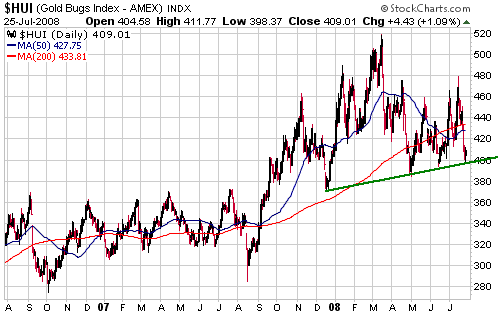
The following chart shows that the AMEX Gold BUGS Index (HUI) bounced off trend-line support late last week.
The most likely scenario, in our opinion, is that the gold sector has
just hit a short-term bottom. Many gold-sector participants are
undoubtedly anticipating an August plunge such as occurred last year,
but it looks, to us, like the HUI is in a very different position to
where it was at this time last year. In particular, in late July of
2007 the HUI had just hit a multi-month HIGH amidst great optimism,
whereas the current situation entails a multi-month LOW amidst great
consternation.
However, we obviously can't rule out the possibility that the HUI will
break below support at 390-400. With so many people watching charts
these days a break below this support could be self-reinforcing and
lead to panic liquidation, although we suspect that three things would
have to happen outside the gold sector in order for the HUI to drop
well below its current level. These three things are:
1. A sharp drop in the euro would relative to the US$
2. A break below support at $120 and a quick drop to around $100 by the oil market
3. An extension of the banking sector's upward trend
We are anticipating significant additional weakness in both the euro
and oil, but we have no idea if this weakness will occur immediately.
Moreover, neither weakness in the euro nor weakness in oil would affect
the fundamental bullish case for gold (gold is an anti-fiat-currency
play, not a pro-euro or pro-oil play). As such, a plunge in the gold
sector on the back of euro and oil weakness would simply lead to a much
better gold-buying opportunity than we are presently expecting.
A major extension of the banking sector's rebound WOULD adversely
affect the bullish case for gold, but we suspect that this sector's
rebound from its 15th July nadir is essentially complete.
It's noteworthy that
Kinross Gold (KGC) has agreed to buy Aurelian Resources (TSX: ARU) at a
substantial premium to its pre-bid price. ARU owns an exploration-stage
gold project with a large, high-quality resource.
This is a move that could pay-off for KGC because the depressed market
environment is allowing it to pick up one of the world's best
undeveloped gold projects at a relatively low price. However, it's a
high-risk move because the project is located in Ecuador. Uncertainty
regarding mining legislation and the security of property rights in
Ecuador caused ARU's stock price to take a beating in April and no
doubt played a big part in the decision of ARU's management to sell the
company at this time. The stock market is obviously concerned about the
political risk being taken-on by KGC in that it immediately reduced
KGC's market cap by roughly the same amount that KGC is paying for ARU
($1.2B); that is, the stock market is effectively saying that KGC is
worth no more with ARU's huge gold deposit than without it.
For those that aren't directly affected by the KGC-ARU deal, the
significance of the deal lies in the fact that KGC, by paying about
$85/ounce for inferred resources, is demonstrating that gold in the
ground has substantial value even when the ground is in a non-ideal
location.
Update
on Stock Selections
(Note: To review the complete list of current TSI stock selections, logon at http://www.speculative-investor.com/new/market_logon.asp
and then click on "Stock Selections" in the menu. When at the Stock
Selections page, click on a stock's symbol to bring-up an archive of our comments on the stock in question)
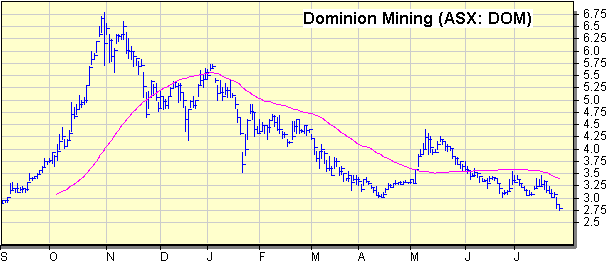
 Dominion Mining (ASX: DOM). Shares: 102M. Recent price: A$2.79 Dominion Mining (ASX: DOM). Shares: 102M. Recent price: A$2.79
We introduced Australian-listed DOM in last week's Interim Update and
promised to provide more info in the Weekly Update. So, here is a
summary of the investment case for DOM:
1. The company operates the very profitable 100K-oz/yr Challenger gold mine in a politically secure location (South Australia).
2. As a result of the cash being thrown off by the Challenger mine, DOM
has built up a cash pile of A$55M. The company has no significant debt.
3. At its current stock price DOM's enterprise value is about A$230M,
which means that it is being valued by the stock market at around
A$2300 per ounce of production. This is low for a profitable gold mine
in a politically secure jurisdiction. In a more buoyant stock market
the company would probably command a valuation of A$3500-$4000 per
ounce of production assuming a gold price of around US$900/oz.
4. The company's total gold resource is presently 1.1M ounces, but an
updated estimate will be reported within the next few weeks.
5. Drilling results have been extremely good and suggest significant
potential for resource/production growth. Some of these results are
highlighted in the quarterly report published last Thursday.
6. We expect the AUD to be a relatively weak currency over the next
several months, so we like the fact that DOM's costs are
AUD-denominated. But even if our currency market outlook proves to be
wrong and the AUD strengthens relative to the USD, there is little
chance of the AUD outperforming gold. In other words, we expect DOM's
already-healthy profit margin to increase.
7. DOM provides considerable exposure to gold's upside potential with a lot less risk than most junior gold-mining stocks.
By the way, Resolute
Mining (ASX: RSG) and Lion Selection (ASX: LST), our other two
Australian resource stock selections, are also candidates for new
buying near their current prices (both stocks ended last week at
A$1.60). RSG's latest quarterly report revealed that things were
progressing well with its in-production gold mines and with its
development-stage projects, and LST is trading at an absurdly large
discount to its net asset value considering that the bulk of this net
asset value will be returned to shareholders via a cash distribution
within the next few months.
Precision Drilling Trust (NYSE: PDS, TSX: PD.UN). Units: 126M. Recent price: US$21.97
We added PDS to the TSI Stocks List at US$21.32 via email alert last Friday.
PDS is a Canadian energy trust that provides drilling services to
natural gas (NG) producers in Canada and the US. The company's
expansion into the US is a relatively new development and was primarily
driven by the downturn in Canada's drilling market during 2006-2007.
Despite the large 2-year decline in the NG price from its late-2005
peak, the level of NG drilling activity in the US didn't deviate from
its upward trend. PDS's management therefore decided to offset the
impact of Canada's slowdown by expanding into the US drilling market, a
strategy that has paid dividends thus far. Also, growth is now
returning to the Canadian drilling market thanks to the large increase
in the NG price during the first half of this year.
PDS earned C$1.02 per unit during the first half of 2008, putting it on
a price/earnings ratio of 11 at Friday's closing price of US$21.50.
This is a low earnings multiple for an oil/gas services company,
especially given that PDS's US business is poised to grow rapidly and
that its core Canadian business has only just begun to rebound
following NG's devastating 2-year bear market.
PDS has a strong balance sheet (its $105M of debt is mostly offset by
$88M of working capital) and currently distributes C$0.13/month to
unit-holders, giving it a yield of about 7.5%.
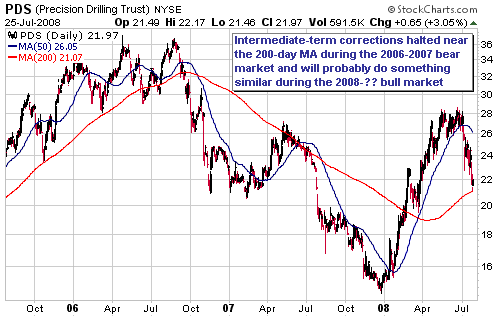
As illustrated by the following chart, the rebound in the NG price
resulted in a big rebound in PDS's unit price during the first half of
this year. We think the NG bull market is intact and that PDS's
drilling business will fare very well over the coming year, but, as is
its wont, the stock market got way ahead of itself during the second
quarter of this year. As a result, there was considerable short-term
downside risk in PDS when the units traded near their recent highs. In
particular, PDS became vulnerable to the sentiment swing that would
inevitably occur once the first substantial correction in NG's new bull
market got underway. This sentiment swing quickly pushed PDS down to
the vicinity of its 200-day moving average, thus creating the buying
opportunity that we have grabbed.
Over the past several years the NG price has shown a strong tendency to
bottom during August or September, so the correction is probably not
yet complete. However, at current prices much of the downside risk
appears to have been wrung out of both NG and PDS.
Energy Fuels Inc. (TSX: EFR). Shares: 52M issued, 63M fully diluted. Recent price: C$0.76
EFR's management appears to have done most things right and EFR remains
on track to become the first junior North American uranium miner to
transition from the exploration to the production phase during the
current cycle. Doing most things right hasn't yet helped the stock
price, but if good progress continues on the ground then the market
will eventually be forced to re-rate the stock.
The most important near-term issue is, unfortunately, out of
management's control. We aren't referring to the depressed market for
junior resource stocks, but, instead, to the final permit for EFR's
Whirlwind mine. A few months ago EFR's management expected that the
final Whirlwind permit, entitled the "Plan of Operations" from the US
Bureau of Land Management, would be approved during the second quarter
of 2008, but the permit hasn't yet been received. According to the
company there are no problems that should prevent the permit from being
issued; it's just a matter of waiting.
The waiting has caused some shareholders to lose interest, leading to a
steady slide in the stock price over the past few months (see chart
below). It is perhaps significant, however, that it has taken EFR
almost 5 months to retrace the gains it made in just three weeks during
February.
We think EFR's risk/reward is extremely attractive near its current price.
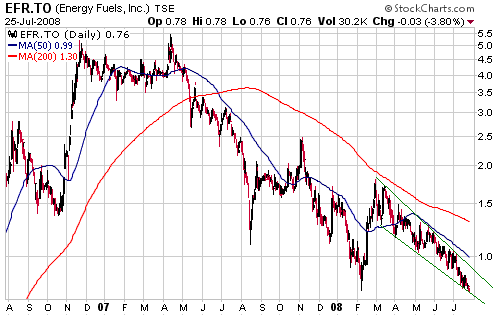
Chart Sources
Charts appearing in today's commentary
are courtesy of:
http://stockcharts.com/index.html
http://www.futuresource.com/
http://www.decisionpoint.com/

|









