|
-- Weekly Market Update for the Week Commencing 28th July 2014
Big Picture
View
Here is a summary of our big picture
view of the markets. Note that our short-term views may differ from our
big picture view.
In nominal dollar terms, the BULL market in US Treasury Bonds
that began in the early 1980s ended in 2012. In real (gold)
terms, bonds commenced a secular BEAR market in 2001 that will continue
until 2018-2020. (Last
update: 20 January 2014)
The stock market, as represented by the S&P500 Index,
commenced
a secular BEAR market during the first quarter of 2000, where "secular
bear market" is defined as a long-term downward trend in valuations
(P/E ratios, etc.) and gold-denominated prices. This secular trend will bottom sometime between 2014 and 2020.
(Last update: 22 October 2007)
A secular BEAR market in the Dollar
began during the final quarter of 2000 and ended in July of 2008. This
secular bear market will be followed by a multi-year period of range
trading.
(Last
update: 09 February 2009)
Gold commenced a
secular bull market relative to all fiat currencies, the CRB Index,
bonds and most stock market indices during 1999-2001.
This secular trend will peak sometime between 2014 and 2020.
(Last update: 22 October 2007)
Commodities,
as represented by the Continuous Commodity Index (CCI), commenced a
secular BULL market in 2001 in nominal dollar terms. The first major
upward leg in this bull market ended during the first half of 2008, but
a long-term peak won't occur until 2014-2020. In real (gold) terms,
commodities commenced a secular BEAR market in 2001 that will continue
until 2014-2020.
(Last
update: 09 February 2009)
Copyright
Reminder
The commentaries that appear at TSI
may not be distributed, in full or in part, without our written permission.
In particular, please note that the posting of extracts from TSI commentaries
at other web sites or providing links to TSI commentaries at other web
sites (for example, at discussion boards) without our written permission
is prohibited.
We reserve the right to immediately
terminate the subscription of any TSI subscriber who distributes the TSI
commentaries without our written permission.
Outlook Summary
Market
|
Short-Term
(1-3 month)
|
Intermediate-Term
(6-12 month)
|
Long-Term
(2-5 Year)
|
|
Gold
|
Bullish
(10-Jun-14) |
Bullish
(26-Mar-12) |
Bullish
|
|
US$ (Dollar Index)
|
Neutral
(10-Jul-14) |
Neutral
(10-Jul-14) |
Neutral
(19-Sep-07) |
|
Bonds (US T-Bond)
|
Bullish
(11-Dec-13)
|
Neutral
(18-Jan-12)
|
Bearish |
|
Stock Market
(DJW)
|
Bearish
(07-Apr-14) |
Bearish
(28-Nov-11) |
Bearish
|
|
Gold Stocks
(HUI)
|
Bullish
(10-Jun-14) |
Bullish
(23-Jun-10) |
Bullish
|
|
Oil |
Neutral
(02-Jun-14) |
Neutral
(31-Jan-11) |
Bullish
|
|
Industrial Metals
(GYX)
|
Neutral
(17-Feb-14) |
Bullish
(28-Apr-14) |
Bullish
(28-Apr-14) |
Notes:
1. The date shown below the current outlook is when the most recent outlook change occurred.
2. "Neutral", in the above table, means that we either don't have a
firm opinion or that we think risk and reward are roughly in balance with respect to the timeframe in question.
3. Long-term views are determined almost completely by fundamentals,
intermediate-term views by
fundamentals, sentiment and technicals, and short-term views by sentiment and
technicals.
Currency devaluation: The
most destructive policy of all
"Lenin is said to have declared that the
best way to destroy the capitalist system was to debauch the currency. By a
continuing process of inflation, governments can confiscate, secretly and
unobserved, an important part of the wealth of their citizens. By this method
they not only confiscate, but they confiscate arbitrarily; and while the process
impoverishes many, it actually enriches some. The sight of this arbitrary
rearrangement of riches strikes not only at security, but at confidence in the
existing distribution of wealth*. Those to whom the system brings windfalls,
beyond their deserts and even beyond their expectations or desires, become
'profiteers', who are the object of the hatred of the bourgeoisie, whom the
inflationism has impoverished, not less than of the proletariat. As the
inflation proceeds and the value of the currency fluctuates wildly from month to
month, all permanent relations between debtors and creditors, which form the
ultimate foundation of capitalism, become so utterly disordered as to be almost
meaningless; and the process of wealth-getting degenerates into a gamble and a
lottery.
Lenin was certainly right. There is no subtler, no surer means of overturning
the existing basis of society than to debauch the currency. The process engages
all the hidden forces of economic law on the side of destruction, and it does it
in a manner which not one man in a million is able to diagnose."
The above quotation is perfect. It does such a good job of succinctly describing
why currency devaluation is a destructive policy, both economically and
socially, that it could have been written by Mises. Strangely, therefore, it was
written by Keynes**.
It seems that Keynes understood the problems wrought by policies designed to
debauch (devalue) the currency, but such understanding is nowhere to be seen
among his modern-day followers. Instead, the modicum of sense contained in the
writings of Keynes has been discarded by the Keynesians of today in favour of a
total focus on "aggregate demand". If you wrongly believe the economy to be an
amorphous blob driven by changes in "aggregate demand", then you are looking at
the economy through a lens that creates such a distorted view of the world that
what you perceive is the opposite of reality. When looking through such a lens,
currency-devaluation policy can appear to be justifiable.
One of the most common 'justifications' for currency devaluation is that it
makes local exporters more competitive. The problem, as explained in previous
TSI commentaries, is that it can only benefit exporters at the EXPENSE of
consumers and importers. There can be no net benefit to the economy. Moreover,
the beneficiaries only benefit temporarily. The reason is that a sustained
reduction in a currency's value on the foreign exchange market requires
relatively high monetary inflation, which leads to rises in domestic prices that
not only counteract any benefit to exporters from the exchange-rate decline, but
also distort relative prices in a way that makes the overall economy less
efficient.
Related to the "we need to devalue our currency to make our exports more
competitive" idiocy is the handwringing that happens in reaction to trade
deficits. According to neo-Keynesian orthodoxy, every dollar that flows out of
the US due to a trade deficit is a dollar less of spending within the domestic
economy, which, in turn, leads to a weaker domestic economy and higher
unemployment. In reality, however, every dollar that flows out due to a trade
deficit eventually returns as some form of investment. That's why the $500B+
annual US trade deficit has not reduced the US money supply. As Joseph Salerno
(a good economist) explains in a
17th July article, trade-deficit dollars get invested by foreigners in US
stocks, bonds, real estate such as buildings and golf courses, and financial
intermediaries like banks and mutual funds, with many of the dollars ultimately
being lent to or invested in US businesses. These businesses then spend the
dollars on paying wages and buying real capital goods like raw materials, plants
and equipment, and software. The point is that the flow of spending in the US
economy is not diminished by a negative trade balance, but merely re-routed.
There will be a redirection of labor and capital out of export industries into
industries producing consumer and capital goods for domestic use, with no net
loss of jobs. A net loss of jobs will, however, come about due to policies put
in place to 'fix' a perceived trade-deficit problem.
Another common 'justification' for currency devaluation is that it lowers real
wages and thus gets around the problem that the nominal price of labour tends to
be 'sticky'. The idea is that nominal wage rates are excessively slow to fall in
response to reduced demand for workers, and that currency devaluation helps by
surreptitiously reducing the real price of labour. The first point to note here
is that the 'stickiness' of wages was never a problem in the US prior to the
1930s, when the Hoover and Roosevelt Administrations took steps to prevent wages
from falling in response to a severe economic downturn. A second and related
point is that government payments to the unemployed can reduce the incentive for
able-bodied people to accept lower wages to re-enter the workforce. In other
words, if nominal wages are problematically 'sticky' it is because of government
intervention, not the free market. Third, the knowledge that modern money
relentlessly loses purchasing power over time would tend to make nominal wages
'stickier' than they would otherwise be. In other words, the policy designed to
address the perceived problem of 'sticky' wages actually contributes to the
problem. In any case, these points are not critically relevant. Regardless of
whether wages really are 'sticky' and regardless of the cause of the supposed
problem, 'sticky' wages could never logically justify a policy that must
ultimately weaken the economy.
The primary problem with currency devaluation is that it leads to non-uniform
changes in prices throughout the economy. In effect, the implementers of
devaluation policy send false price signals into the economy, which leads to
more investing mistakes than would otherwise happen. As a result of the greater
number of investing mistakes, there ends up being less wealth. Furthermore, the
smaller pool of wealth will be redistributed by the devaluation policy, often in
a way that is so obviously unfair that it provokes calls for new interventions
and punitive taxes. It therefore puts the economy on the proverbial "slippery
slope".
In summary, Keynes wasn't right about much, but early in his career he was
absolutely right about currency devaluation. It is a process that engages all
the hidden forces of economic law on the side of destruction, and it does it in
a manner that not one man in a million will be able to diagnose.
*The undeserved wealth distribution caused by currency
devaluation policy is the root cause of today's fixation on "inequality".
Unfortunately, none of the most popular writers on this topic understand the
cause of the perceived problem.
**The quotation is from Chapter 6 of Keynes' 1919 book titled
"The Economic Consequences of the Peace".
China Update
If you have been reading well-informed
analyses on the topic then you will probably realise that China's economy is a
slow-motion disaster in progress. China's economy has been the setting for
mal-investment on an unprecedented scale, the result of which will be one of the
most spectacular economic busts ever recorded or, more likely, very many years
-- perhaps even decades -- of lacklustre performance. The latter long-term
possibility appears to be the more likely due to the central government's
near-total control of the banking system and the money supply.
However, it would be a mistake to assume that China's economic problems mean
that it would be a good idea to bet against China's stock market at this time.
Massive economic imbalances do not imply future stock market weakness. In fact,
the Shanghai Stock Exchange Composite Index (SSEC) is close to signaling the end
of its cyclical bear market.
We currently aren't interested in trading China's stock market from either the
short side or the long side, but the intermediate-term risk/reward looks more
bullish than bearish.

On the monetary inflation front, since making a new 15-year low in January-2014
the year-over-year rate of change in China's M1 money supply has rebounded. The
loosening of the monetary reins has undoubtedly had a lot to do with the gradual
upturn in the stock market.
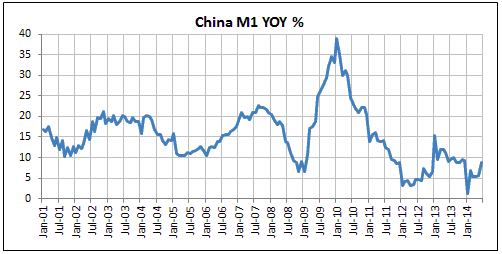
When the rate of change in China's M1 money supply has reversed direction in
January, as it has done in 5 of the past 6 Januarys, the new trend has lasted
until at least the following January. China therefore looks set to experience a
further easing of monetary conditions over the next few months.
The Stock
Market
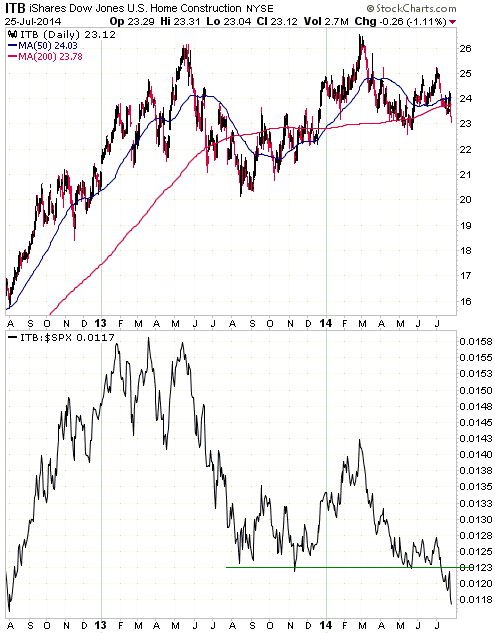
The following chart shows the iShares US
Home Construction ETF (ITB) and the ITB/SPX ratio.
ITB has essentially traded sideways since the first half of last year, but the
ITB/SPX ratio commenced a major downward trend in May of 2013 and ended last
week at a new 18-month low. This suggests to us that the rebound in the US
residential real estate market ended during the second quarter of last year.
Some equity bull markets appear to have ended or to be close to an end. At the
same time, there are signs that new equity bull markets are getting underway
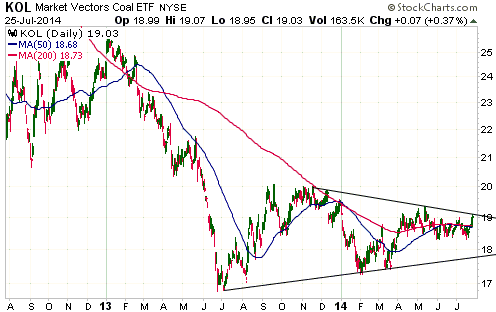
elsewhere. For example, the coal-mining sector, one of the worst-performing
equity sectors over the past three years, is close to signaling a major upward
trend reversal.
The coal-mining sector is represented on the following daily chart by the Market
Vectors Coal ETF (KOL). KOL ended last week in a similar position to the SSEC (a
proxy for China's stock market), in that any significant additional strength
from here would signal the end of its cyclical bear market.
As an aside, although almost half of the entire world's coal production is
consumed in China, we doubt that there is a direct causal relationship between
the budding upward reversal in China's stock market and the budding upward
reversal in KOL. However, both could be indirectly related to the loosening of
monetary conditions in China.
We might be interested in buying KOL following a 10% pullback in the broad US
stock market.
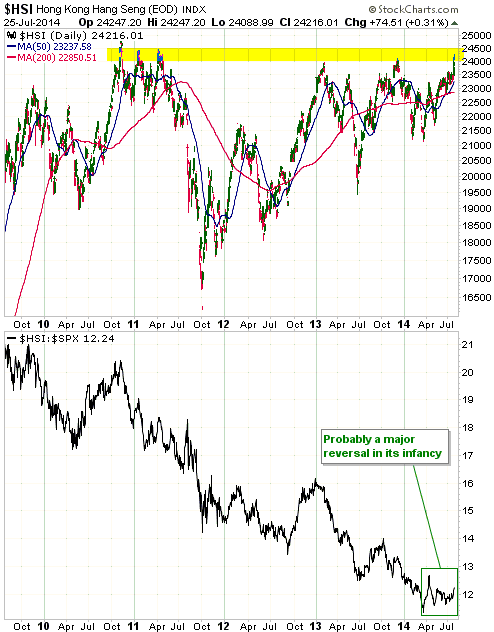
The Hong Kong stock market, as represented by the Hang Seng Index (HSI), is
short-term 'overbought' and at long-term resistance. Therefore, it probably
won't make significant additional headway in the near future. However, the HSI's
chart pattern suggests a bullish intermediate-term outcome for this market. It
is also worth noting that the HSI/SPX ratio appears to be in the process of
reversing a 5-year downward trend.
This week's
important US economic events
| Date |
Description |
| Monday Jul 28 |
Pending Home Sales Index
Dallas Fed Mfg Survey | | Tuesday
Jul 29 |
Case-Shiller Home Price Index
Consumer Confidence | | Wednesday
Jul 30 |
FOMC Meeting Announcement
Q2 GDP | | Thursday
Jul 31 |
Employment Cost Index
Chicago PMI
|
| Friday Aug 01 |
Monthly Employment Report
ISM Mfg Index
Motor Vehicle Sales
Personal Income and Spending
Construction Spending
Consumer Sentiment |
Gold and
the Dollar
Gold and Silver
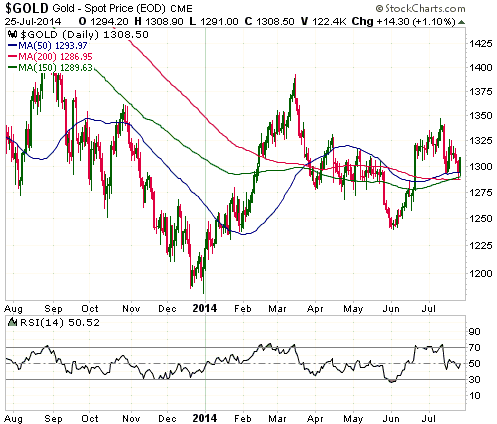
Gold's 50-day, 150-day and 200-day moving averages established a likely range
for a correction low. The 50-day MA in the low-$1290s had been tested during the
week before last, but the price action and the relatively high speculative
net-long position in COMEX gold futures suggested that gold would drop into the
$1280s to test the 150-day and 200-day moving averages before the correction
ended. This happened last Thursday, and Friday's upward reversal is a
preliminary sign that the test was successful.
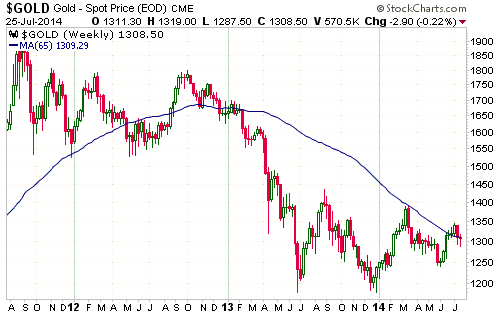
As we noted when it was peaking in the $1340s earlier this month, the gold price
could drop to test the aforementioned daily moving averages but would probably
remain above its 65-week moving average on a weekly closing basis. The following
weekly chart shows that for all intents and purposes this has happened, as gold
rallied enough last Friday to end the week within $1 of its 65-week MA.
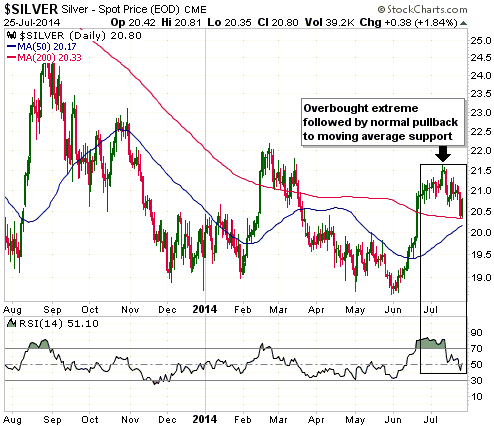
In the 16th July Interim Update we mentioned that silver had support at
$19.90-$20.40 and that this support would probably be tested before the
correction came to an end. Silver traded in this support range last Thursday and
then rebounded with gold on Friday.
With one exception, the short-term corrections in the gold and silver markets
have now achieved as much as could reasonably be expected. The exception is the
insignificant decline in the speculative net-long position in COMEX gold
futures. At 160K contracts, the speculative net-long position in COMEX gold
futures remains near a 52-week high. It would ideally drop to less than 130K
contracts prior to the start of a tradable rally.
As explained in previous commentaries, speculators drive the gold price, and in
the futures market the commercial position is simply an offset of the
speculative position. For example, in order for speculators, as a group, to
build up a 160K-contract net-long position, commercials, as a group, MUST become
net short by 160K contracts. The sum of the net positions must always equal
zero. Consequently, a short-term rise in the gold price will almost always be
accompanied by an increase in the speculative net-long position and an
offsetting increase in the commercial net-short position. It is therefore absurd
to view a higher speculative net-long position or a higher commercial net-short
position as bearish. That being said, a large and rapid increase in the
speculative net-long position suggests short-term risk. It indicates that
sentiment has become too bullish too quickly and that the potential exists for
substantial 'long' liquidation in the futures market.
In a nutshell, the COT situation is nothing more than a sentiment indicator. As
is the case in all markets, a sharp rise in bullish gold sentiment to a
relatively high level makes the gold market more vulnerable to disappointment.
Further to the above, it's a concern that the speculative net-long position
remains relatively high. However, it is not a big concern to us, because there
is often a surge in bullish sentiment in the early part of a new bull market.
Our guess is that gold made its correction low when it traded at $1287 last
Thursday, but we won't be confident that the correction has ended until after
the price closes above $1325.90.
Gold Stocks
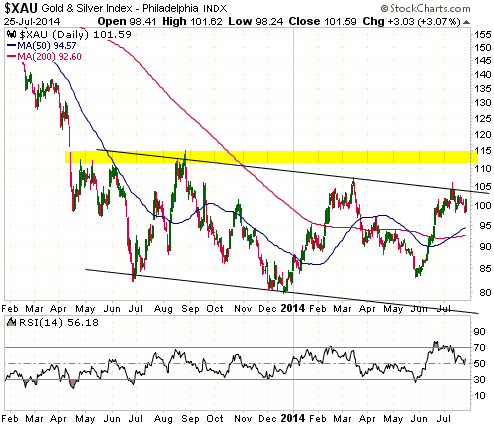
Unlike gold bullion, the senior gold-stock indices haven't yet made it down to
moving-average support. For example, the 50-day MA for the XAU is around 94,
whereas last week's low for the XAU was around 98. Refer to the following daily
chart for details.
It's bullish that gold stocks have held up better than gold bullion during the
correction to date, but it means that the gold-stock indices could spike a few
percent below last week's lows before resuming their upward trends. Also, the
GDXJ/GDX ratio hasn't yet signaled an end to the correction. It would do so by
diverging positively from the senior indices, that is, by making a higher low
while the XAU and the HUI made lower lows (as per December-2013 and April-May of
this year), or by rising sharply.
The XAU has resistance at 104-105 and then at 112-115. We expect that the upward
trend will resume within the coming two weeks, with or without a spike down to
the 50-day MA, and that the higher of the above-mentioned resistance ranges will
be tested within the coming two months.
The Currency Market
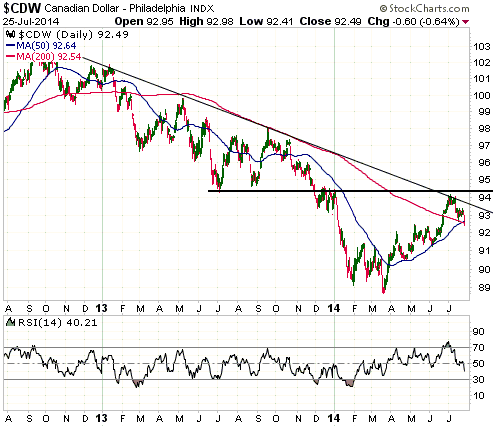
In the 25th June Interim Update, we wrote:
"The Canadian Dollar (C$) has moved up to intermediate-term resistance in the
93-94 range. There are no surprises here, just more evidence that
commodity-related investments are slowly gaining popularity. However, it will be
surprising if the C$ breaks above 94 within the next few weeks. As far as we are
concerned, that would be too much too soon.
We expect that the C$ will make a short-term top in the 93-94 range and then
'correct' for at least a few weeks. The 50-day MA would be a likely target for a
correction low."
Soon after, the C$ peaked near important resistance at 94 and began to
'correct'. It ended last week just below its 50-day MA, which means that it is
now close to the most likely level for a correction low.
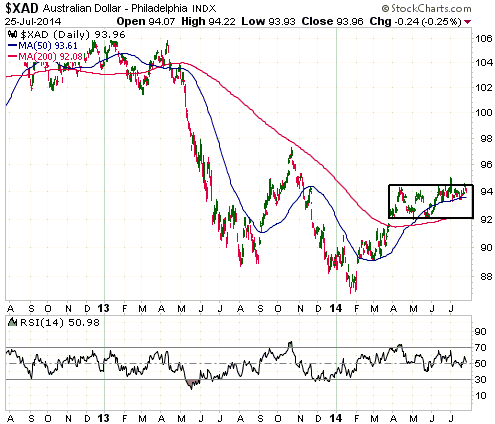
The Australian Dollar (A$), the other major "commodity currency", has been
oscillating within a horizontal range since April. This is probably a mid-trend
consolidation.
We expect that the A$ will resume its upward trend within the next three weeks.
97-98 is a realistic 2-month update target.
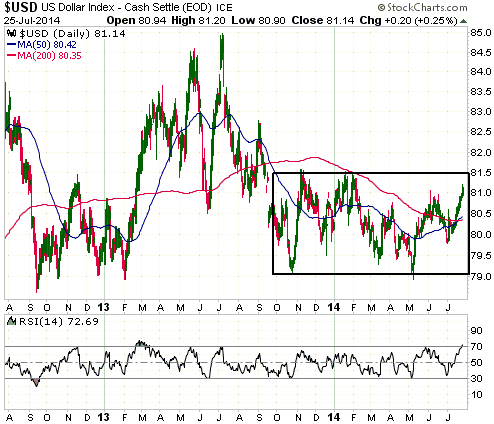
The Dollar Index has spent the past 10 months oscillating between 79.0 and 81.5.
Until about three weeks ago we were operating under the assumption that the
eventual breakout from this range would be to the downside, but now we are
uncertain. A downside breakout would indicate that there was going to be one
more decline to the low-70s as part of the Dollar Index's major bottoming
pattern, whereas an upside breakout would indicate that the bottoming pattern
was complete and that a substantial advance had begun.
The Dollar Index is now short-term 'overbought' and near the top of its 10-month
range. This suggests to us that it will make a short-term top this week or next.
The position of the coming short-term top will be telling. If the Dollar Index
manages to break solidly above 81.5 before making its next short-term top, it
will tell us that the ensuing decline will be within the context of a new
intermediate-term advance. However, if the Dollar Index reverses downward from
at or below 81.5 it will tell us that the odds are still in favour of a final
decline to the low-70s.
Updates
on Stock Selections
Notes: 1) To review the complete list of current TSI stock selections, logon at
http://www.speculative-investor.com/new/market_logon.asp
and then click on "Stock Selections" in the menu. When at the Stock
Selections page, click on a stock's symbol to bring-up an archive of
our comments on the stock in question. 2) The Small Stock Watch List is
located at http://www.speculative-investor.com/new/smallstockwatch.html
 Company
news/developments for the week ended Friday 25th July 2014: Company
news/developments for the week ended Friday 25th July 2014:
[Note: AISC = All-In Sustaining Cost, FS = Feasibility Study, IRR =
Internal Rate of Return, MD&A = Management Discussion and Analysis,
M&I = Measured and Indicated, NAV = Net Asset Value, NPV(X%) = Net
Present Value using a discount rate of X%, P&P = Proven and
Probable, PEA = Preliminary Economic Assessment, PFS =
Pre-Feasibility Study]
*Batero Gold (BAT.V) issued financial statements last week
indicating that the company still has about C$0.15/share of cash and
working capital, meaning that the stock is still trading at a
sizeable discount to its cash (BAT ended last week at C$0.10).
BAT remains in hibernation pending a higher gold price. Its cash
burn rate is low, but its gold project in Colombia won't begin to
look viable until the gold price breaks above $1400/oz and it
probably won't generate market-moving news anytime soon.
*Pilot Gold (PLG.TO) reported a drilling result during the first
half of June that constituted a new discovery at its TV Tower
project in Turkey. The new discovery was the Valley gold-copper
porphyry target and the discovery hole returned 0.99 grams/tonne
gold and 0.39% copper over 153.1 metres starting from near the
surface.
Last week PLG reported another exceptional intercept from the Valley
target: 1.59 g/t Au and 0.48% Cu over 130.9 metres, again starting
from near the surface.
PLG has many irons in the fire. There is a good chance that at least
one of these 'irons' will pay off in a big way.
*Pretium Resources (PVG) is issuing 6.8M new shares at
US$7.25/share to a syndicate of underwriters to raise US$49.5M.
Silver Standard Resources (SSRI) will be selling $10.5M of its PVG
shares at the same price to the same syndicate of underwriters.
The financing is being done at a discount of about 10% to the market
price just prior to word of the financing getting out, so it
naturally prompted a quick decline of around 10% in the stock price.
In the 23rd June Weekly Update, we wrote: "Due to the value of
the Brucejack deposit indicated by the FS, we think that PVG would
be a buy if it pulled back to around US$6.50. At that price there
wouldn't be much downside risk, because there is little doubt that
the project has the potential to be developed into a profitable gold
mine at the current gold price. The doubt/disagreement revolves
around whether it should be developed into a 400K-oz-year operation
using bulk mining or a much smaller operation using selective
mining."
Thanks to the discounted financing and the gold market's
consolidation, there is a realistic chance that PVG will soon reach
our suggested buy zone (around US$6.50). We wanted to make it clear
that we still consider the stock to be a good candidate for new
buying at this level.
List
of candidates for new buying
From within the ranks of TSI stock selections, the best candidates for new
buying at this time are:
1) AAU (last Friday's closing price: US$1.36).
2) EDV.TO (last Friday's closing price: C$0.92).
3) EVN.AX (last Friday's closing price: A$0.77).
4) PVG around US$6.50 (last Friday's closing price: US$6.98).
5) SBB.TO (last Friday's closing price: C$0.84).
Chart Sources
Charts appearing in today's commentary
are courtesy of:
http://stockcharts.com/index.html

|









