|
-- Weekly Market Update for the Week Commencing 28th October 2013
Big Picture
View
Here is a summary of our big picture
view of the markets. Note that our short-term views may differ from our
big picture view.
In nominal dollar terms, the BULL market in US Treasury Bonds
that began in the early 1980s will end by 2013. In real (gold)
terms, bonds commenced a secular BEAR market in 2001 that will continue
until 2014-2020. (Last
update: 23 January 2012)
The stock market, as represented by the S&P500 Index,
commenced
a secular BEAR market during the first quarter of 2000, where "secular
bear market" is defined as a long-term downward trend in valuations
(P/E ratios, etc.) and gold-denominated prices. This secular trend will bottom sometime between 2014 and 2020.
(Last update: 22 October 2007)
A secular BEAR market in the Dollar
began during the final quarter of 2000 and ended in July of 2008. This
secular bear market will be followed by a multi-year period of range
trading.
(Last
update: 09 February 2009)
Gold commenced a
secular bull market relative to all fiat currencies, the CRB Index,
bonds and most stock market indices during 1999-2001.
This secular trend will peak sometime between 2014 and 2020.
(Last update: 22 October 2007)
Commodities,
as represented by the Continuous Commodity Index (CCI), commenced a
secular BULL market in 2001 in nominal dollar terms. The first major
upward leg in this bull market ended during the first half of 2008, but
a long-term peak won't occur until 2014-2020. In real (gold) terms,
commodities commenced a secular BEAR market in 2001 that will continue
until 2014-2020.
(Last
update: 09 February 2009)
Copyright
Reminder
The commentaries that appear at TSI
may not be distributed, in full or in part, without our written permission.
In particular, please note that the posting of extracts from TSI commentaries
at other web sites or providing links to TSI commentaries at other web
sites (for example, at discussion boards) without our written permission
is prohibited.
We reserve the right to immediately
terminate the subscription of any TSI subscriber who distributes the TSI
commentaries without our written permission.
Outlook Summary
Market
|
Short-Term
(1-3 month)
|
Intermediate-Term
(6-12 month)
|
Long-Term
(2-5 Year)
|
|
Gold
|
Bullish
(21-Oct-13)
|
Bullish
(26-Mar-12)
|
Bullish
|
|
US$ (Dollar Index)
|
Neutral
(24-Dec-12)
|
Neutral
(18-Sep-13)
|
Neutral
(19-Sep-07)
|
|
Bonds (US T-Bond)
|
Bullish
(24-Jun-13)
|
Neutral
(18-Jan-12)
|
Bearish |
|
Stock Market
(DJW)
|
Neutral
(18-Sep-13)
|
Bearish
(28-Nov-11)
|
Bearish
|
|
Gold Stocks
(HUI)
|
Bullish
(21-Oct-13)
|
Bullish
(23-Jun-10)
|
Bullish
|
|
Oil |
Neutral
(30-Jul-12)
|
Neutral
(31-Jan-11)
|
Bullish
|
|
Industrial Metals
(GYX)
|
Neutral
(30-Jul-12)
|
Neutral
(29-Aug-11)
|
Neutral
(11-Jan-10)
|
Notes:
1. In those cases where we have been able to identify the commentary in
which the most recent outlook change occurred we've put the date of the
commentary below the current outlook.
2. "Neutral", in the above table, means that we either don't have a
firm opinion or that we think risk and reward are roughly in balance with respect to the timeframe in question.
3. Long-term views are determined almost completely by fundamentals,
intermediate-term views by
fundamentals, sentiment and technicals, and short-term views by sentiment and
technicals.
No Interim Update this
week
We'll be moving house during the second half
of this week and therefore won't be able to do an Interim Update. However, we'll
send out an email alert if something dramatically unexpected or unexpectedly
dramatic happens in the financial markets.
The Fed has lost an
important part of its control
Due to the extraordinary US monetary policy of
the past few years, a US inflation problem is probably going to become obvious
to almost everyone within the next few years. It is generally assumed that when
obvious evidence of an inflation problem eventually emerges, the Fed will
address the problem by tightening monetary conditions. However, we think that
the Fed has effectively lost the ability to implement genuinely restrictive
monetary policy.
To understand why the Fed may have lost the ability to tighten, you first have
to understand that a rise in interest rates doesn't necessarily imply tighter
monetary conditions and a fall in interest rates doesn't necessarily imply
looser monetary conditions. This is a point that is missed by analysts who claim
that US monetary conditions began to loosen when the Fed began to reduce its
targeted interest rate in September of 2007. It also relates to why monetary
conditions were tight in Japan over the bulk of the past 20 years despite the
Bank of Japan's relentless Zero Interest Rate Policy (ZIRP).
The fact is that the growth rate of the economy-wide money supply* is the only
reliable indicator of whether monetary conditions are becoming tighter or
looser. Consequently, a higher interest rate only implies tighter monetary
conditions to the extent that it is associated with a falling TMS (True Money
Supply) growth rate, and a lower interest rate only implies looser monetary
conditions to the extent that it is associated with a rising TMS (True Money
Supply) growth rate. For example, even though the Fed began to cut its targeted
interest rate in September of 2007, the TMS growth rate didn't begin to rise
from a low level until September of 2008. In fact, the year-over-year TMS growth
rate was lower in August of 2008 than in September of 2007, meaning that the
first 11 months of the Fed's supposed monetary loosening of 2007-2008 were
actually accompanied by tightening monetary conditions. It wasn't until the Fed
began to directly inject large amounts of money into the economy in September of
2008 that a genuine loosening of monetary conditions got underway. For another
example, Japan's rate of money-supply growth averaged only about 2% per year
over the past 20 years, meaning that the country that consistently had the
lowest interest rates in the world also consistently had the tightest monetary
conditions in the world.
This relates to our claim that the Fed has effectively lost control, because, as
discussed in our 30th September commentary (see "Another nail in the coffin of
the deflation case"), the level of excess reserves in the US banking system is
now so massive that it will be practically impossible for the Fed to push the
Fed Funds Rate (FFR) upward by draining reserves from the banks and money from
the economy. We say "practically impossible" because with the current level of
reserves the Fed would have to drain hundreds of billions of dollars from the
system just to effect a 0.25% hike in the FFR. This would immediately collapse
the stock market, causing the 'tightening' program to end almost as soon as it
began. As a result, a future boost to the FFR will require a similar boost to
the interest rate paid by the Fed on bank reserves. More specifically, by moving
the interest rate on bank reserves upward the Fed will be able to raise the FFR
even though the banks are inundated with excess reserves, because banks won’t
lend reserves to other banks for less than what the Fed is paying them. This was
also discussed in our 30th September commentary.
The point we are working around to is that the Fed's next rate-hiking campaign
will likely do nothing to tighten monetary conditions because the Fed can no
longer control the FFR by adjusting bank reserves. In fact, due to the need to
increase the interest paid on bank reserves in order to increase the FFR, the
next rate-hiking campaign will have to be accompanied by an additional BOOST to
bank reserves. Furthermore, the higher the Fed decides to push the FFR, the
greater the amount of interest it will have to pay on bank reserves and the
larger the total quantity of bank reserves will become. This won't necessarily
lead to a higher money supply (bank reserves are not part of the money supply
and there is no consistent relationship between bank reserves and bank
money-creation), but adding to bank reserves most definitely cannot be construed
as genuine monetary tightening.
The Fed hasn't totally lost control, in that it still has the ability to loosen
monetary conditions and to moderate the pace at which it pumps new money. Also,
monetary conditions could temporarily become genuinely tight for reasons other
than deliberately restrictive Fed policy. Our point is that the Fed is no longer
capable, short of quickly precipitating a devastating asset-price collapse, of
bringing about a genuine tightening of monetary conditions in response to a
burgeoning "price inflation" problem. Instead, the Fed appears to have
permanently locked itself into a pro-inflation position.
*The True Money Supply (TMS), which is physical currency
in circulation plus money in commercial-bank demand deposits plus money in
commercial-bank savings deposits, is the correct money-supply aggregate. M1, M2,
M3, MZM and the Monetary Base are not reliable indicators of the economy-wide US
money supply.
The Stock
Market
The US
We've been focusing on the Dow's failure to confirm the new highs made firstly
by the NDX and later by the SPX. This non-confirmation was still in place at the
end of last week.
A similar non-confirmation exists between the Dow Transports and the Dow
Industrials. As illustrated by the chart displayed below, the Dow Transports
rocketed upward to new highs last week while the Dow Industrials remained below
its September high.
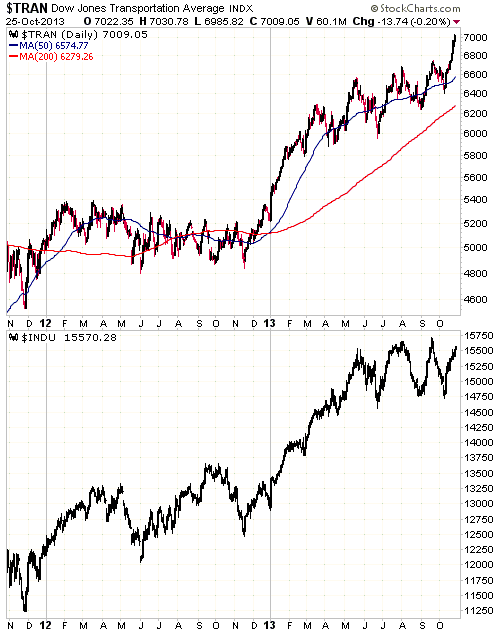
If the Dow Industrials Index makes a new high this week it will remove a
non-confirmation with longer-term bearish implications, but it will not
constitute a buy signal. The reason is that if the Dow 'confirms' the other
indices in the near future it will be doing so with the overall market
dangerously extended to the upside.
Due to the extent to which the US stock market is 'overbought', there's a high
risk of a significant decline over the coming month with or without a confirming
move to new highs by the Dow Industrials Index.
Hong Kong
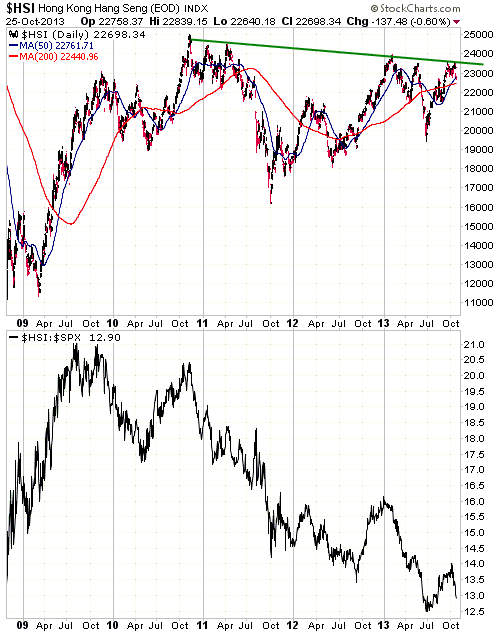
The following chart shows Hong Kong's Hang Seng Index (HSI) and the HSI/SPX
ratio. The picture presented by this chart is interesting, because it suggests
that the HSI has either just made an intermediate-term peak near major
resistance or is close to completing a three-year bull-market consolidation. The
chart also shows that the Hong Kong market has been in a downward trend relative
to the US market for about four years. Perhaps this long period of relative
weakness is about to end.
We haven't yet drawn any conclusions, but we are paying close attention to the
HSI's performance in nominal terms and relative to the SPX.
This week's
important US economic events
| Date |
Description |
| Monday Oct 28 |
Pending Home Sales
Industrial Production
Dallas Fed Mfg Survey | | Tuesday
Oct 29 |
PPI
Retail Sales
Case-Shiller Home Price Index
Business Inventories
Consumer Confidence | | Wednesday
Oct 30 |
FOMC Announcement
CPI | | Thursday
Oct 31 |
Chicago PMI
|
| Friday Nov 01 |
Motor Vehicle Sales
ISM Mfg Index |
Gold and
the Dollar
Gold
The Fundamentals
We do not yet have conclusive evidence, but it appears that gold bullion
commenced a new cyclical bull market in June of 2013 and that the gold sector of
the stock market made a 'double bottom' in June and October. This is consistent
with the true fundamentals, as opposed to the fundamentals upon which many gold
bulls focus. We are referring, for example, to the upside breakout during
May-2013 in the 10yr-2yr US yield spread and the relative weakness in US bank
stocks over the past 4 months.
That being said, not all fundamental gold drivers and indicators are bullish at
this time. Of particular note, credit spreads haven't yet confirmed a reversal
(from narrowing to widening) and gold hasn't yet completed a bottoming pattern
relative to commodities in general. That is, more evidence is still to come.
Assuming that a new cyclical gold bull market is underway, the next 12 months of
this bull market will almost certainly NOT be driven by a blatant "price
inflation" problem. It will, we think, be driven primarily by the realisation
that "QE" has completely failed to bring about economic progress. Another way of
saying this is that gold's upward trend over the next 12 months will be driven,
like all major upward trends in the gold market, by declining confidence in the
senior central banks, but in this case the proximate cause of the declining
confidence will be evidence, in the form of economic weakness, that QE has been
a failure.
The Price Action
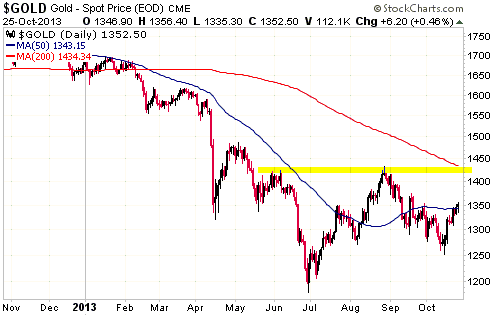
Gold has just achieved consecutive daily closes above its 50-day MA, thus giving
us another sign that a major bottom is in place. Note, though, that it isn't yet
far enough above its 50-day MA for this MA to act as support during a downward
correction.
More evidence is obviously needed to confirm beyond doubt that a major bottom,
as opposed to a short-term bottom, is in place. For example, resistance defined
by the September rebound high ($1376) will have to be overcome.
The final piece of the puzzle will fall into place when resistance in the $1420s
(the yellow shaded area on the following daily chart) is surmounted. We don't
expect this resistance to be breached within the coming few weeks, but it could
be tested. We would view a near-term test of this resistance as a short-term
selling opportunity.
The statement to be published by the Fed after week's FOMC meeting could lead to
additional volatility in all the financial markets over the coming few days,
although the Fed is not expected to make any changes at this meeting and almost
certainly won't make any changes.
Gold Stocks
Like gold bullion, the HUI has just achieved consecutive daily closes above its
50-day MA. This makes it more likely that the HUI will test intermediate-term
resistance in the low-280s within the next few weeks.
Getting through resistance in the low-280s would leave little remaining doubt
that a major bottom was in place. This is likely to happen within the next three
months, but probably won't happen within the next few weeks.
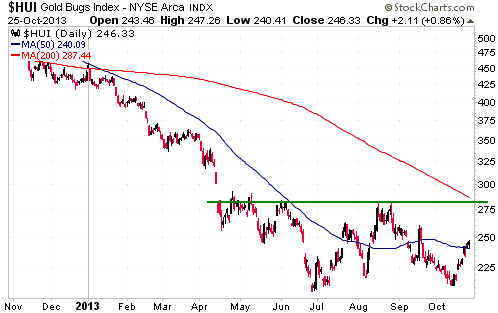
The HUI's chart pattern and the rate of recovery following previous major
bottoms of the past 50 years suggests that the HUI could trade as high as 350
within the next three months. This should be viewed as the maximum realistic
short-term upside potential. Going the other way, for the major bottom scenario
to remain intact a near-term pullback should not result in a daily close below
225. Consequently, our short-term bullish outlook is now contingent upon the HUI
remaining above 225 on a daily closing basis.
It is worth highlighting the recent price action of Agnico Eagle (AEM), a
1M-oz/year gold producer. AEM broke below support defined by its June and August
lows during the week before last, but then reversed upward. Last week's rally in
this stock in response to a bullish production forecast indicates that the
October downside breakout was false.
As we've mentioned numerous times in the past, a false downside breakout is a
more reliably bullish signal than an upside breakout.
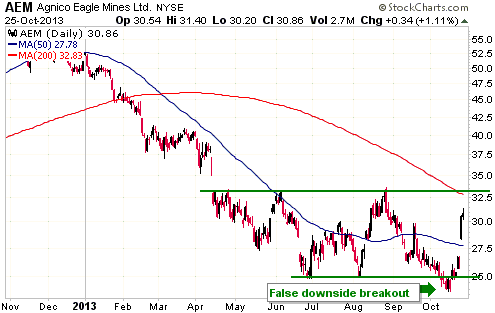
AEM needs to break above intermediate-term resistance at $32.50-$33.00 to
complete a major bottoming pattern. This resistance probably won't be breached
in the near future, although it will probably be tested.
A test of resistance at $32.50-$33.00 followed by a pullback to $28-$29 would
create a good set-up for a short-term trade in anticipation of a rally to
$40-$42.
Currency Market Update
At the beginning of this year we thought that problems with euro-zone government
debt and banks would return to "Page 1" during the second half of the year. This
was the main reason we maintained an intermediate-term bullish view on the
Dollar Index from the start of May through to the first half of September.
Putting it another way, we thought that the resumption of the euro-zone's debt
crisis would cause an intermediate-term euro decline and Dollar Index advance to
get underway before the end of this year.
We will ultimately be proven right about euro-zone government debt and banking
problems, but it was clear by the middle of last month that we were wrong about
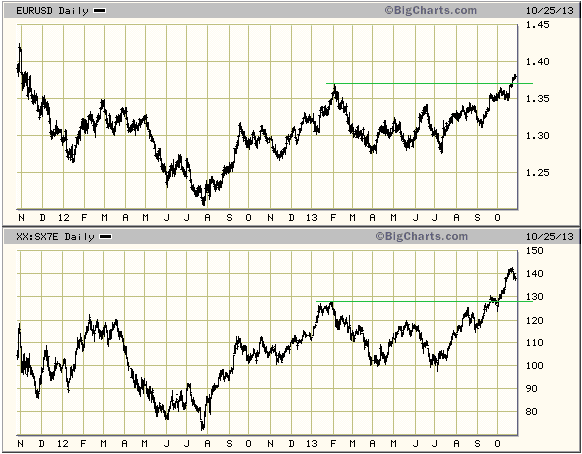
the problems rising to the surface during 2013. As illustrated by the bottom
half of the following chart, the SX7E, a proxy for euro-zone bank stocks, has
been very strong over the past few months and broke out to new multi-year highs
earlier this month. As illustrated by the top half of the following chart, this
led to an upside breakout in the euro.
The upshot is that as things currently stand, the financial markets couldn't
care less about the precarious financial positions of many euro-zone governments
and banks. The markets' perception will change, but the timing is unknown.
Regardless of what is in store for the currency market over the next 12 months,
the odds favour some weakness in the euro and strength in the Dollar Index over
the next month or so. This is because the euro is now very 'overbought' on a
short-term basis and testing important resistance at 138 while the Dollar Index
is very 'oversold' on a short-term basis and marginally above critical support
at 79.
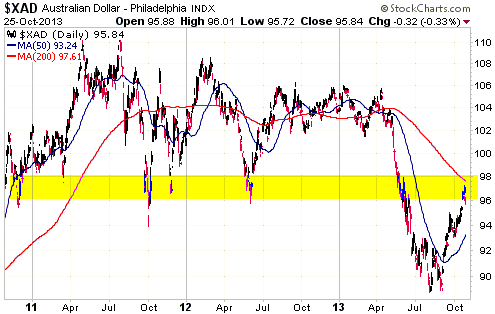
When the A$ broke below support at 96-98 during the second quarter of this year
it completed a major topping pattern. After slumping to 89 during the third
quarter it has since rebounded to the former support (now resistance) at 96-98.
Here are the two most likely A$ scenarios:
1. A bear market rebound has just ended and a downward trend to new multi-year
lows has just begun.
2. The bear market is not over, but perceived recovery in China and weakness in
the US$ mean that the rebound is also not over. In this case, the A$ will
consolidate over the next few weeks and probably drop back to near its 50-day MA
before resuming its short-term upward trend.
Update
on Stock Selections
Notes: 1) To review the complete list of current TSI stock selections, logon at
http://www.speculative-investor.com/new/market_logon.asp
and then click on "Stock Selections" in the menu. When at the Stock
Selections page, click on a stock's symbol to bring-up an archive of
our comments on the stock in question. 2) The Small Stock Watch List is
located at http://www.speculative-investor.com/new/smallstockwatch.html
 Company
news/developments for the week ended Friday 25th October 2013: Company
news/developments for the week ended Friday 25th October 2013:
[Note: FS = Feasibility Study, IRR = Internal Rate of Return, MD&A =
Management Discussion and Analysis, M&I = Measured and Indicated,
NAV = Net Asset Value, NPV(X%) = Net Present Value using a discount
rate of X%, P&P = Proven and Probable, PEA = Preliminary Economic
Assessment, PFS = Pre-Feasibility Study]
*Almaden Minerals (AAU) reported more results from infill drilling
at its Tuligtic gold-silver project in Mexico. The latest results
were consistent with the good results reported in other press
releases over the past two months.
*Asanko Gold (AKG) announced last Thursday that it has arranged a
debt facility with RK Mine Finance that should fully fund its Esaase
gold project (Ghana) through to production.
AKG will be borrowing $130M at an interest rate of LIBOR plus 6%.
When added to the roughly $180M of cash that the company is likely
to end the year with, AKG will have about $310M to build its Esaase
gold mine and cover its working capital needs. This compares to the
initial capex estimate of $286M included in the PFS completed in
May-2013.
This is a remarkably good financing deal for AKG, considering that
a) there is no hedging requirement linked to the debt, b) the 4-year
quarterly repayment schedule doesn't start until two years after the
loan is drawn, c) it's a very difficult market for development-stage
junior gold miners, and d) the project doesn't yet have a completed
FS (the FS is scheduled to be finished in December-2013).
The current plan of AKG's management is to commence mine
construction in Q1-2014 and be in production at the rate of 200K
ounces per year by Q4-2015. This plan assumes that the project
economics indicated in the FS will not be materially worse than the
project economics indicated in the PFS, and that the required
permits will be obtained as presently expected.
In our opinion, the market under-reacted to this very positive news.
*Lydian International (LYD.TO) reported that recent metallurgical
testing of its Amulsar gold project (Armenia) achieved gold
recoveries ranging from 88% to 95% and showed that overall gold
recovery was not affected by a cold temperature. This positive news
helped LYD gain 50% last week.
LYD's Amulsar project is low-grade, but the FS showed better
economics than many higher-grade projects. This is largely because
of the favourable continuity, depth and metallurgy of the deposit.
*Pilot Gold (PLG.TO) issued a technical press release discussing
the geological details that point to the potential for the "K2"
target at the TV Tower project (Turkey) to host a shallow,
bulk-tonnage oxide gold-mineralized system at least four kilometres
long. Drilling will determine whether this potential really does
exist.
Assays for 17 drill holes are currently pending.
*Pretium Resources (PVG) reported the final results from the
underground drilling associated with its Bulk Sample Program (BSP)
and exploration drilling. The results were excellent, with 12 of the
reported intersections grading more than 1,000 grams per tonne gold
and with the underground BSP-related drilling results generally
being consistent with Snowden's resource model.
*Ramelius Resources (RMS.AX): Not surprisingly, given that the
rights were exercisable at A$0.18 and RMS traded at A$0.13-A$0.15
over the past two weeks, RMS's 1-for-4 rights issue ended up being
hugely under-subscribed. 91M rights were issued, but only 1.4M were
exercised.
RMS's management now has three months to place the unexercised
rights with interested investors. This could put an 18c lid on the
stock in the short-term, because for the next three months anyone
wanting to take a large position will be able to do so by purchasing
shares directly from the company at A$0.18. However, A$0.18 is still
more than 20% above the current price and there is huge longer-term
reward potential.
We think that RMS is a good candidate for new buying at A$0.14 or
lower.
*Sabina Gold and Silver (SBB.TO) completed its 2013 Back River
drilling program last month, but assay results will continue to be
released until near the end of this year. Last week SBB released the
final set of infill drilling results for the Umwelt deposit at Back
River.
As usual for this project, the latest batch of results contained
some very impressive intercepts. For example, Hole 13GSE377 returned
21.96 g/t Au over 19.72m and Hole 13GSE386 returned 17.30 g/t Au
over 25.60m.
The next news of importance for SBB is expected to be an updated
resource estimate in January of 2014.
Addition
to the TSI Stocks List: Rio Alto Mining (TSX: RIO, NYSE: RIOM). Shares: 176M
issued, 184M fully diluted. Recent price: C$1.89/US$1.81
There is a short-term RIO trading position in the TSI Stocks List. Our plan is
to exit this position in the $3.00-$3.50 range within the next few months. We
are now adding a long-term position in the same stock with a much higher
valuation-based price target.
We first took a close look at RIO (or RIOM on the NYSE) in mid-April after its
price plunged to around $3.50 in sympathy with a sector-wide collapse. At that
time and at that price it wasn't interesting enough to us, even though it was
profitable with a strong balance sheet and seemingly good management. This is
because it appeared to be no better than fairly valued within a sea of
under-valued gold-mining stocks, and because its long-term prospects were tied
as much to copper as to gold. But thanks to stock-price weakness that is totally
unrelated to on-the-ground performance (RIO's production performance over the
past two quarters has been good and is likely to be even better during the
current quarter), the stock now offers excellent relative value considering the
company's profitability and long-term growth potential. Also, RIO will be almost
100% focused on gold over the next two years, and by the time the company
develops its copper production there's a good chance that a new cyclical copper
bull market will be underway (meaning: the long-term copper exposure could turn
out to be a plus).
Here's a synopsis of the RIO/RIOM story:
1. Almost all of RIO's value is in its La Arena project in Peru. This project
has a 1.7M-ounce M&I oxide gold resource and an M&I sulphide resource comprising
3.8M ounces of gold and 3.7B pounds of copper.
2. At this time all production comes from the oxide portion of the resource.
This year, that will amount to at least 200K ounces.
3. The oxide resource is very low grade (0.42-g/t average), but it is being
mined very profitably at the present gold price. The all-in sustaining cost for
2013 is expected to be about $1,000/oz, which is well below the industry average
and proves that grade, while important, isn't everything.
4. Even if RIO doesn't define additional oxide gold resources, it appears to
have enough resources to maintain its present rate of production for at least a
few more years.
5. A major expansion to enable the mining of the copper-gold sulphide resource
is expected to enter the construction phase during the second half of next year.
The cost of the expansion will be determined via a FS scheduled to be completed
during Q2-2014, but will probably be around $300M. Provided that the oxide
operation is still generating plenty of cash, RIO should be able to
cost-effectively finance this capex.
6. At the current stock price and assuming working capital of around $50M, RIO's
enterprise value is about US$270M. This means that the market is valuing RIO's
current production at around $1350/oz, which is low. In effect, it means that
the market is giving RIO's profitable oxide gold production a low valuation and
assigning no value to the much larger sulphide resource.
7. At around today's gold price of $1350/oz, this year's production rate and
this year's total (that is, including everything) cost per ounce, RIO would
likely have a pre-tax profit of about $30M/year. Applying a very conservative
multiple of 10 to this pre-tax profit estimate and adding $50M of cash results
in a $350M valuation for the equity, allowing nothing for the sulphide resource
and associated growth potential. This equates to about $2.00/share, which we
view as the low-case valuation.
8. Higher-case valuations are largely dependent on the gold price assumption.
For example, it is not unreasonable to assume that the gold price will average
$1650 next year. Keeping other assumptions the same and again allowing nothing
for the sulphide resource, this would lead to a per-share valuation of about
$5.40.
9. Further to points 6, 7, and 8 above, RIO offers considerable leverage to
gains in the gold price and at the same time offers downside protection due to
its low costs and strong balance sheet. There are many junior gold stocks that
have more upside potential, but they generally also have more downside risk.
10. The biggest risk with RIO is that it is a single-mine company. This makes it
riskier than profitable multi-mine companies such as Endeavour (EDV.TO) and
Evolution (EVN.AX).
The following chart shows that the stock has just tested its June low.
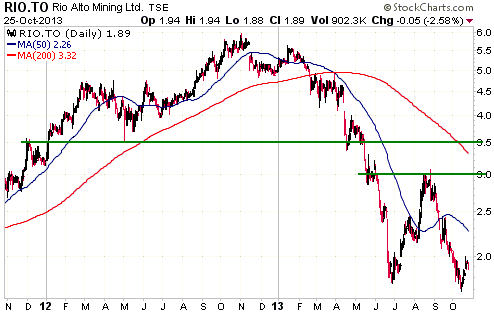
Candidates
for new buying
From within the ranks of TSI stock selections, below is a list of the best
candidates for new buying at this time. Note that for this list of 'best buys'
to be useful we must limit it to 5 stocks or less. This could involve not
mentioning stocks that offer excellent value and are good -- but not among the
best few -- candidates for new buying. Note as well that the stocks included in
this list of 'best buys' do not necessarily offer the best value. In the current
market environment we are placing more emphasis than usual on risk, meaning that
we could view a more expensive stock as a better candidate for new buying due to
its lower risk.
1) AAU (last Friday's closing price: US$1.43)
2) AKG (last Friday's closing price: US$2.52)
3) EDV.TO/EVR.AX (last Friday's closing price: C$0.76)
4) GSS at no higher than US$0.50 (last Friday's closing price: US$0.50)
5) RIO.TO/RIOM (last Friday's closing price: C$1.89/US$1.81)
Chart Sources
Charts appearing in today's commentary
are courtesy of:
http://stockcharts.com/index.html
http://bigcharts.marketwatch.com/

|









