-- Weekly Market Update for the Week Commencing 28th October 2019
Copyright
Reminder
The commentaries that appear at TSI
may not be distributed, in full or in part, without our written permission.
In particular, please note that the posting of extracts from TSI commentaries
at other web sites or providing links to TSI commentaries at other web
sites (for example, at discussion boards) without our written permission
is prohibited.
We reserve the right to immediately
terminate the subscription of any TSI subscriber who distributes the TSI
commentaries without our written permission.
True
Fundamentals Summary
[Notes:
1) The date shown next to the current True Fundamentals Model (TFM) signal is
when the most recent change occurred. 2) Charts of the Gold and Equity
TFMs are included in the "Charts and Indicators" section of the TSI web
site]
| Market | True Fundamentals Model (TFM) |
| Gold (US$ Price) | Bullish (04 Oct 2019) |
| US Equity (SPX) | Bearish (04 Oct 2019) |
| Currency (Dollar Index) | Neutral (15 Mar 2019) |
| Commodities (GNX) | Bearish (01 Jun 2018) |
Last week's posts at the TSI Blog
A potential game-changer from the Fed
Summary of current
thinking/positioning
1) The Dollar Index (DX)
confirmed a short-term reversal to the downside three weeks ago and must
end a week below 96 to confirm an intermediate-term reversal to the
downside. We are anticipating such a reversal, but there remains a
(diminishing) risk that the DX will first move sharply higher for 1-3
months.
2) The US$ gold price, the US$ silver price and the
gold-mining indices are still immersed in corrections and are at risk of
experiencing sharp price declines within the next couple of weeks, but new
upward trends are expected to begin before the end of November.
3)
The Fed's new asset monetisation program has increased the risk for
bearish stock-market speculators and clear signs of equity strength have
started to emerge outside the US. However, the senior US stock indices
probably will reach short-term tops within the next two weeks and the
final few weeks of the year could involve a 'flight to safety'.
4)
The T-Bond probably will trade below its September low in the near future,
but we expect that major price weakness (yield strength) in the Treasury
market will be postponed until next year.
5) Industrial commodities
such as oil and copper could be in the process of bottoming, but we expect
that meaningful price strength won't show up until next year.
6) We
are holding a cash reserve of 25%-30%.
Interest Rates
What will the Fed do?
There is an FOMC meeting on Tuesday-Wednesday of this week, which
means that the Fed will make its next formal monetary-policy announcement
on Wednesday 30th October. What is this announcement likely to say about
interest rates?
In the minutes of the July FOMC meeting the Fed
admitted that it was taking into account market expectations regarding
rate cuts when deciding what to do. As we noted in a
blog post on 27th August, the implication of this admission is that if
the market expects the Fed to cut rates, then to avoid disappointing the
market the Fed will cut rates. In the weeks leading up to an FOMC meeting
the Fed's senior representatives have the opportunity to alter market
expectations through their regular speeches, but if we get to the week
before an FOMC meeting and the market is assigning a high probability to
an X% rate cut then an X% rate cut is almost certainly what the Fed will
deliver.
According to the
CME FedWatch Tool, at the time of writing there is a 94% probability
that the Fed Funds Rate (FFR) target range will be reduced from 175-200
basis points (bp) to 150-175bp at this week's FOMC meeting. Also, the CME
FedWatch Tool shows a 73% probability of the FFR target range being
150-175bp after the 11th December FOMC meeting. These figures imply a near
certainty of a 25bp rate cut on 30th October and a high probability that
the Fed will then be on hold for the remainder of the year.
The Fed
will cut rates by 0.25% this week, but what it does at the 11th December
meeting will be determined by what happens in the markets in the meantime.
For example, a sizable stock market decline during the weeks leading up to
the December FOMC meeting would tip the scales decisively in the direction
of another rate cut at that time.
Assuming that on Wednesday of
this week the Fed does what most market participants expect, which is cut
by 0.25% and signal that future rate cuts will depend on future data, a
big market reaction is unlikely. However, there is a risk that the main
'safe havens', meaning gold and the T-Bond, will sell off.
Lower interest rates lead to slower growth
In one
important respect, the average central banker is like the average
politician. They both tend to focus on the direct and/or short-term
effects and ignore the indirect and/or long-term effects of policies. In
the case of the politician, this is understandable if not excusable. After
all, the overriding concern of the average politician is winning the next
election. The desire to be popular also influences the decisions of
central bankers, but there is a deeper reason for the members of this
group's short-sightedness. The deeper reason is their unwavering
commitment to Keynesian economic theory.
All central bankers are
Keynesians at heart (if they weren't they wouldn't be central bankers),
and Keynesian economic theory revolves around the short-term and the
superficial. It's all about policy-makers in the government and the
central bank attempting to 'manage' the economy by stimulating demand
under some conditions and dampening demand under other conditions, with
the conditions determined by measures of current or past economic
activity. For example, if certain statistics move an arbitrary distance in
one direction then an attempt will be made to boost "aggregate demand".
That the concept of "aggregate demand" is bogus is never acknowledged,
because acknowledging that the economy comprises millions of distinct
individuals as opposed to an amorphous blob would call into question the
entire basis for central control of money and interest rates.
In
the short-term, the manipulation of money and interest rates often seems
to work. In particular, pumping money and forcing interest rates below
where they otherwise would be can lead to increased economic activity in
the form of more consumption and more investment. What's happening,
however, is that false signals are causing people to make mistakes.
One problem is that people are incentivised by cheaper credit to
consume more than they can afford, which guarantees reduced consumption in
the future. The bigger problem, though, is on the investment front, in
that projects and businesses that would not be financeable at free-market
rates of interest are made to appear economically viable. This could seem
like a very good thing for a while, but it means that a lot of resources
get used in ventures that eventually will fail. It also means that the
businesses that would have been viable in a non-manipulated rate
environment suffer profit-margin compression due to the ability, created
by the abundance of artificially-cheap credit, of relatively inefficient
and/or unprofitable competitors to remain in operation.
Thanks to
the investing errors and the general profit-margin compression that result
from it, the policy of interest-rate suppression leads to reduced economic
growth over the long term. Furthermore, it's not so much that central
bankers weigh the long-term negatives against the short-term positives and
opt for the latter; it's that their chosen theoretical framework doesn't
even allow them to consider the long-term negatives.
A final plunge in
the T-Bond?
On a short-term basis the T-Bond
and gold markets are in similar positions. Both markets reached
'overbought' extremes about two months ago and have since been in
correction mode. Also, it's likely that both markets are close to
correction lows in terms of time, but in each case there is a high risk of
a price plunge prior to a sustained turn to the upside.
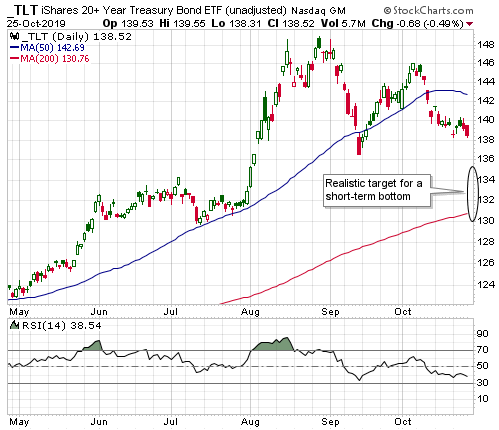
The T-Bond
market is represented on the following daily chart by the iShares 20+ Year
Treasury Fund (TLT). We mentioned three weeks ago that TLT probably was
about to commence a sharp multi-week decline and we noted two weeks ago
that $130-$135 was a reasonable target for a short-term bottom. We still
have this target in mind.
We suspect that whatever additional
downside is going to materialise will do so within the next three weeks.
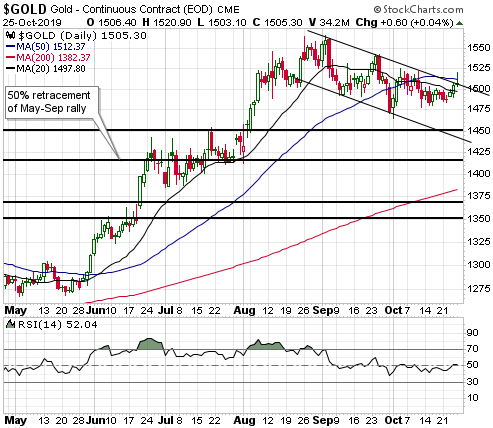
It's the same story with gold, because there's a good chance that concerns
about economic weakness and the trade war will soon return to
centre-stage.
The Stock Market
Stock market volatility was low
last week, but the price action was interesting nonetheless. Here are the
most significant recent developments:
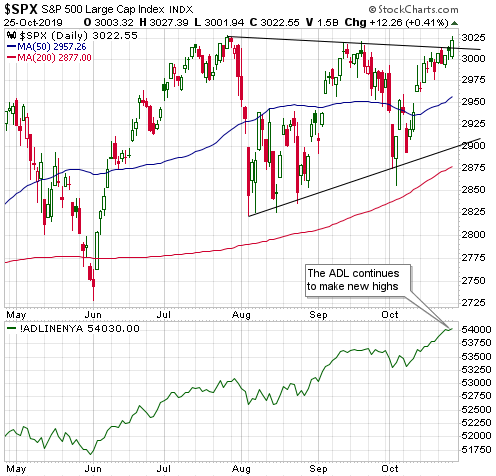
1) Although the S&P500 Index
(SPX) only made a small gain last week, the upper section of the following
daily chart shows that it was enough to enable the world's most important
stock index to break above the top of its contracting triangle. The lower
section of the same chart shows that this breakout was accompanied by
impressive strength in the NYSE Advance-Decline Line (ADL).
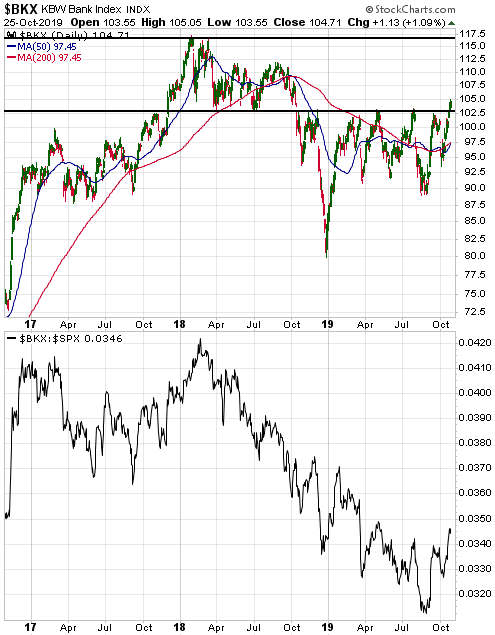
2) Last week the Bank Index (BKX) moved above intermediate-term
lateral resistance to a new high for the year. We've been expecting this
breakout for a few months. Moreover, the BKX/SPX ratio broke the sequence
of declining tops that dates back to early 2018.
Bank stocks are
poised to perform well over the coming 12 months, both in nominal dollar
terms and relative to the broad market. Note, though, that a weekly BKX
close below 100 would invalidate last week's upside breakout.
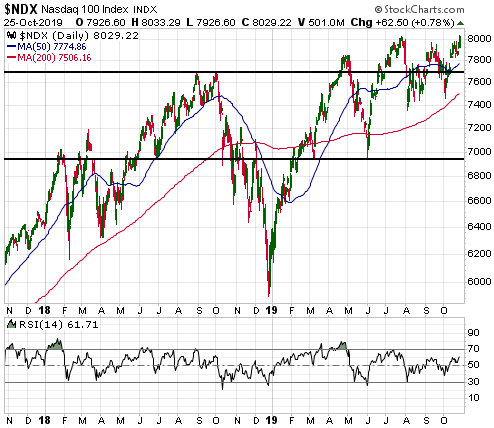
3) Last week the NASDAQ100 Index (NDX) made a marginal new all-time
high.
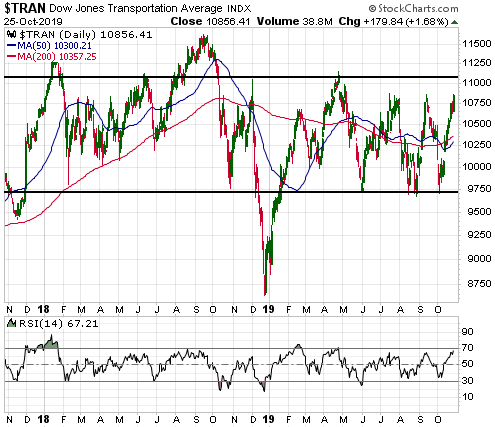
4) The Dow Transportation Average (TRAN) has gone from an 8-month low
to a 5-month high in the space of only three weeks. It is now a little
stretched to the upside and less than 3% from resistance defined by this
year's high, so significant additional gains are unlikely in the
near-term.
5) The Semiconductor Index (SOX) broke above the top of the rising
'wedge' that formed over the past 6 months and ended last week at an
all-time high.

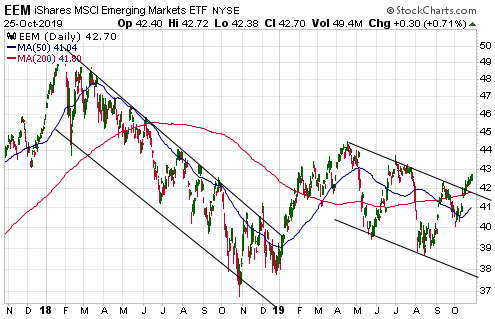
6) A week ago we wrote: "...it looks like the Emerging Markets Equity
ETF (EEM) is about to break upward from the channel in which it has traded
since April." Last week it broke above its channel top.
Last week's upside breakouts and other bullish developments were
caused at least in part by the Fed's recent introduction of a new
money-pumping program. The new program has the potential to extend the
long-term equity bull market well into next year, but there are two
reasons, one technical and the other fundamental, to believe that the
market won't make much additional headway before commencing its next
significant correction.
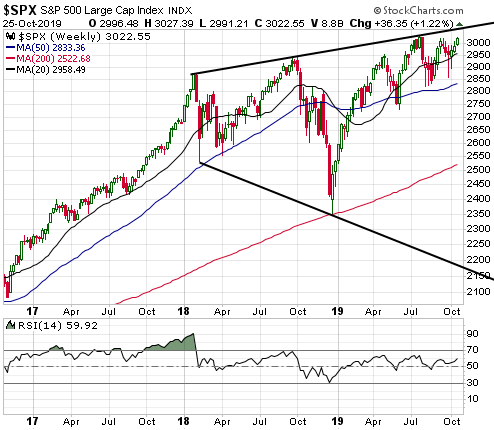
The technical reason is illustrated by the
following weekly chart. The chart shows that over the past 18 months the
SPX has commenced a sizable multi-week decline soon after making a new
all-time high. If the pattern continues, the SPX won't go higher than
about 3070 before reversing course.
The fundamental reason is that the so-called "Phase 1" US-China trade
deal could be in trouble. Everything was supposedly agreed and all that
was left was for presidents Trump and Xi to put pen to paper when they met
on the sidelines of the APEC Economic Leaders' Meeting in Chile in
mid-November. However, there now appears to be a difference of opinion as
to what has been agreed. In particular, the US side is saying that the
Chinese side has agreed to buy $40B-$50B per year of US agricultural
products and that existing tariffs will remain in place for now, but the
Chinese side is saying something along the lines of: "Let's go back to the
way things were in 2017. We'll buy about $20B/year of US agricultural
products and you eliminate most tariffs."
If the "Phase 1" trade
deal were to disintegrate there would, we think, be a rapid shift away
from general equities and a surge in demand for gold and T-Bonds.
This week's
significant US economic events
[Notes:
1) The most important events
(to the markets) are shown
in bold. 2) A list of global economic events can be found
HERE]
| Date | Description |
| Monday Oct-28 | No important events scheduled |
| Tuesday Oct-29 |
Pending Home Sales Consumer Confidence Index Case-Siller Home Price Index |
| Wednesday Oct-30 |
FOMC Statement Q3 GDP (preliminary) |
| Thursday Oct-31 |
Personal Income and Spending Chicago PMI |
| Friday Nov-01 |
Monthly Employment
Report ISM Mfg Index Construction Spending Motor Vehicle Sales |
Gold and the Dollar
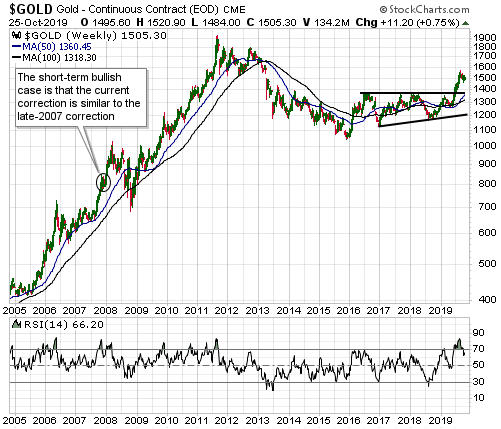
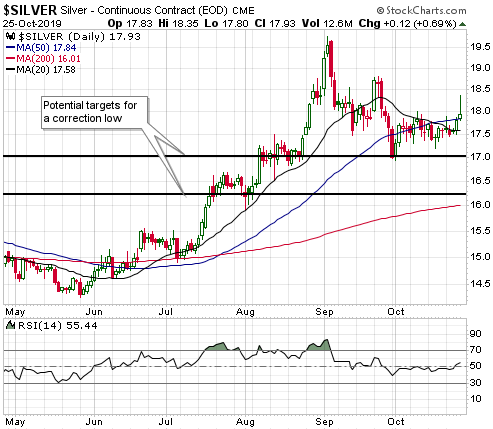

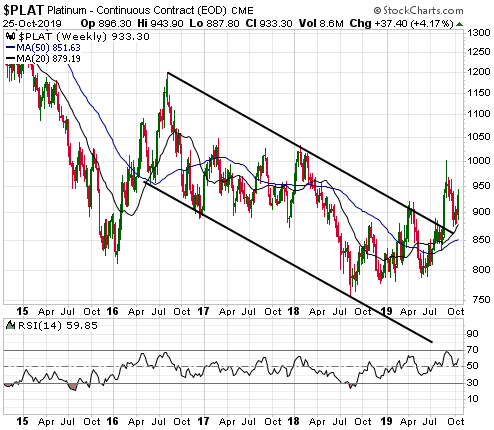
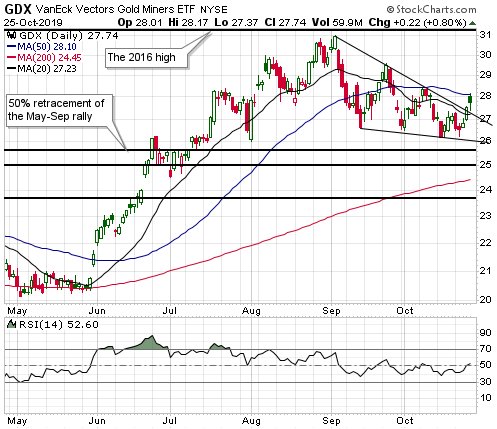
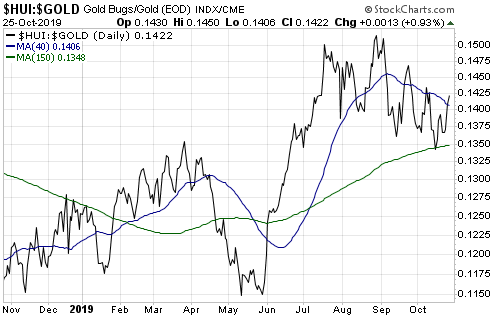
The most positive recent development for the gold mining sector is the
performance of the HUI/gold ratio. As illustrated by the following chart,
HUI/gold bounced off its 150-day MA in mid-October and closed above its
40-day MA last Friday. This is a preliminary signal of an upward trend
reversal.
To solidify the reversal the HUI/gold ratio must hold
above its 40-day MA this week. By the same token, if the gold sector is
still in correction mode then HUI/gold probably will move back below its
40-day MA within the next few days.
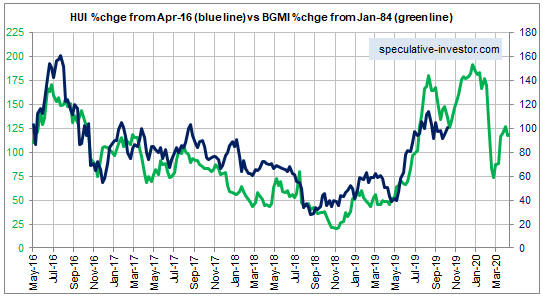
Turning to our comparison of the present-day HUI and the Barron's Gold
Mining Index (BGMI) of the 1980s, the updated chart displayed below
suggests that the correction could be complete. However, a
correction-ending plunge within the next two weeks also would be roughly
in line with this model.
The upshot is that the gold sector's short-term risk/reward is
neutral. There is still a high risk of a final correction-ending plunge
that takes GDX and the HUI down to their 200-day MAs, but we are into the
time window when the correction was/is expected to end and it wouldn't
take much additional strength from here to shift the odds in favour of a
sustainable up-turn.
The gold sector's intermediate-term
risk/reward is bullish.
The Currency Market
The following daily chart shows that the Dollar Index (DX) has been
oscillating within a channel since August of last year. The channel has an
upward slope, but, as mentioned in earlier commentaries, the choppy price
action does not have the look of an upward trend.
We think that a
1-2 year period of US$ weakness, driven by weakness in US equities
relative to European equities and the narrowing of the US-Europe
interest-rate gap, has begun or will begin within the next few months.
It's possible that there will be a US$ surge in response to fear of a
global recession prior to the start of an intermediate-term decline in the
DX, but such a surge would be short-lived because it would provoke the Fed
into becoming very 'easy' very quickly.
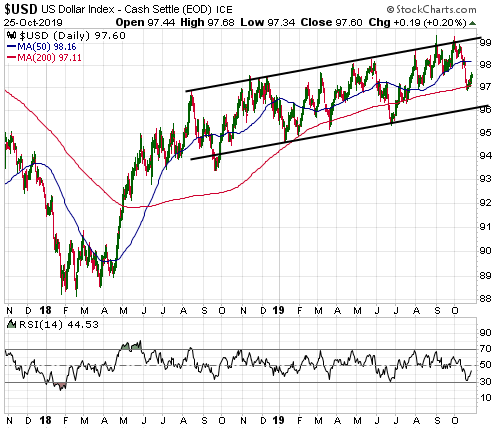
Last week the DX rebounded from its 200-day MA. Unfortunately, this
doesn't tell us anything useful about the future, because the rebound
could be a counter-trend move within a short-term downward trend or the
start of a larger rally.
Updates
on Stock Selections
Notes: 1) To review the complete list of current TSI stock selections, logon at
http://www.speculative-investor.com/new/market_logon.asp
and then click on "Stock Selections" in the menu. When at the Stock
Selections page, click on a stock's symbol to bring-up an archive of
our comments on the stock in question. 2) The Small Stock Watch List is
located at http://www.speculative-investor.com/new/smallstockwatch.html
 Company
news/developments for the week ending Friday 25th October 2019:
Company
news/developments for the week ending Friday 25th October 2019:
[Note: AISC = All-In Sustaining Cost, EBITDA = Earnings Before
Interest, Tax, Depreciation and Amortisation (a measure of cash flow), EV
= Enterprise Value or Electric Vehicle, FS = Feasibility Study, FY =
Financial Year, IRR = Internal Rate of Return, ISR = In-Situ Recovery, JV
= Joint Venture, MD&A = Management Discussion and Analysis, M&I = Measured
and Indicated, NAV = Net Asset Value, NPV(X%) = Net Present Value using a
discount rate of X%, NSR = Net Smelter Return or Net Smelter Royalty, P&P
= Proven and Probable, PEA = Preliminary Economic Assessment, PFS =
Pre-Feasibility Study]
*Alkane Resources (ALK.AX)
published its quarterly report for the September-2019 quarter (the first
quarter of FY2020). The report was generally positive (as discussed
below), but with one exception it contained no important new information.
The one exception is the following comment:
"A demerger and
listing of Australian Strategic Materials is under active consideration by
the Alkane Board. Consultation with regulators is underway."
In other words, the separation of ALK into two companies, one focused on
gold and the other focused on the Dubbo specialty metals project, is under
consideration. This is exactly what we have been saying the company should
do for the past two years, as it could unlock substantial value for
shareholders. Due to the opportunities to expand the gold business that
have cropped up this year, the separation makes even more sense now than
it did a year ago.
The quarterly report included another above-plan
performance from the Tomingley Gold Operation (TGO), with gold production
of 7.5K ounces at an AISC of A$1268/oz (US$862/oz). This has led to
production guidance for FY2020 (the financial year ending 30th June 2020)
being improved from 27K-32K ounces of gold at an AISC of A$1300-$1450 to
30K-35K ounces of gold at an AISC of A$1250-$1400. Note: The current A$
gold price is around $2200/oz.
The Tomingley open pit is depleted
and the current production is solely from the processing of stockpiles.
However, the life of the operation has been extended by the construction
of an underground mine that is scheduled to go into production during the
March quarter of 2020. Also, exploration results indicate the potential to
establish a new pit within a few kilometres of the existing plant.
With regard to the Dubbo specialty metals project, the commercial scale
pilot plant being constructed as part of the investment in Clean Metal
Processing Technology with Ziron Tech of South Korea is due to be
commissioned in the March quarter of 2020.
ALK's balance sheet is
strong. The company is debt free with cash, bullion plus listed
investments of about A$74M. This figure is down by about A$7M since the
end of the preceding quarter due to investments in exploration drilling,
underground mine development and the Dubbo project's pilot plant.
*Columbus Gold (CGT.TO) had noteworthy news over the past
week. First, the company announced early last week that it had raised
C$2.5M by selling 15.6M new shares to Sandstorm Gold at C$0.16/share. This
means that Sandstorm now owns about 8% of CGT. Second, late last week the
company noted conclusions from a recent government report that suggest
increasing government support for the Montagne d'Or gold project in French
Guiana. CGT's 45% stake in this project is by far its most important
asset.
Project permitting is taking longer than expected and
probably won't be complete before mid-2020. Permitting risk is probably
the main reason that CGT is trading at a small fraction of the estimated
net present value of its Montagne d'Or stake.
List
of candidates for new buying
From within the ranks of TSI
stock selections the best candidates for new buying at this time, listed
in alphabetical order, are:
1) AAU (last Friday's closing price:
US$0.66)
2) AOI (last Friday's closing price: C$1.18)
3)
JRV.AX, JRV.V (last Friday's closing price: A$0.21, C$0.19)
4) OIH
(last Friday's closing price: US$11.77)
5) TGB (last Friday's
closing price: US$0.44)
The above list is limited to five stocks.
It sometimes will contain less than five, but it never will contain more
than five regardless of how many stocks are attractively priced for new
buying.
Chart Sources
Charts appearing in today's commentary
are courtesy of:
https://stockcharts.com/