<% 'pass = Request.Form("pass") IF ((Request.Form("pass") = 1) OR (Session("pass") = "pass")) THEN %> The Speculative Investor


   -- Weekly Market Update for the Week Commencing 28th November 2016

Big Picture View

Here is a summary of our big picture view of the markets. Note that our short-term views may differ from our big picture view.

The BULL market in US Treasury Bonds that began in the early 1980s ended in early-2015, but there will be many years of topping action in bond prices and bottoming action in bond yields before major new trends get underway. (Last update: 29 June 2015)

The stock market, as represented by the S&P500 Index, commenced a secular BEAR market during the first quarter of 2000, where "secular bear market" is defined as a long-term downward trend in valuations (P/E ratios, etc.) and gold-denominated prices. This secular trend will bottom sometime between 2018 and 2020. (Last update: 29 June 2015)

A secular BEAR market in the US Dollar began during the final quarter of 2000 and ended in July of 2008. This secular bear market will be followed by a multi-year period of range trading. (Last update: 09 February 2009)

Gold commenced a secular bull market relative to all fiat currencies, the CRB Index, bonds and most stock market indices during 1999-2001. This secular trend will peak sometime between 2018 and 2020. (Last update: 29 June 2015)

Commodities, as represented by the CRB Index, commenced a secular BULL market in 2001 in nominal dollar terms. The first major upward leg in this bull market ended during the first half of 2008, but a long-term peak won't occur until 2018-2020. (Last update: 29 June 2015)

Copyright Reminder

The commentaries that appear at TSI may not be distributed, in full or in part, without our written permission. In particular, please note that the posting of extracts from TSI commentaries at other web sites or providing links to TSI commentaries at other web sites (for example, at discussion boards) without our written permission is prohibited.

We reserve the right to immediately terminate the subscription of any TSI subscriber who distributes the TSI commentaries without our written permission.

Outlook Summary

Market
Short-Term
(1-3 month)
Intermediate-Term
(6-18 month)
Long-Term
(2-5 Year)
Gold N/A Neutral
(21-Nov-16)
Bullish
US$ (Dollar Index) N/A Neutral
(17-Aug-16)
Neutral
(19-Sep-07)
US Treasury Bonds (TLT) N/A Neutral
(21-Nov-16)
Bearish
Stock Market (DJW) N/A Neutral
(14-Nov-16)
Bearish
Gold Stocks (HUI) N/A Neutral
(21-Nov-16)
Bullish
Oil N/A Neutral
(26-Oct-15)
Bullish
Industrial Metals (GYX) N/A Neutral
(10-Oct-16)
Bullish
Notes:
1. Our short-term expectations are discussed in the commentaries, but except in special circumstances we won't attempt to assign a "bullish", "bearish" or "neutral" label to these expectations.
2. The date shown below the current outlook is when the most recent outlook change occurred.
3. "Neutral" means that we think risk and reward are roughly in balance with respect to the timeframe in question.

4. Long-term views are determined almost completely by fundamentals and intermediate-term views are determined by a combination of fundamentals, sentiment and technicals.

Last week's posts at the TSI Blog

Where did all the money go?

Which of these markets is wrong?


Summary of current thinking/positioning

1) Continuing to expect that the overall corrections/downturns for gold and the associated mining indices will extend into Q1-2017. Unsure as to whether there will be an intervening tradable rebound.

2) Expecting that 2017 will be a bullish year for commodities. Maintaining long-term exposure to non-gold commodities while acknowledging that the early-2016 lows could be tested prior to the start of the aforementioned bullish period.

3) Expecting a decline in the oil price to a January-February bottom and positioned for this outcome via USO put options expiring in February. In addition to being a speculation, these options have been purchased as a hedge against short-term weakness in the commodity markets.

4) Thinking that government bonds have commenced a long-term bear market, but that the US Treasury Bond is close to a short-term price bottom.

5) Expecting a further 6-12 month extension to the equity bull market and looking for opportunities to add to general non-US equity exposure, but maintaining a very small short-term bearish speculation via QID (leveraged NDX bear fund) call options expiring in January-2017.

6) Thinking that the Dollar Index is close to a 1-2 month top, but that it will move to new multi-year highs during the first quarter of 2017 and won't reach a major top before the second quarter of 2017.

7) Maintaining a large cash reserve in recognition of the downside risk in almost all equities (current cash percentage is 40%-45%).

Every central bank wants a weaker US$

Every central bank in the world, including the US Federal Reserve, now wants a weaker US$, which proves that central banks can be overwhelmed by market forces even when they are united in their goals.

Central banks outside the US want a weaker US$ due to the long-term consequences of the actions that they themselves took many years ago to strengthen the US$. To put it another way, they now want to strengthen their own currencies against the US$ because their economies are suffering from the inevitable ill-effects of the currency-depreciation policies implemented at an earlier time. As discussed in the past, currency depreciation/devaluation is always counter-productive because it "engages all the hidden forces of economic law on the side of destruction, and it does so in a manner that not one man in a million will be able to diagnose." It is still a very popular policy, though, because at a superficial level -- the level at which most economists and all central bankers operate -- it seems practical.

Unfortunately for the central banks that are now trying to prop-up their currencies relative to the US$, a central bank's ability to weaken its currency is much greater than its ability to bring about currency strength. The reason is that weakening a currency can usually be achieved by increasing its supply, and if there is one thing that central banks are good at it's creating money out of nothing. Actually, creating money out of nothing, and, in the process, engaging all the hidden forces of economic law on the side of destruction, is the ONLY thing they are good at.

The problem they are now facing is that once confidence in the currency has been lost, bringing about currency strength or at least a semblance of stability will generally require either a very long period of politically-unpopular monetary prudence or a deflationary depression. There is no quick-and-easy way to obtain the desired result.

The crux of the matter is that there is very little that central banks outside the US can now do in the short-term to stop the US$ from rising. The best they can do is to NOT inflate. Other than that, they should simply avoid the temptation to 'do something' and instead just wait for the current trends to exhaust themselves.

The US central bank also wants a weaker US$. This is because the senior members of the Fed operate at the same superficial level as their counterparts throughout the world. They see the direct, short-term positives that a weaker currency would bring to some parts of the economy, but are incapable of seeing the broader, longer-term and indirect negatives.

The difference is that the Fed actually has the power to create short-term weakness in the US$. It could, for example, surprise the world by not hiking its targeted interest rate in December. That would knock the Dollar Index down by at least a couple of points. To build on the decline it could then start emphasising the sluggishness of US industrial production and dropping hints that another QE program is coming.

Doing so would, however, be a reckless course of action even by Keynesian standards. The US dollar's upward trend would be over, but at the cost of a total loss of credibility on the part of the Fed and breathtaking instability in the financial markets.

Once lost, confidence is difficult for a central bank to regain. The Fed is therefore now backed into a corner where for the sake of appearances it will have to take small steps in the direction of tighter monetary policy, even though it would prefer a weaker US$.

Commodities

The general commodity-price trend

Early this year we predicted that a cyclical bull market in commodities would develop from a first-quarter bottom, a prediction that was primarily based on the evidence that gold had commenced a cyclical bull market of its own. With the evidence having shifted to the point where it seems that gold has NOT yet commenced a bull market, should we abandon the view that the Q1-2016 turnarounds in the commodity indices were of cyclical importance?

The answer is no, for two reasons. First, although it can no longer be viewed as the most likely scenario, there is still a realistic chance that a gold bull market is in progress. For this to remain the case, however, the fundamental backdrop will have to make a sustained shift in a gold-bullish direction well before the gold price returns to its 2015 low. Second, while the sort of commodity rally that was seen during the 1970s and 2001-2011 would not be possible in the absence of a gold bull market, a 1-2 year commodity rally would be possible. This would be similar to what happened during 1999-2000, when the markets for industrial commodities were strong in parallel with a weak gold market.

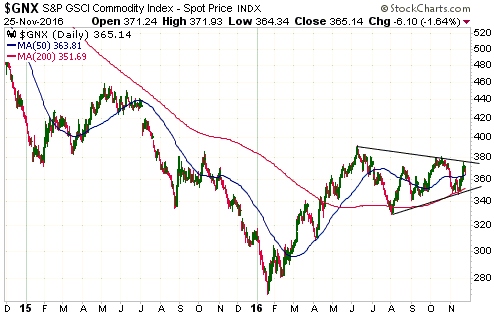
Turning to the price action, the following daily chart shows that since reaching a year-to-date peak in June, the Goldman Sachs Spot Commodity Index (GNX) has traded within a contracting range. This price pattern is non-committal in that it could be either a top or a bullish consolidation. The benefit of the doubt can reasonably be given to the more bullish interpretation as long as the price remains above the 200-day MA.


Natural Gas (NG)

Two weeks ago, with the NG price having just dropped to test important support in the $2.50s, we wrote:

"Following the sort of gain that the NG price achieved, a decline to the 200-day MA would be a normal occurrence. The 200-day MA happens to be slightly below important lateral support at $2.50, which, in turn, is not far below last Friday's low. Therefore, there's a decent chance that NG's 'retracement' is almost complete."

It turned out that NG's retracement wasn't "almost complete", it was totally complete. As illustrated below, the price has quickly rebounded from slightly above support at $2.50 to within a few percent of this year's high.
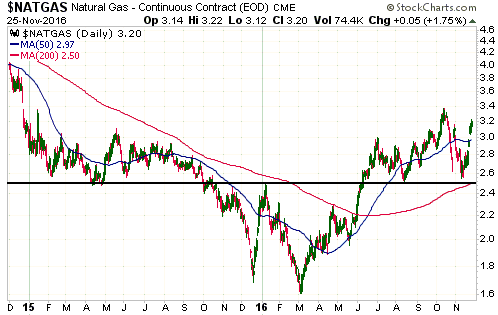


We are bullish on NG's intermediate-term prospects, but other than not expecting support at $2.50 to be breached we have no opinion on what the NG price will do over the coming 1-2 months. We won't be surprised if it spends several weeks consolidating in the $2.80-$3.40 range, but we also won't be surprised if it makes a solid break to a new 12-month high before consolidating.

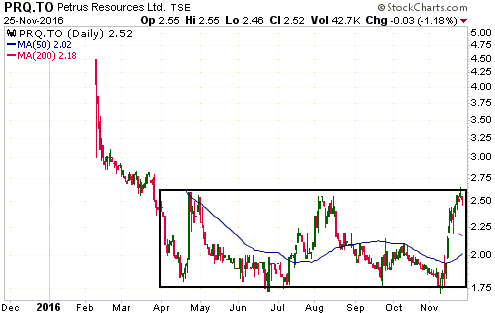
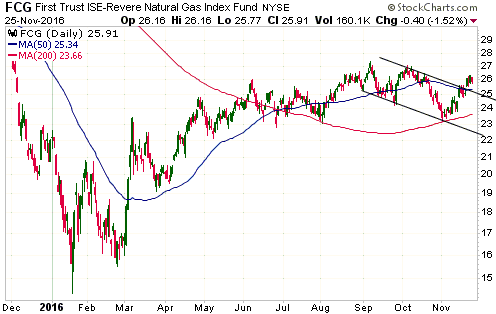
The TSI Stocks List has exposure to NG via FCG, a US-listed ETF that holds the stocks of numerous companies involved in the NG and oil businesses. It also has higher-risk/higher-reward exposure via Petrus Resources (PRQ.TO), a junior Canadian NG producer. Charts of FCG and PRQ are displayed below.

Note that neither FCG nor PRQ has a strong short-term correlation with NG, but both should perform well over the next year as long as the overarching trend is toward a higher NG price. Due to its under-valuation, PRQ could also perform well in a flat commodity-price environment.


The Stock Market

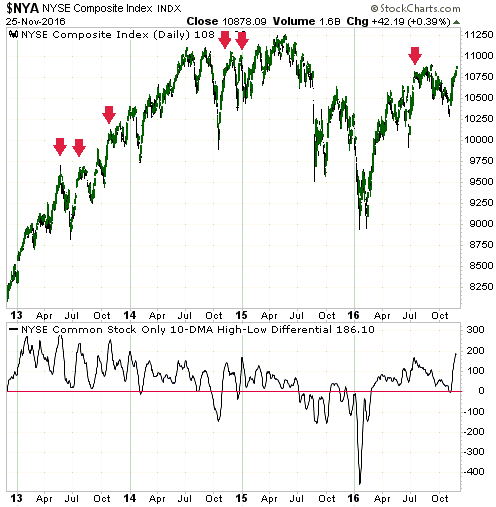
Based on indicators of internal market strength such as the 10-day MA of the NYSE High-Low Differential (the 10-day MA of the number of NYSE common stocks making new 52-week highs minus the number making new 52-week lows), the senior US stock indices are likely to be trading at higher levels in 6 months' time. However, the same indicators suggest that the market has come too far too fast and will trade as much as 5% lower within the next 6 weeks.

The following chart compares the NYSE Composite Index (NYA) with the NYSE High-Low Differential and shows what we mean. The red arrows on the chart mark points where there had just been a sharp rise in the High-Low Differential to near the top of its 2-year range. In each case the NYA soon commenced a multi-week decline while remaining within its intermediate-term upward trend.

The same chart also shows the multi-month bearish divergence between the NYA and the High-Low Differential that occurred prior to the intermediate-term decline that began in mid-2015. We are referring to the fact that the High-Low Differential trended downward while the NYA trended upward for a few months prior to the mid-2015 market top. There's a high probability that the next intermediate-term top will be preceded by a similar divergence.


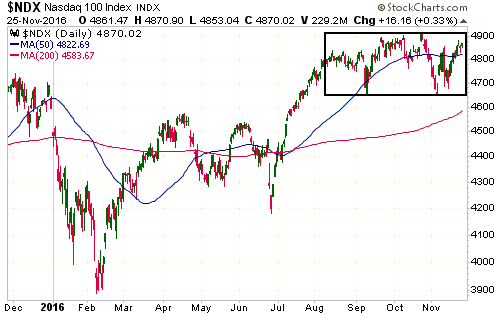
The S&P500 Index (SPX) confirmed its upside breakout by ending the week comfortably above the August high of 2194. Interestingly, however, the NASDAQ100 Index (NDX) is still trading below its September and October highs (see chart below).

The NDX's recent performance constitutes a significant non-confirmation. It doesn't call into question the intermediate-term bullish message being sent by 'market internals', but it does add to the evidence pointing to a short-term top.

Note that the NDX would have to end this week above 4912 to bring itself into line with the other senior US stock indices.


This week's significant US economic events [Notes: 1) The most important events (to the markets) are shown in bold. 2) A list of global economic events can be found HERE]

Date Description
Monday November 28 Dallas Fed Mfg Survey
Tuesday November 29 Case-Siller Home Price Index
Q3 GDP (revised)
Consumer Confidence
Wednesday November 30 Chicago PMI
Pending Home Sales Index
Fed's Beige Book
Thursday December 01 Motor Vehicle Sales
ISM Mfg Index
Construction Spending
Friday December 02 Monthly Employment Report


Gold and the Dollar


Gold

Current Market Situation

For both the bullion market and the gold-mining sector, today we'll step back and look at some long-term weekly and monthly charts.

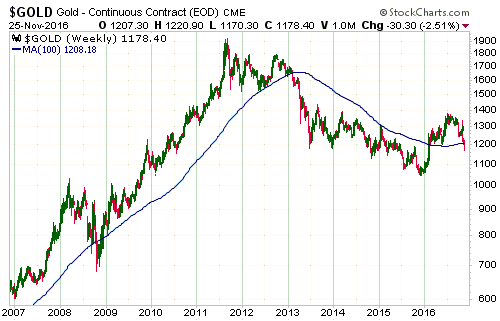
First, here is a weekly chart of the US$ gold price. The blue line on the chart is the 100-week moving average (MA).

Apart from a brief period in 2008 near the crescendo of the Global Financial Crisis, gold spent the entire period from late-2001 through to late-2012 above its 100-week MA. Downward corrections during this period generally ended at or just above this MA. It then spent the entire period from early-2013 through to early-2016 below this MA. The position of the US$ gold price relative to its 100-week MA has therefore indicated, with a lag, whether gold was in a bull market or a bear market.

The break above the 100-week MA in February of this year was a confirming signal that a bull market had begun in December-2015. This bull-market signal was still in place at the end of the week before last, but it was eliminated by last week's price action.

A weekly close above $1210 is needed to reinstate the bull-market signal.


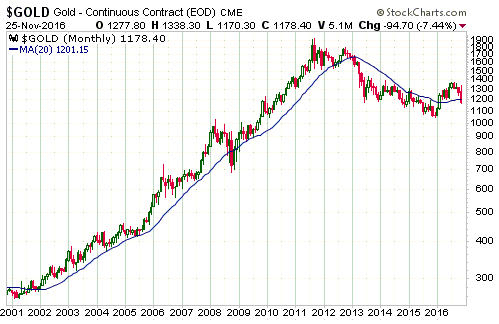
Second, here is a monthly chart of the US$ gold price. The blue line on the chart is the 20-month moving average.

The 20-month MA has acted in similar fashion to the 100-week MA, but because its signals are based on monthly closing prices they will usually be generated a little later. For example, the 20-month MA bull/bear indicator will confirm the message of the 100-week MA bull/bear indicator if the gold price ends this Wednesday (30th November) below US$1201.


The implication is that the price action is beginning to confirm the message of 'the fundamentals', which is that a new gold bull market did NOT commence last December. The message will change at some future time (quite possibly during the first half of next year), but the current message is what it is.

A rebound could begin as soon as this week and probably won't begin any later than mid-December (within a few days of the 14th December FOMC announcement), but for a rebound to have longer-term significance it must, at a minimum, achieve a weekly close above $1210. It must also be accompanied by a fundamental shift in gold's favour.

The most useful gold-market sentiment indicator is the Commitments of Traders (COT) report, but unfortunately the latest COT report is almost 2 weeks old (due to last week's public holiday, the COT data for last week won't be issued until Monday of this week). The latest COT report indicated that gold-market sentiment hadn't yet reached a supportive level, but the gold price has since fallen $45 so the situation could now be very different.

We look forward to viewing the COT report that will be published at the end of this week as it will reveal the effects on speculative sentiment of last week's break below support in the low-$1200s.

The Indian Effect

We want to reiterate that the goings-on in India are unlikely to have a meaningful effect on the global US$-denominated gold price. Any effect should be limited to short-term sentiment-driven fluctuations.

The poorly-planned and economically-disastrous decision by India's Prime Minister to ban the most commonly-used currency notes has, to date, brought about a net increase in Indian demand for gold. This is evidenced by the large increase in the price of gold in India. However, the increase in Indian gold demand clearly did not offset the negative effect on global gold demand caused by a rising real interest rate in the US.

By the same token, if India's Prime Minister tries to make a terrible situation even worse by banning gold imports to the country or passing laws to restrict the ownership of gold, the effect on the gold price will be swamped by whatever is happening to gold's true fundamentals.

Gold Stocks

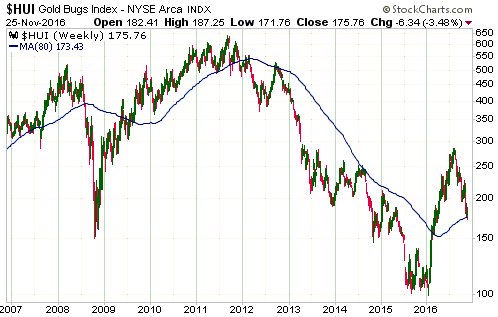
The position of the HUI relative to its 80-week MA is a lagging bull/bear indicator for the gold-mining sector.

The following weekly chart shows that the HUI spent the entire period from late-2011 to early-2016 below its 80-week MA, with bear-market rebounds in 2012 and 2014 ending right at this MA. It also shows that a decisive cross from below to above the 80-week MA (a bull-market signal) happened in February-2016.

Last week the HUI traded below its 80-week MA while remaining above it on a weekly closing basis. This lagging bull-market signal therefore remains intact, although it is not possible for the HUI to be in a bull market when gold is not in a bull market.


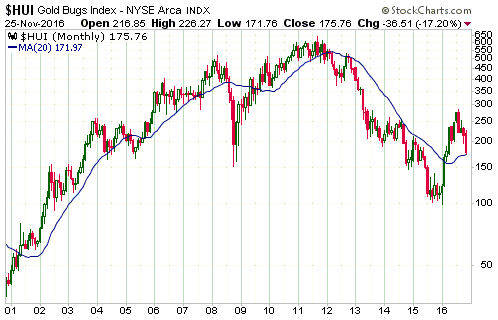
As is the case with gold, at a monthly level (see chart below) it is the HUI's position relative to its 20-period MA that provides lagging confirmation of a bull or bear market. This indicator is still bullish, although it would turn bearish with a 30th November close below 171.


Although the HUI has suffered a peak-to-trough decline of about 40%, for this volatile sector of the market a decline of such magnitude is not unusual for an intermediate-term bull-market correction. Furthermore and as noted above, the price action has not yet invalidated the bull-market scenario for the HUI. The problem, as also noted above, is that it is not possible for the HUI to be in a bull market when gold is not in a bull market.

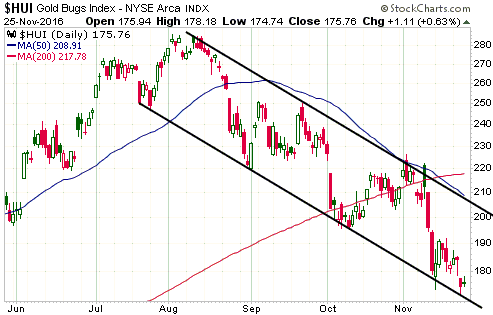
Turning to the shorter-term price action, the following daily chart shows that the HUI's downward-sloping price channel is now very well defined. It also shows that the HUI is yet to close below its 14th November spike low, which means that the gold-mining sector has taken gold's breach of $1200 in stride.

The close proximity to the bottom of the well-defined channel combined with the resilience being shown by the HUI indicates that a rebound will probably soon begin. We wrote something similar last week and no rebound materialised, but all we can do is assess the evidence as it is presented each week.

A daily close above 196 would be a preliminary sign that a significant rebound had begun, while a daily close above the channel top would be a more definitive sign.


The Currency Market

The Dollar Index

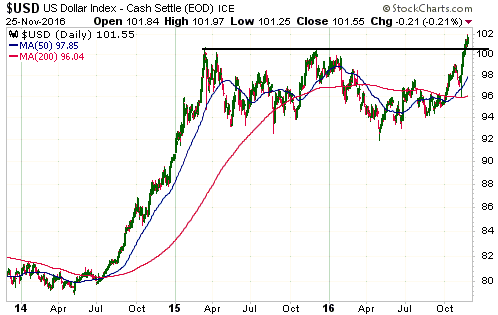
As illustrated below, the Dollar Index has clearly broken above intermediate-term resistance to new multi-year highs. Strangely, though, neither the Dollar Index's major component (the euro) nor any of its minor components has recently broken out to new multi-year lows.


The Dollar Index is likely to maintain its overall upward trend and not reach a major top until at least the second quarter of next year, but we continue to think that it is close to a 1-2 month top.

That being said, even though 'every man and his dog' expects the Fed to hike its targeted interest rate by 0.25% at the December FOMC Meeting it is possible that the speculating community's anticipation of and then reaction to this obvious event will delay a 1-2 month top until shortly after the 14th December FOMC announcement. This is possible because the currency market has demonstrated in the past that it is capable of discounting the same news over and over again.

Revisiting the Pound's long-term cycle

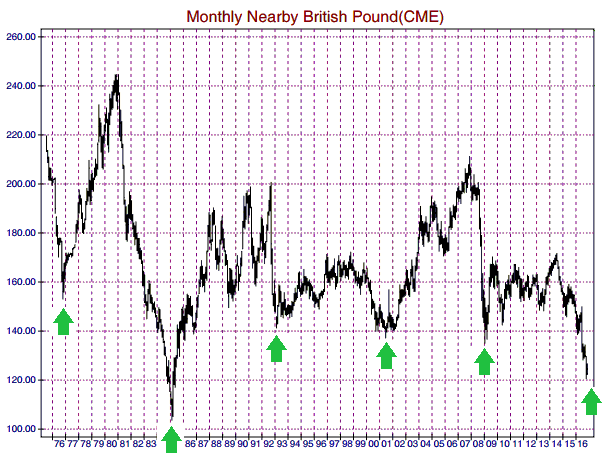
Since the 1970s, the British Pound has been making major bottoms at 8-year intervals (plus or minus a couple of months). We've indicated the 8-year cycle lows with green arrows on the following monthly chart.

We don't know why the Pound has made major bottoms at such regular intervals over more than 4 decades, but whatever the reason the market action of the past several months suggests that the remarkable 8-year cycle is set to continue. In other words, the stage is set for the next major bottom to happen on schedule -- near the 8-year anniversary of the preceding one.

Happening on schedule would involve reaching a major bottom any time from October of this year to the middle of next year, although a bottom during the first quarter of 2017 would be the best fit.


                                                    Chart source: http://www.mrci.com/

Although there is a possibility that the Pound bottomed in October, this possibility has a low probability. The reason is that all previous major bottoms in the Pound occurred very close to intermediate-term bottoms in the US$ gold price. With the US$ gold price having broken well below its October low and not yet showing any sign of having bottomed, in the context of the past 40 years it would be unprecedented if the Pound had already bottomed.

Updates on Stock Selections

Notes: 1) To review the complete list of current TSI stock selections, logon at http://www.speculative-investor.com/new/market_logon.asp and then click on "Stock Selections" in the menu. When at the Stock Selections page, click on a stock's symbol to bring-up an archive of our comments on the stock in question. 2) The Small Stock Watch List is located at http://www.speculative-investor.com/new/smallstockwatch.html

Company news/developments for the week ending Friday 25th November 2016:
[Note: AISC = All-In Sustaining Cost, FS = Feasibility Study, FY = Financial Year, IRR = Internal Rate of Return, ISR = In-Situ Recovery, MD&A = Management Discussion and Analysis, M&I = Measured and Indicated, NAV = Net Asset Value, NPV(X%) = Net Present Value using a discount rate of X%, P&P = Proven and Probable, PEA = Preliminary Economic Assessment, PFS = Pre-Feasibility Study]

  *Blackham Resources (BLK.AX) has recently been a relatively weak gold stock, meaning that its price has fallen even further than the average gold-mining stock in response to the recent decline in the gold price. For two reasons, this relative weakness doesn't make sense. First, BLK offers better value than the average gold-mining stock. Second, by virtue of having forward-sold about half of next year's production when the gold price was close to its highs a few months ago, BLK has significantly less-than-average short-term and intermediate-term exposure to the gold price.

We suspect that the main reason for the stock's relative weakness is selling by the Canadian investors who participated in the A$25M equity financing in August. These investors bought 25M shares when the speculative enthusiasm for gold was near its peak and have probably been exiting as the enthusiasm waned.

Of course, for every share sold there is a share bought. Furthermore, it is often the case that as selling by 'weak hands' ramps up in reaction to a downward trend, buying by value-oriented investors also ramps up and at some point the latter begins to overwhelm the former. For example, as selling by participants in the A$1.00/share equity financing has driven BLK's price downward, Hunter Hall Investment Management (HHL), a value-oriented money manager, has become a more active buyer. HHL has bought 21M BLK shares since mid-September, including 11M over the past 4 weeks.

  *Energold Drilling (EGD.V) published its financial results for the quarter ending 30th September 2016.

Revenue for the quarter was C$18.9M, which was C$4M lower than the previous year's September quarter. It is therefore clear that EGD is still dealing with the effects of an industry-wide slowdown in drilling activity.

EGD's balance sheet remains strong, with adjusted working capital (current assets minus current liabilities and long-term debt) of C$50M. This is up by C$4M from the end of the preceding quarter, although during the latest quarter the company raised C$6.5M through equity financings so in reality the business consumed about C$2.5M of cash during the quarter.

The adjusted working capital equates to about C$0.91/share, which means that EGD is cheap near its current share price of C$0.85. However, it should currently not be near the top of a shopping list. This is because a sustained pick-up in drilling activity could now be delayed until at least the second half of 2017.

  *Petrus Resources (PRQ.TO), a junior Canadian natural gas producer, continues to be the recipient of substantial insider buying. Don Gray, the company's chairman, has been the main buyer. He has purchased many hundreds of thousands of shares over the past six months, including about 400K (about C$800K worth) over just the past two weeks.

Our hope/expectation is that the PRQ story will eventually become more widely known, enabling a major upward trend in the stock price.

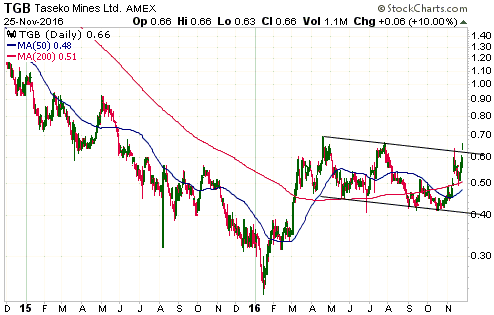
  *Taseko Mines (TGB) is a highly leveraged play on the copper price. Not surprisingly, therefore, its stock price has responded positively to the recent goings-on in the copper market. The response to date has not exactly been stellar, but the stock price broke above the top of a 7-month channel on Friday.


We continue to expect that the copper price will trade above $3.00/pound -- a price at which TGB would be very profitable and deserving of a much higher valuation -- before the end of 2017, but we also continue to be cautious with regard to copper's short-term prospects. Copper has certainly surprised on the upside over the past three weeks, but even if a major rally is in its early stages it could drop back to its 50-day MA and lateral support in the $2.30s before resuming its advance.

List of candidates for new buying

From within the ranks of TSI stock selections the best candidates for new buying at this time, listed in alphabetical order, are:

1) AAU (last Friday's closing price: US$1.05)

2) BLK.AX (last Friday's closing price: A$0.47)

3) EVN.AX (last Friday's closing price: A$1.91)

4) PG.TO (last Friday's closing price: C$2.21)

Note that the above list is limited to five stocks. It will sometimes contain less than five, but it will never contain more than five regardless of how many stocks are attractively priced for new buying.

Chart Sources

Charts appearing in today's commentary are courtesy of:

http://stockcharts.com/index.html

<% Session("pass") = "pass" Session.Timeout = 480 ELSE Response.Redirect "market_logon.asp" END IF %>