|
-- Weekly Market Update for the Week Commencing 29th September 2008
Big Picture
View
Here is a summary of our big picture
view of the markets. Note that our short-term views may differ from our
big picture view.
Bonds commenced a secular BEAR market in
June of 2003. (Last
update: 22 August 2005)
The stock market, as represented by the S&P500 Index, commenced
a secular BEAR market during the first quarter of 2000, where "secular
bear market" is defined as a long-term downward trend in valuations
(P/E ratios, etc.) and gold-denominated prices. This secular trend will bottom sometime between 2014 and 2020. (Last update: 22 October 2007)
The Dollar commenced a secular BEAR market during the final quarter of 2000. The
first major downward leg in this bear market ended during the first
quarter of 2005, but a long-term bottom won't occur until 2008-2010. (Last update: 28 March 2005)
Gold commenced a
secular bull market relative to all fiat currencies, the CRB Index,
bonds and most stock market indices during 1999-2001. This secular trend will peak sometime between 2014 and 2020. (Last update: 22 October 2007)
Commodities, as
represented
by the CRB Index, commenced a secular BULL market in 2001. The first
major upward leg in this bull market ended during the second quarter of
2006, but a long-term
peak won't occur until at least 2008-2010. (Last update: 08 January 2007)
Copyright
Reminder
The commentaries that appear at TSI
may not be distributed, in full or in part, without our written permission.
In particular, please note that the posting of extracts from TSI commentaries
at other web sites or providing links to TSI commentaries at other web
sites (for example, at discussion boards) without our written permission
is prohibited.
We reserve the right to immediately
terminate the subscription of any TSI subscriber who distributes the TSI
commentaries without our written permission.
Outlook Summary
Market
|
Short-Term
(0-3 month)
|
Intermediate-Term
(3-12 month)
|
Long-Term
(1-5 Year)
|
Gold
|
Bullish
(30-Jun-08)
|
Bullish
(12-May-08)
|
Bullish
|
US$ (Dollar Index)
|
Neutral
(10-Sep-08)
| Neutral
(22-Sep-08)
|
Neutral
(19-Sep-07)
|
Bonds (US T-Bond)
|
Neutral
(14-Jul-08)
|
Bearish
(22-Sep-08)
|
Bearish
|
Stock Market (S&P500)
|
Neutral
(02-Jun-08)
|
Bearish
(12-May-08)
|
Bearish
|
Gold Stocks (HUI)
|
Bullish
(30-Jun-08)
|
Bullish
(12-May-08)
|
Bullish
|
| Oil | Neutral
(03-Sep-08)
| Neutral
(22-Sep-08)
| Bullish
|
Industrial Metals (GYX)
| Neutral
(18-Jun-08)
| Neutral
(22-Sep-08)
| Bullish
|
Notes:
1. In those cases where we have been able to identify the commentary in
which the most recent outlook change occurred we've put the date of the
commentary below the current outlook.
2. "Neutral", in the above table, means that we either don't have a
firm opinion or that we think risk and reward are roughly in balance with respect to the timeframe in question.
3. Long-term views are determined almost completely by fundamentals,
intermediate-term views by giving an approximately equal weighting to
fundmental and technical factors, and short-term views almost
completely by technicals.
Parallels with the 1930s
There are always major
differences between the current cycle and any previous cycle, so we
should never assume that the financial markets will follow the same
path, this time round, that they followed during an apparently-similar
period from history. Having said that, the similarities between the
current decade and the 1930s are becoming increasingly pronounced. 2008
is looking very much like 1938.
After the US stock market crashed in 1929, the Hoover Administration
and then the Roosevelt Administration attempted to rejuvenate the
economy by increasing government spending. This was done in a
relatively moderate way during 1930-1932 by Hoover, and then
extravagantly by Roosevelt beginning in 1933. The Roosevelt spending
and regulatory spree appeared to have some positive effects, in that
the economy began to recover during 1933-1934 and by early 1937 a
fully-fledged boom was underway. This led Roosevelt to believe that he
had successfully 'primed the pump' and that the economy had shifted
onto a self-sustaining growth path. However, the economic strength of
early-1937 proved to be a 'smoke screen' created by rampant inflation.
The 'smoke screen' began to clear during 1937 and the Roosevelt boom
began to unravel at warp speed. The turnaround was so fast and so
complete that by early 1938 the Great Depression was back in full
force. The grand "New Deal" had apparently come to naught and the
Administration found itself back where it had started. Actually, it was
way behind where it had started because as well as failing to cure the
Depression the New Deal had blown-out the federal budget, dramatically
increased the federal debt, doubled taxes, reduced the value of the US$
by almost half, and put in place a regulatory quagmire that was
severely hindering the productive efforts of private industry.
The Roosevelt Presidency was ultimately saved by the wars in Europe and
Asia, as these provided the excuse for an even greater
government-sponsored inflation.
Like the 1930s, the current decade began with a collapsing stock
market, which, in turn, prompted a massive increase in government
deficit-spending and the expansion of the government's regulatory
tentacles. And as was the case during the first half of the 1930s, the
huge increase in government spending during the first few years of this
decade was followed by an economic recovery that eventually transformed
into an inflation-fueled boom. The current decade then continued to
mimic the experience of the 1930s in that soon after a drop in the rate
of monetary inflation the artificial boom unraveled at a phenomenal
pace. Just think: it was less than 12 months ago that many analysts
were marveling at the unstoppable global bull market.
The 'Bush Boom' of 2003-2007 was like the 'Roosevelt Boom' of 1933-1937
in that both were, in effect, smoke screens created by rapid increases
in the supply of money and credit. However, the 2003-2007 boom was more
global in nature.
The similarities with the 1930s look set to continue, but whereas the
build-up to war and then the outbreak of war provided the justification
for an even bigger dose of inflation in 1938 and beyond, the signs are
that this time round the primary justification will be financial rather
than geopolitical. We certainly aren't ruling out the possibility that
war-related 'excuses' for money-supply growth will emerge over the next
couple of years. At this stage it just seems that saving the banking
system from itself, arresting the decline in home prices and
"stabilising the economy" will provide all the justification that's
needed to crank-up the monetary printing presses.
Someone who gets it
One -- perhaps the only -- member of the US Government who understands
how the current mess was created and why the proposed "stabilisation
plan" will only make things worse, is Ron Paul. Here are some excerpts
from an open letter sent by Congressman Paul late last week:
"The financial meltdown the economists of the Austrian School predicted has arrived.
We are in this crisis because of an excess of artificially created
credit at the hands of the Federal Reserve System. The solution being
proposed? More artificial credit by the Federal Reserve. No liquidation
of bad debt and malinvestment is to be allowed. By doing more of the
same, we will only continue and intensify the distortions in our
economy - all the capital misallocation, all the malinvestment - and
prevent the market's attempt to re-establish rational pricing of houses
and other assets."
..."The president assures us that his administration "is working with
Congress to address the root cause behind much of the instability in
our markets." Care to take a guess at whether the Federal Reserve and
its money creation spree were even mentioned?
We are told that "low interest rates" led to excessive borrowing, but
we are not told how these low interest rates came about. They were a
deliberate policy of the Federal Reserve. As always, artificially low
interest rates distort the market. Entrepreneurs engage in
malinvestments - investments that do not make sense in light of current
resource availability, that occur in more temporally remote stages of
the capital structure than the pattern of consumer demand can support,
and that would not have been made at all if the interest rate had been
permitted to tell the truth instead of being toyed with by the Fed"
..."It's the same destructive strategy that government tried during the
Great Depression: prop up prices at all costs. The Depression went on
for over a decade. On the other hand, when liquidation was allowed to
occur in the equally devastating downturn of 1921, the economy
recovered within less than a year."
..."F.A. Hayek won the Nobel Prize for showing how central banks'
manipulation of interest rates creates the boom-bust cycle with which
we are sadly familiar. In 1932, in the depths of the Great Depression,
he described the foolish policies being pursued in his day - and which
are being proposed, just as destructively, in our own:
Instead of furthering the
inevitable liquidation of the maladjustments brought about by the boom
during the last three years, all conceivable means have been used to
prevent that readjustment from taking place; and one of these means,
which has been repeatedly tried though without success, from the
earliest to the most recent stages of depression, has been this
deliberate policy of credit expansion.
To combat the depression
by a forced credit expansion is to attempt to cure the evil by the very
means which brought it about; because we are suffering from a
misdirection of production, we want to create further misdirection - a
procedure that can only lead to a much more severe crisis as soon as
the credit expansion comes to an end... It is probably to this
experiment, together with the attempts to prevent liquidation once the
crisis had come, that we owe the exceptional severity and duration of
the depression."
..."The very people who have spent the past several years assuring us
that the economy is fundamentally sound, and who themselves foolishly
cheered the extension of all these novel kinds of mortgages, are the
ones who now claim to be the experts who will restore prosperity! Just
how spectacularly wrong, how utterly without a clue, does someone have
to be before his expert status is called into question?"
The Stock
Market
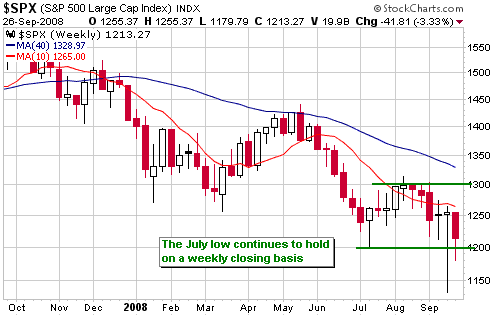
The US stock market gained
enough ground during the final two days of last week to ensure that the
S&P500 Index continued to hold above its July low on a weekly
closing basis.
It is very unlikely
that the MOAB (Mother Of All Bailouts) and the various other
inflationary actions being taken/planned will bring the equity bear
market to an end, but they could usher-in a very lengthy (6 months or
longer) period of consolidation and thus extend the overall bear market
into 2010 or even 2011. We'll talk more about this possibility after
the MOAB's details have been confirmed.
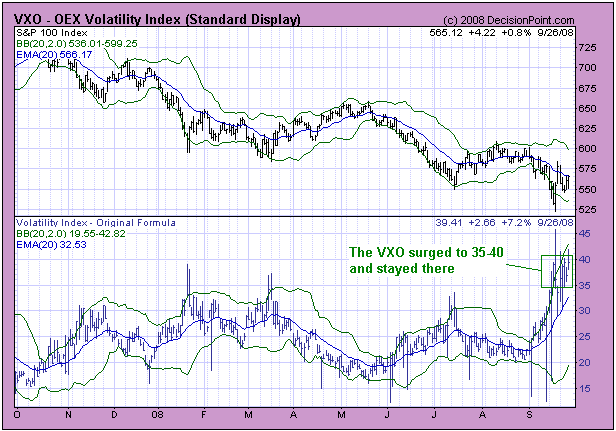
Although the stock market has stopped going down, nervousness remains
near peak levels. This is evidenced by the way the OEX Volatility Index
(VXO) surged to a very high level about two weeks ago and then stayed
there. Refer to the following chart for details. This is very unusual
behaviour in that moves to such high VXO levels have, in the past, been
short-lived spikes.
In addition to indicating that the stock market is still on edge, the
ban on short selling could have something to do with the VXO and other
volatility indices remaining near their recent extremes. The reason is
that the inability to hedge or speculate by selling short could have
increased the demand for options, thus boosting option premiums (the
popular volatility indices such as the VIX and the VXO aren't measures
of actual volatility, they are measures of the volatility implied by
option premiums).
Like all the markets,
the stock market's performance over the next couple of weeks will
largely be dictated by news regarding the MOAB. One plausible scenario
is that the stock market will shoot upward as soon as the MOAB deal is
finalised, and then give back most of its knee-jerk gains as investors
begin to have second thoughts about whether the deal actually fixes
anything.
This week's
important US economic events
| Date |
Description |
Monday Sep 29
| Persoanl Income and Spending
| Tuesday Sep 30
| Chicago PMI
Consumer Confidence
| | Wednesday Oct 01
| ISM Index
Construction Spending
| | Thursday Oct 02
| Factory Orders
| | Friday Oct 03
| Monthly Employment Report
ISM Services
|
Gold and
the Dollar
Gold
Current Market Situation
The latest H.4.1 Report
shows that the amount of credit extended by the Fed to banks and other
financial corporations grew by $204B during the week ending 24th
September. That's a 22% increase in one week! Just to be clear: the Fed
extends additional credit -- and grows its balance sheet -- by
providing Federal Reserve notes in exchange for some type of security.
The security has historically been in the form of Treasuries, but
nowadays almost anything can be used as security. In other words, the
Fed has just created 204 billion new dollars within the space of only
one week.
Now, in last week's Interim Update we said that the Fed's ability to
print new money was limited by its own target for the Fed Funds rate
(FFR), in that excessive money-creation by the Fed would push the
actual FFR to below the target FFR. How, then, did the Fed manage to
create such a huge amount of new money last week without pushing the
FFR to well below the official target of 2.0%?
The answer is: it didn't. The Fed flooded the banking system with so
much new money last week that it drove the FFR down to 1.2%. Refer to http://www.federalreserve.gov/releases/h15/update/
for details. In effect, there was an unofficial 80 basis-point rate cut
last week (at least, a temporary one). As far as we can recall, the
last time something like this happened was the week of the 9/11
disaster.
From an investment perspective, the upshot of the above is that after
being a bearish influence on gold for more than two years the monetary
backdrop is now becoming gold-bullish at a frenetic pace.
Gold's intermediate-term prospects are becoming increasingly bullish,
but in the here-and-now its price continues to consolidate in the
$850-$900 range. For a short while last Friday it looked like the metal
was going to break upward from this range, but it wasn't to be. The
failure of the gold-stock indices to react strongly to gold's move
above $900 on Friday morning proved to be an omen.
The gold market will probably remain volatile this week as it and all
the other markets continue to respond to new developments regarding the
MOAB. It's possible that final agreement regarding the huge bailout
will initially be regarded as overtly bullish for the financial sector
and that it will take a short while for the markets to begin
discounting the bailout's inflationary implications. If so, the market
reaction to the aforementioned agreement could entail a fall in the
investment demand for gold and a quick decline in the gold price,
followed, a few days later, by the resumption of gold's upward trend.
Alternatively, it is possible that the market will immediately 'see'
the inflationary implications of the so-called "rescue package".
We don't know what the gold market's initial reaction will be once a
bailout agreement is reached, but we strongly believe that a negative
reaction would prove to be WRONG. We would therefore view a negative
reaction as another good buying opportunity.
Bullionvault.com versus Goldmoney.com
Bullionvault.com and Goldmoney.com are two services that enable their
customers to buy/sell gold via the internet and to choose the location
of the vault in which the metal is stored. Neither service deals in
"electronic gold"; rather, when you buy gold via either of these
services you are buying a chunk of physical metal. It just so happens
that the change of ownership is transacted electronically.
We've given Bullionvault.com a few positive mentions in TSI
commentaries over the years. We have been very satisfied with the
Bullionvault service and have therefore had no incentive to sample a
competing service such as Goldmoney, but we suspect that Goldmoney.com
is just as good. At least, we have no reason to believe that it isn't
as good and are not aware of anyone having a bad experience with the
company. Furthermore, Goldmoney.com offers its customers the added
benefit of being able to trade physical silver.
Gold Stocks
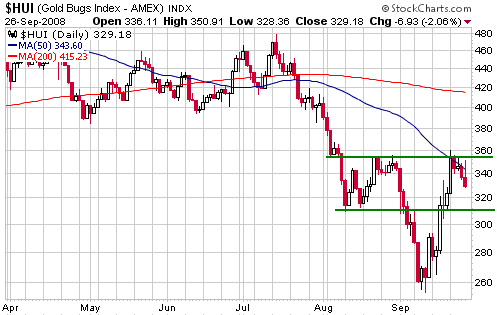
We had identified the mid 350s as a logical place for the HUI's
up-trend to pause and, therefore, a place at which it made sense to
take a small amount of money off the table. The following daily chart
shows that the HUI hit the aforementioned resistance last Monday and
then pulled back over the rest of the week.
The 320s became a reasonable downside target after a pullback was set
in motion, so the pullback could now be almost complete in terms of
both price and time. However, the HUI could continue down to support at
around 310 without doing any technical damage whatsoever. A drop to
around 310 would constitute a 50% retracing of the preceding advance
and would potentially complete the "right shoulder" of a "head and
shoulders" bottom.
We suggest adding
exposure to senior gold/silver stocks at the current level and
especially if the initial market reaction to a bailout agreement leads
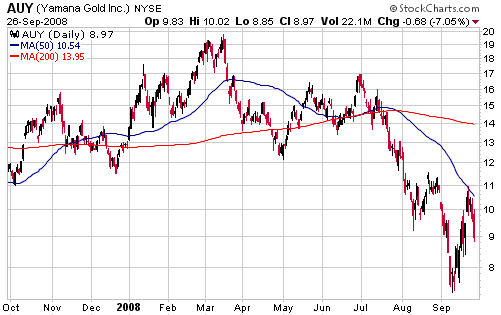
to some additional near-term weakness. Two likely candidates for new
buying are Yamana Gold (AUY) and Silver Wheaton (SLW).
Interestingly, the above-mentioned stocks have similar prices and chart
patterns even though they are very different companies (daily charts
are displayed below). For example, both stocks bottomed in mid
September in the $7-$8 range, rocketed up to their 50-day moving
averages at around $11, and then quickly retraced about half of their
gains. The $13-$14 range is a reasonable short-term upside target for
both stocks.

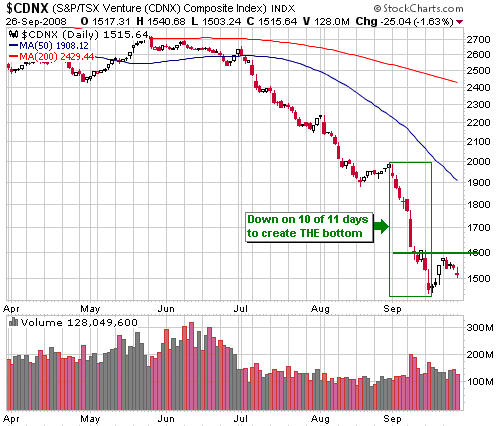
The CDNX (TSX Venture
Composite Index), a proxy for the junior end of the gold sector, did
not rebound as strongly as the HUI prior to last week's pullback, but
this is to be expected because the demand for the most speculative gold
stocks won't increase until it becomes obvious that the senior gold
stocks have commenced intermediate-term upward trends. However, we
think it will eventually be proven that the CDNX's plunge during the
first 11 trading days of September created the ultimate correction low.
With reference to the following daily chart, a close above 1600 would
be preliminary evidence that a correction low is in place for the CDNX.
Currency Market Update
Long-Term Outlook
We were long-term bears on the Dollar Index from the 120s down to 80,
but when this index fell below 80 in September of 2007 we upgraded our
long-term outlook to "neutral". Our thinking, at the time, was that
there was only about 10 points of additional downside potential, and on
this basis it made no sense to maintain a long-term bearish outlook.
Earlier this year, after the Dollar Index had fallen to the low-70s, we
seriously considered upgrading our long-term dollar view to "bullish".
Our thinking was that the US$ had become so under-valued relative to
the other major fiat currencies -- especially relative to the euro --
that the upside potential over the coming 5 years had become
significantly greater than the downside risk over the same period.
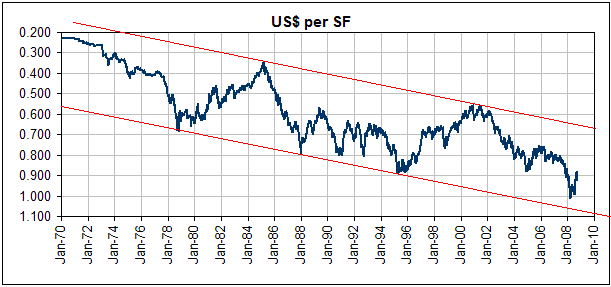
Also, by March of this year the US$ had fallen far enough in Swiss
Franc (SF) terms that it was nearing the bottom of the channel drawn on
the following long-term chart. Finally and as mentioned in a number of
TSI commentaries over the years, this chart shows that the SF/US$
exchange rate has traced out a post-1970 pattern that can be described
as: 8-10 years down followed by 6 years up. So, as well as being close
to its long-term channel bottom relative to the SF it seemed that the
US$ was into the final 1-3 years of its bear market (assuming that the
post-1970 pattern continued).
The main reason we
decided against such an upgrade was the enormous US military machine.
To be more specific, there's a firmly entrenched perception within the
US Government that the US must maintain a strong military presence
throughout much of the world and be constantly ready to project massive
military force at the President's whim. This, in turn, creates a
powerful inflationary bias because funding the military machine leads
to far greater federal deficit-spending than would otherwise occur.
In effect, the perceived need to fund a global military presence adds
to the US dollar's inflation risk. We cannot quantify this risk because
we cannot accurately forecast US military spending, but in our minds
the risk is big enough to offset the dollar's long-term upside
potential resulting from its current under-valuation.
The US$ has rebounded over the past 2.5 months in response to: a) its
attractive valuation relative to the euro, b) the unwinding of a large
US$ short position, and c) the realisation that many other parts of the
world will be following the US into recession. But at the same time,
the US dollar's inflation risk has burgeoned courtesy of the efforts to
offset the essential de-leveraging underway in the financial sector by
leveraging-up the balance sheets of the Fed and the US Government.
Current Market Situation
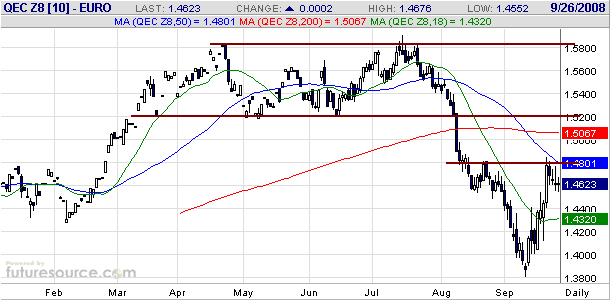
The euro's short-term chart looks similar to the HUI's short-term
chart, but we don't think the euro has anywhere near the upside
potential of the gold sector. At this stage we expect the December euro
to test, but not breach, resistance in the low-1.50s.
Update
on Stock Selections
(Note: To review the complete list of current TSI stock selections, logon at http://www.speculative-investor.com/new/market_logon.asp
and then click on "Stock Selections" in the menu. When at the Stock
Selections page, click on a stock's symbol to bring-up an archive of our comments on the stock in question)
 Orsu Metals (TSX: OSU) (Formerly European Minerals). Shares: 457M issued, 621M fully diluted. Recent price: C$0.29 Orsu Metals (TSX: OSU) (Formerly European Minerals). Shares: 457M issued, 621M fully diluted. Recent price: C$0.29
This is what we wrote about OSU in the 23rd July Interim Update, when the stock was trading at C$0.67:
"Half the [company's gold] resource
is associated with the Varvarinskoye project, which is currently being
ramped up and is expected to be producing gold at 80% of design
capacity by year-end. It is expected that full production, comprising
140K ounces/year of gold and 25M pounds/year of copper, will be reached
during the first quarter of 2009. If this occurs and costs are roughly
as planned then Varvarinskoye will generate sufficient cash flow to
justify around C$1.80/share for OSU. The company's earlier-stage
projects are probably worth around C$0.20/share at this time, but
should increase in value as more work is done. This gives us a rough
total valuation of C$2.00/share assuming that current production/cost
plans are achieved."
..."Performance is the key. If OSU's
new management can simply do what they say they are going to do then
the stock market will be forced to price the stock at a much higher
level."
OSU's stock price has since plunged to C$0.29, so the Varvarinskoye
project must have encountered major problems over the past two months,
right? Wrong, the ramp-up to full production appears to be progressing
well. For example, according to last Friday's press release
the production rate has already reached 80% of design capacity and, as
a result of a planned $5M upgrade, is expected to be well ABOVE design
capacity by Q2-2009.
With the benefit of hindsight it is clear that we should have exited
OSU earlier this year when it became known that delays in the
production ramp-up were going to cause financial problems, but the
benefit of hindsight is something we never have in real time. The
financial and operational problems have since been overcome, but the
price is now a lot lower.
Like most companies that have suffered large declines in their stock
prices and have had to re-state their financial results, OSU has been
served with a claim for damages. We don't think this ambit claim represents a significant risk.
OSU's current stock price exemplifies the irrational valuation evident
throughout the world of junior resource stocks. Prices are irrationally
low right now, and at some point in the future they will be
irrationally high. We prefer to buy when prices are irrationally low,
but that's just us.
Chart Sources
Charts appearing in today's commentary
are courtesy of:
http://stockcharts.com/index.html
http://www.futuresource.com/
http://www.decisionpoint.com/

|









