|
-- Weekly Market Update for the Week Commencing 29th October 2012
Big Picture
View
Here is a summary of our big picture
view of the markets. Note that our short-term views may differ from our
big picture view.
In nominal dollar terms, the BULL market in US Treasury Bonds
that began in the early 1980s will end by 2013. In real (gold)
terms, bonds commenced a secular BEAR market in 2001 that will continue
until 2014-2020. (Last
update: 23 January 2012)
The stock market, as represented by the S&P500 Index,
commenced
a secular BEAR market during the first quarter of 2000, where "secular
bear market" is defined as a long-term downward trend in valuations
(P/E ratios, etc.) and gold-denominated prices. This secular trend will bottom sometime between 2014 and 2020.
(Last update: 22 October 2007)
A secular BEAR market in the Dollar
began during the final quarter of 2000 and ended in July of 2008. This
secular bear market will be followed by a multi-year period of range
trading.
(Last
update: 09 February 2009)
Gold commenced a
secular bull market relative to all fiat currencies, the CRB Index,
bonds and most stock market indices during 1999-2001.
This secular trend will peak sometime between 2014 and 2020.
(Last update: 22 October 2007)
Commodities,
as represented by the Continuous Commodity Index (CCI), commenced a
secular BULL market in 2001 in nominal dollar terms. The first major
upward leg in this bull market ended during the first half of 2008, but
a long-term peak won't occur until 2014-2020. In real (gold) terms,
commodities commenced a secular BEAR market in 2001 that will continue
until 2014-2020.
(Last
update: 09 February 2009)
Copyright
Reminder
The commentaries that appear at TSI
may not be distributed, in full or in part, without our written permission.
In particular, please note that the posting of extracts from TSI commentaries
at other web sites or providing links to TSI commentaries at other web
sites (for example, at discussion boards) without our written permission
is prohibited.
We reserve the right to immediately
terminate the subscription of any TSI subscriber who distributes the TSI
commentaries without our written permission.
Outlook Summary
Market
|
Short-Term
(1-3 month)
|
Intermediate-Term
(6-12 month)
|
Long-Term
(2-5 Year)
|
|
Gold
|
Bullish
(17-Oct-12)
|
Bullish
(26-Mar-12)
|
Bullish
|
|
US$ (Dollar Index)
|
Bearish
(29-Oct-12)
|
Neutral
(09-Jan-12)
|
Neutral
(19-Sep-07)
|
|
Bonds (US T-Bond)
|
Bearish
(02-Jul-12)
|
Neutral
(18-Jan-12)
|
Bearish |
|
Stock Market
(DJW)
|
Bearish
(30-Jul-12)
|
Bearish
(28-Nov-11)
|
Bearish
|
|
Gold Stocks
(HUI)
|
Bullish
(22-Oct-12)
|
Bullish
(23-Jun-10)
|
Bullish
|
|
Oil |
Neutral
(30-Jul-12)
|
Neutral
(31-Jan-11)
|
Bullish
|
|
Industrial Metals
(GYX)
|
Neutral
(30-Jul-12)
|
Neutral
(29-Aug-11)
|
Neutral
(11-Jan-10)
|
Notes:
1. In those cases where we have been able to identify the commentary in
which the most recent outlook change occurred we've put the date of the
commentary below the current outlook.
2. "Neutral", in the above table, means that we either don't have a
firm opinion or that we think risk and reward are roughly in balance with respect to the timeframe in question.
3. Long-term views are determined almost completely by fundamentals,
intermediate-term views by
fundamentals, sentiment and technicals, and short-term views by sentiment and
technicals.
The Fed strikes again
The Federal Reserve, the central planning
agency responsible for manipulating US money supply and interest rates, issued
its latest strategy statement last Wednesday. There were no surprises, but the
following excerpt is worth highlighting:
"If the outlook for the labor market does not improve substantially, the
Committee will continue its purchases of agency mortgage-backed securities,
undertake additional asset purchases, and employ its other policy tools as
appropriate until such improvement is achieved in a context of price stability."
The Fed is rowing in the wrong direction, because by purchasing assets with
money created out of nothing it is placing obstacles in the way of a genuine
recovery. This means that the harder it rows, the less likely the economy will
get to the point where it is making strong real (sustainable) progress. Be that
as it may, by repeating the above sentence the Fed has re-confirmed that it will
row even harder if it doesn't perceive a return to strength.
Whereas last week's FOMC statement was almost an exact copy of the preceding
one, there's a good chance that the next statement, which will be published on
12th December, will contain some significant changes. This is because the Fed's
"Operation Twist" (selling short-dated Treasury securities and using the
proceeds to purchase long-dated securities) is scheduled to conclude at the end
of this year and probably can't be extended due to a lack of short-dated
securities. That is, one string of the Fed's 'policy accommodation bow' will
soon be no more. The question is: will the Fed find a new string to replace the
one that can no longer be used? The answer is: probably, but we should know for
sure on 12th December.
Monetary Inflation Update
Here are short notes on what's happening to
monetary inflation rates in the euro-zone and Australia.
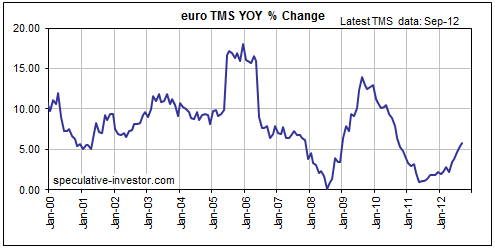
The year-over-year (YOY) rate of growth in euro True Money Supply (TMS) moved a
little higher in September, building on its upward trend. The probability of the
euro-zone experiencing genuine deflation was never high, but it is now low and
getting lower by the month. At the same time, the probability of a new European
investment bubble is rising. The German property market is a candidate for the
next bubble.
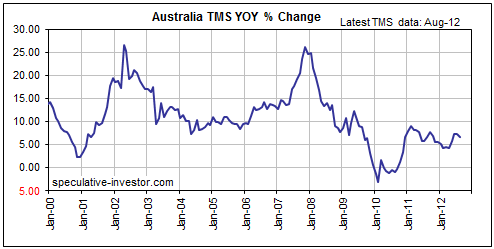
The large swings in Australia's YOY TMS growth rate evident on the following
chart are mostly due to changes in the rate at which the commercial banks make
new loans. Unlike the central bank in the US, the Reserve Bank of Australia
hasn't done much in the way of direct money creation. It doesn't need to do
anything yet, because the activities of the commercial banks are keeping the
money supply growing at 5%-8%.
Australia had a very high monetary inflation rate during 2006-2008 and is
undoubtedly still feeling the effects of this inflation (it takes a few years
for the full effects of a money-supply surge to ripple through the economy).
Adding more money at the rate of 5%-8% per year is only going to worsen the
inflation problem.
The Stock
Market
Apple and the Miners
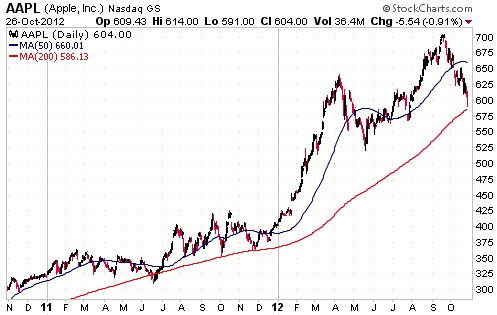
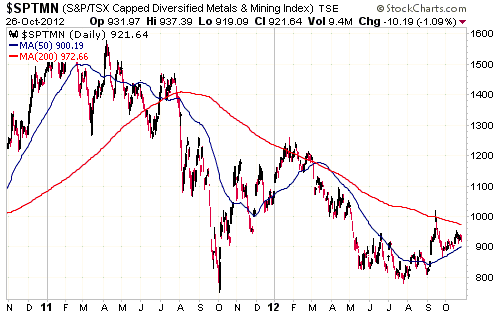
The first of the following daily charts shows the performance of Apple (AAPL)
over the past two years. The second chart shows the performance of the
Diversified Metals and Mining Index (SPTMN) over the same period. An inverse
relationship is evident, in that while AAPL has made a sequence of rising tops
SPTMN has made a sequence of declining tops. To put it another way, over the
past 18 months stock market participants have increasingly favoured AAPL at the
expense of the mining sector.
Is a reversal in the works, with investor interest beginning to shift away from
AAPL and towards the mining sector?
It's too soon to tell. It's possible, for example, that the mining sector has
led to the downside and that tech favourites such as AAPL are about to join the
long-term decline. The possibility that we favour is that diversified mining
stocks will rally into early next year within the context of a long-term
downward trend, regardless of what happens to AAPL. (Note: The gold mining
sector is fundamentally very different from, and must therefore be analysed
separately from, the diversified mining sector).
On a related matter, Apple's stock shows no sign of being immersed in an
investment bubble. The company has net cash and cash equivalents of about
$120/share, which means that at Friday's closing price of $604 its enterprise
value is around $480/share. It earned $44/share over the past 12 months, so it
is currently trading at a P/E ratio of only 11. Considering that its earnings
are still growing rapidly a good argument could therefore be made that the stock
is significantly under-valued.
While there is clearly no bubble in the stock's current valuation, the company's
earnings may well constitute a type of bubble. AAPL could now be in a similar
situation to the home-building companies in 2005. When the home-building stocks
were reaching major peaks in mid-2005 they didn't appear to be expensive based
on what they were earning at the time and what they were expected to earn over
the coming 12 months, despite having made huge price gains over the preceding
three years. However, the earnings had been boosted to an unsustainable level as
part of an property investment bubble.
Current Market Situation
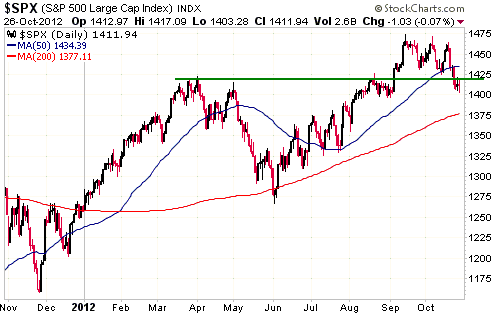
The S&P500 Index (SPX) dropped below support in the 1420s last week. This is
evidence that an intermediate-term peak was put in place in September, but the
evidence is far from conclusive. In fact, we think the odds are in favour of two
of the three senior US stock indices making new multi-year highs before an
intermediate-term decline gets underway (the SPX and the Dow stand a good chance
of making new highs, but the NDX has probably peaked). The reason is that
sentiment has become depressed and the market is quickly becoming 'oversold'
despite the SPX having only fallen by 5% from its peak.
This week's
important US economic events
| Date |
Description |
| Monday Oct 29 |
Personal Income and Spending
Dallas Fed Mfg Survey
| | Tuesday Oct 30 |
Case-Shiller Home Price Index
Consumer Confidence | | Wednesday
Oct 31 |
Employment Cost Index
Chicago PMI | | Thursday
Nov 01 |
ISM Index
Construction Spending
Motor Vehicle Sales
Q3 Productivity and Costs
|
| Friday Nov 02 |
Monthly Employment Report
Factory Orders
|
Gold and
the Dollar
Gold
What will a major gold top look like? (Part 2)
In the 1st October Weekly Update we described three signs that will likely be
seen at around the time of, or just prior to, gold's ultimate price top. First,
we said that by the time the ultimate top of gold's bull market is close at hand
the general public will have given up on the idea that returning to economic
health requires more money-printing, more government spending and more debt. The
purveyors of such economic quackery will still have their fans, but they will
most definitely be in the minority. Second, we reiterated the historical fact
that the most important gold peaks of the past 40 years occurred well after the
monetary backdrop had turned gold-bearish. We then said that as a consequence of
gold's tendency to follow major changes in the monetary situation, gold probably
won't reach its ultimate top until well after the Fed stops trying to
'stimulate' the economy using cheap credit and money-pumping. Third, we cited
the strong tendency observed under the current monetary system for long-term
bull markets to go to absurd extremes and culminate in spectacular upside
blow-offs during their final 12 months.
Not one of these three signs has been evident during the past few years.
Furthermore, based on the time it would take for the above-mentioned signs to
appear it is reasonable to conclude that gold's ultimate price top lies a
minimum of two years into the future.
We are revisiting this topic today because our 1st October commentary omitted an
important indicator of a gold top. It's an indicator we've included in many
TSI commentaries over the past ten years that for some unknown reason escaped
our most recent discussion of what to look for when trying to determine if
gold's bull market is nearing its end. We are referring to the relationship
between gold and the US stock market. The relationship is illustrated below and
can be expressed as follows: Secular trends in the Dow Industrials Index
relative to gold go hand-in-hand with secular trends in stock market valuation
(represented on the following chart by the S&P500's price-to-peak-earnings
ratio, also known as the Hussman P/E). Due to this relationship, gold probably
won't be close to a major peak relative to the Dow until after the SPX's Hussman
P/E makes a prolonged move to single digits. To put it more succinctly, near a
major gold top the US stock market will be very under-valued.
Note that the relationship between gold and the stock market isn't just a
coincidence. It stems from gold being the world's most durable, transportable
and widely accepted store of value. As other investments fall out of favour (as
indicated, for example, by a long-term downward trend in the US stock market's
P/E ratio) there is an increase in demand for the store-of-value function that
gold has provided with great success for thousands of years.
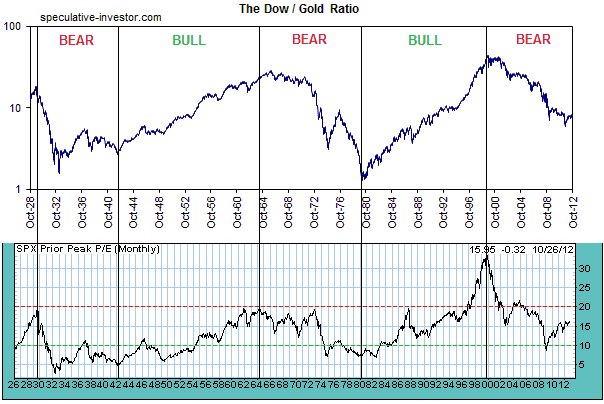
[Chart
Source: The bottom section of the chart (the SPX P/E) is from
www.decisionpoint.com. The top
section is our creation.]
The US stock market is not remotely close to being under-valued at this time.
Therefore, the link between gold and the US stock market's valuation is sending
the same signal as the other indicators of a major gold top, which is that a
major gold top is probably still years away.
Current Market Situation
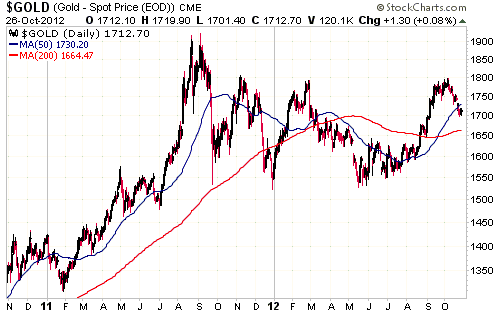
In the 22nd October Weekly Update we used the performance of the
euro-denominated gold price (gold/euro) to arrive at a downside target of
US$1685 for gold's current correction. Nothing of significance changed over the
intervening week. As illustrated by the following daily chart, the US$ gold
price edged a little lower, moved slightly below its 50-day moving average (the
blue line) and came within about $15 of the aforementioned downside target.
Sentiment in the gold market can best be described as mixed at this time. The
speculative net-long position in COMEX gold futures is still at a moderately
high level, but there's no good reason to expect it to fall much further if --
as we currently believe -- we are dealing with a routine short-term correction.
Market Vane's bullish percentage has pulled back from the mid-70s to the
mid-60s, which is about as far as it should pull back in reaction to a normal
price correction.
The bottom line is that gold still appears to be experiencing a routine
short-term correction. There is no evidence in the price action that the
correction is complete, but the remaining downside potential looks small.
Gold Stocks
Current Market Situation
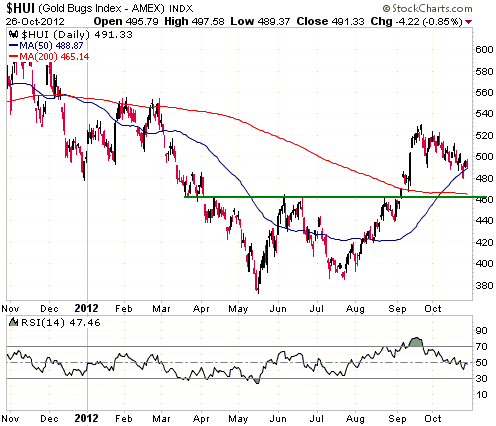
An end to the gold sector's correction has not yet been signaled, but it's a
good bet that the HUI was at or very close to its correction low when it dropped
to 480 on Wednesday 24th October. At that time it was slightly below its 50-day
moving average (the ideal price level for a correction low) and its daily
RSI(14) was in the low-40s (at the lower end of the range it usually reaches
during routine short-term corrections). However, that doesn't imply it's now
'off to the races'. If a correction low is in place, the most likely price
action from here would entail about three weeks of basing prior to the start of
a strong rally.
Update on the SA Strikes
One of the mines operated by Gold Fields Ltd (GFI) remains shut down due to a
labour dispute. Other than that, the strikes that disrupted gold mining in South
Africa over the past two months have ended, with company managements and unions
having agreed on wage hikes of between 1.5% and 10.8% for different categories
of workers. Anglogold estimates that the terms agreed with unions will increase
its South African wage bill by 2.5%. There will also be large extraordinary
costs due to lost production and the re-starting of mines that were shut down.
As a result of the strikes the South African gold stocks were relatively weak
over the past two months, although it is fair to say that the market took the
strike news in stride as the weakness wasn't as pronounced as it could have
been.
The most puzzling reaction to South Africa's recent labour unrest was in the
platinum market. Unlike the gold sector, where mining has resumed at all mines
bar one, large parts of South Africa's platinum mining sector remain idle. And
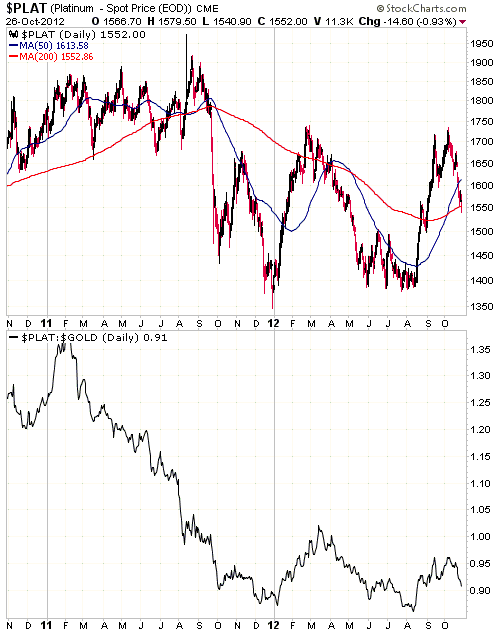
yet, after rallying strongly during August-September the platinum price has
plunged over the past three weeks (see chart below). This plunge in the US$
platinum price wiped out more than half of the preceding gain and is difficult
to understand given the importance of South African mine supply to platinum's
global supply-demand equation. Platinum's recent weakness relative to gold is
even more difficult to understand given the irrelevance of South African mine
supply to gold's global supply-demand equation. The bottom section of the
following chart shows the platinum/gold ratio.
Almost immediately after the platinum price turned higher in August we suggested
buying the Physical Platinum ETF (PPLT) for a short-term trade. This worked
well. Another short-term trading opportunity is brewing in the platinum market,
but the risk/reward isn't quite right just yet.
Currency Market Update
We don't know why, but over the past 10 years the euro has tended to make
important reversals during November-January. These November-January reversals
are indicated by green arrows on the following weekly chart.
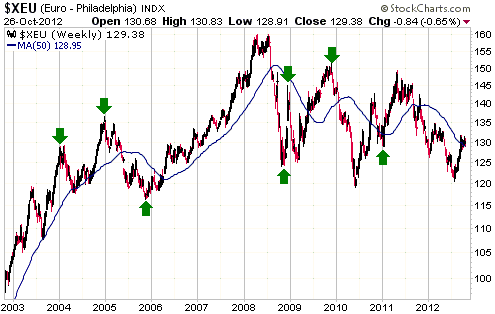
The euro could be headed for another November-January reversal, in this case a
reversal from up to down. However, for this to be the case it will have to break
above its September high over the weeks ahead and rise to at least 135. Price
action of this nature would probably eliminate the remaining speculative
net-short position in euro futures and establish a sentiment platform capable of
supporting an intermediate-term euro decline and Dollar Index rally.
Our view is that while the next big multi-quarter trend in the currency market
is likely to involve euro weakness and strength in the Dollar Index, on a
short-term basis the stage appears to be set for euro strength and US$ weakness.
Our short-term US$ outlook has therefore shifted from "neutral" to "bearish".
Update
on Stock Selections
Notes: 1) To review the complete list of current TSI stock selections, logon at
http://www.speculative-investor.com/new/market_logon.asp
and then click on "Stock Selections" in the menu. When at the Stock
Selections page, click on a stock's symbol to bring-up an archive of
our comments on the stock in question. 2) The Small Stock Watch List is
located at http://www.speculative-investor.com/new/smallstockwatch.html
 Company
news/developments for the week ended Friday 26th October 2012: Company
news/developments for the week ended Friday 26th October 2012:
*Clifton Star Resources (CFO.V) reported additional drilling
results. The latest batch of results was mostly from holes drilled
outside the Beattie, Donchester and Central Duparquet pit shells
previously outlined (the conceptual mine plan for CFO's Duparquet
project comprises three pits at this stage). That is, the results
were mostly from exploration holes drilled to identify new
resources. There were some decent intercepts, but nothing
eye-catching.
We await the Preliminary Economic Assessment (PEA) for the Duparquet
project, which remains on track for completion at the end of this
year. The PEA will be the first test of whether CFO has its hands on
a project with strong potential to be developed into a profitable
mine.
*Elgin Mining (ELG.TO) reported drilling results from its Bjorkdal
gold mine in Sweden. The drilling was done with the aim of adding
underground resources and appears to have been successful. Some of
the best holes and intercepts were:
Hole 2012-007, which returned 5.0 metres of 9.71 g/t Au;
Hole 2012-015, which returned 3.0 metres of 10.53 g/t Au, 2.0 metres
at 7.13 g/t Au, and 4.0 metres at 4.30 g/t Au;
Hole 2012-017, which returned 3.9 metres at 8.0 g/t Au, 1.0 metre at
116.0 g/t Au, and 3.3 metres of 9.16 g/t Au;
Hole 2012-027, which returned 4.1 metres at 4.30 g/t Au, 3.0 metres
at 13.99 g/t Au, and 3.9 metres at 5.42 g/t Au;
Hole 2012-031, which returned 2.0 metres at 10.32 g/t Au, and 3.0
metres at 4.27 g/t Au;
Hole 2012-033, which returned 3.0 metres at 14.46 g/t Au, 3.1 metres
at 8.20 g/t Au, 2.0 metres at 8.38 g/t Au, and 2.0 metres at 10.92
g/t Au;
Hole 2012-034, which returned 3.1 metres at 4.02 g/t Au, and 2.0
metres at 9.29 g/t Au.
These results are positive, especially considering that they are
from the vicinity of an operating mine.
From our perspective, the big test for ELG will be the next set of
quarterly production results from Bjorkdal. The results for the
previous quarter were sub-par, with production coming in lower than
expected and costs coming in higher than expected (the cash cost was
$1,071/oz). The next quarterly report will probably be published 3-4
weeks from now and must show a significant improvement to maintain
our interest. A significant improvement is likely.
*Evolution Mining (EVN.AX) reported its production and financial
results for the September quarter. Gold production was 94K ounces,
or about 5K ounces above plan. The cash operating cost was $732/oz,
which was better than planned and continues the positive trend
(per-ounce cash cost was $809 in the March quarter and $762 in the
June quarter). The Mt Carlton project is on track for commissioning
in December of this year and is expected to contribute 25K-30K
ounces to the company's total production during the first half of
next year.
That's the good news. The bad news is that despite the solid
production performance, EVN's operations didn't generate any free
cash flow during the latest quarter. Excluding the $53M invested in
the Mt Carlton mine construction and the one-off $21M stamp duty
charge associated with last year's merger, EVN was roughly
cash-neutral during the quarter. Almost all the cash generated by
its operations was ploughed back into its operations via capital
investment and exploration.
This, in essence, is why gold mining stocks generally make poor
long-term investments. Even the best ones (like EVN) have to invest
a lot of money in their operations every year just to stand still.
They don't consistently have substantial free cash flow (money left
over after paying ALL expenses).
EVN hit a high of A$2.14 last week before pulling back and ending
the week at A$1.90. We highlighted it as a buy in the A$1.30-A$1.50
range several times earlier this year. There is very little chance
of the stock trading below A$1.50 again, but with evidence emerging
that gold's correction is almost over it would now be a good
candidate for new buying in the A$1.80s. The stock will probably
trade at least as high as A$2.50 and has the potential to trade
above A$4.00 within the next 12 months.
*Keegan Resources (KGN) confirmed that the revised Pre-Feasibility
Study (PFS) for the Esaase gold project would be completed during
the first quarter of next year and advised that in support of the
PFS it was conducting additional metallurgical tests. These tests
are required due to the change in the mine plan.
We expect the revised PFS to show much improved economics compared
to the original PFS.
*Pretium Resources (PVG) announced that the Feasibility Study (FS)
for its high-grade Brucejack gold project would be completed during
the second quarter of 2013 and would be based on a mining rate of
2,700 tonnes per day. The PEA published in February of this year was
based on a mining rate of 1,500 tonnes per day to yield average
life-of-mine gold production of 287K ounces, so the size of the
planned operation is being substantially increased for the FS. It
looks like PVG is aiming for an underground mine with average annual
production of around 500K ounces.
*Rio Novo Gold (RN.TO) reported a small increase in the resource
at its Almas gold project in Brazil. The project now contains a
Measured and Indicated mineral resource of 839,033 Au ounces grading
0.86 Au g/t and an Inferred resource of 496,131 Au ounces grading
0.84 Au g/t. The resource has a low average grade, but it should
still be possible to develop a profitable mining operation due to a
low capex requirement and simple mine plan. Whether this is, in
fact, the case will be established by the FS that is scheduled to be
completed within the next few weeks.
RN's market cap (currently around $20M) is extremely low relative to
the potential value of its assets. Our main concern at this time is
that there will be substantial financing-related dilution of the
stock.
*UEX Corp. (UEX.TO) reported the results from one more hole
drilled into the new Kianna East discovery at its 49%-owned Shea
Creek project in Canada's Athabasca Basin. The hole intersected 7.0m
grading 4.72% U3O8, Including 3.5m grading 8.12% U3O8. This is
another very interesting high-grade result. Kianna East could be an
important find.
*Volta Resources (VTR.TO) reported the results from 110 holes
drilled into its Kiaka gold project in Burkina Faso. These drilling
results included many good intersections and will expand the
existing M&I gold resources, mostly by converting Inferred resources
to the M&I category. However, we are concerned that VTR is chewing
up too much of its treasury in an effort to grow its in-ground gold
inventory. Aggressively drilling a low-grade deposit with the aim of
quickly increasing its size would be the right approach if the
market were rewarding such efforts and financing were easy to come
by, but it's the opposite of the right approach in the present
environment.
VTR needs to take a leaf out of KGN's book and shift its focus to
the development of a smaller higher-grade resource. If it doesn't it
will probably end up having to do a large equity financing at a very
low price per share, thus greatly reducing the company's per-share
value.
Endeavour
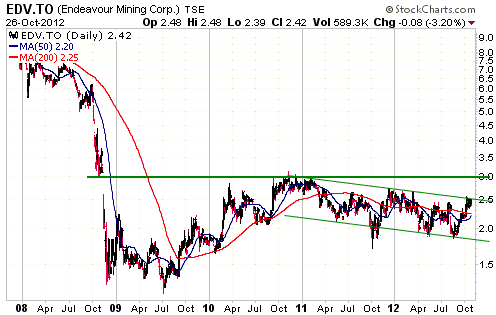
Mining (TSX: EDV, ASX: EVR). Shares: 416M issued, 451M fully diluted. Recent
price: C$2.42
EDV has substantial valuation-related upside potential. The chart (see below)
also suggests the potential for large gains. There is resistance at C$2.50 and
at C$3.00, but after that there is no chart-related resistance until C$5.00.
Rye
Patch Gold (TSXV: RPM). Shares: 146M. Recent price: C$0.445
Our interest in RPM is solely due to the high probability that it will prevail
in a court case and thus obtain ownership of a valuable portion of the Rochester
project formerly owned by Coeur d'Alene Mines (CDE). When we added RPM to the
TSI List two weeks ago it looked like the case would go to trial before the end
of this year, but RPM announced last Friday that the trial might not happen
until September of next year.
The delay is due to CDE not being ready in time for the originally scheduled
November-2012 trial date, which supports the idea that CDE's case is weak. It
makes us even more confident that the legal battle will eventually go in RPM's
favour, but RPM was supposed to be a short-term trade and there is now a good
chance that the winner of the battle won't be determined until around this time
next year. Consequently, unless there is a new development we will probably exit
the stock if it returns to the low-C$0.50s. In the mean time, the company's
other projects should limit the downside in the stock price.
Frontier
Rare Earths (TSX: FRO). Recent price: C$0.58
FRO is developing the Zandkopsdrift rare earths project in South Africa. It is a
member of the TSI Small Stocks Watch List, which means that it is a small stock
that we aren't following closely at TSI but has speculative merit and could be
of interest to some of our readers.
FRO issued important news last week. In a nutshell, it is expanding its
partnership with Korea Resources (Kores). Full details can be found
HERE, but the key points are: 1) Kores will be paying $23.8M for 10% of
Zandkopsdrift by 30th November of this year (2 months later than originally
planned); 2) Kores will have the right to increase its ownership to 50% by
paying an amount determined by the project's Feasibility Study (FS); and 3) the
FS is scheduled to be complete in Q4 2013.
One reason that FRO is interesting is that it will have about $55M of cash once
Kores pays $23.8M for 10% of the project. This equates to about $0.61/share,
which means that the market is assigning zero value to the project. Another
reason that FRO is interesting is that Kores' desire to spend $23.8M for 10% of
the project implies that it perceives a value of at least $238M for the entire
project and a value of at least $214M for FRO's 90% stake. $214M equates to
$2.38 per FRO share. FRO is therefore potentially worth at least $3/share
($2.38/share for 90% of the project plus $0.61/share of cash).
It seems that a lot of patience will be required with this one, however, as the
FS (the next big market-moving event) is 12 months away.
Chart Sources
Charts appearing in today's commentary
are courtesy of:
http://stockcharts.com/index.html
http://www.decisionpoint.com/

|









