|
-- Weekly Market Update for the Week Commencing 29th November 2010
Big Picture
View
Here is a summary of our big picture
view of the markets. Note that our short-term views may differ from our
big picture view.
In nominal dollar terms, the BULL market in US Treasury Bonds
that began in the early 1980s will end by mid-2010. In real (gold)
terms, bonds commenced a secular BEAR market in 2001 that will continue
until 2014-2020. (Last
update: 09 February 2009)
The stock market, as represented by the S&P500 Index, commenced
a secular BEAR market during the first quarter of 2000, where "secular
bear market" is defined as a long-term downward trend in valuations
(P/E ratios, etc.) and gold-denominated prices. This secular trend will bottom sometime between 2014 and 2020. (Last update: 22 October 2007)
A secular BEAR market in the Dollar
began during the final quarter of 2000 and ended in July of 2008. This
secular bear market will be followed by a multi-year period of range
trading. (Last
update: 09 February 2009)
Gold commenced a
secular bull market relative to all fiat currencies, the CRB Index,
bonds and most stock market indices during 1999-2001. This secular trend will peak sometime between 2014 and 2020. (Last update: 22 October 2007)
Commodities,
as represented by the Continuous Commodity Index (CCI), commenced a
secular BULL market in 2001 in nominal dollar terms. The first major
upward leg in this bull market ended during the first half of 2008, but
a long-term peak won't occur until 2014-2020. In real (gold) terms,
commodities commenced a secular BEAR market in 2001 that will continue
until 2014-2020. (Last
update: 09 February 2009)
Copyright
Reminder
The commentaries that appear at TSI
may not be distributed, in full or in part, without our written permission.
In particular, please note that the posting of extracts from TSI commentaries
at other web sites or providing links to TSI commentaries at other web
sites (for example, at discussion boards) without our written permission
is prohibited.
We reserve the right to immediately
terminate the subscription of any TSI subscriber who distributes the TSI
commentaries without our written permission.
Outlook Summary
Market
|
Short-Term
(0-3 month)
|
Intermediate-Term
(3-12 month)
|
Long-Term
(1-5 Year)
|
Gold
|
Bullish
(27-Oct-10)
|
Bullish
(12-May-08)
|
Bullish
|
US$ (Dollar Index)
|
Neutral
(01-Sep-10)
| Neutral
(27-Sep-10)
|
Neutral
(19-Sep-07)
|
Bonds (US T-Bond)
|
Neutral
(20-Sep-10)
|
Bearish
(14-Dec-09)
|
Bearish
|
Stock Market (S&P500)
|
Bearish
(29-Nov-10)
|
Bearish
(11-Oct-10)
|
Bearish
|
Gold Stocks (HUI)
|
Bullish
(01-Sep-10)
|
Bullish
(23-Jun-10)
|
Bullish
|
| Oil | Bearish
(29-Nov-10)
| Bearish
(01-Mar-10)
| Bullish
|
Industrial Metals (GYX)
| Bearish
(29-Nov-10)
| Bearish
(25-May-09)
| Neutral
(11-Jan-10)
|
Notes:
1. In those cases where we have been able to identify the commentary in
which the most recent outlook change occurred we've put the date of the
commentary below the current outlook.
2. "Neutral", in the above table, means that we either don't have a
firm opinion or that we think risk and reward are roughly in balance with respect to the timeframe in question.
3. Long-term views are determined almost completely by fundamentals,
intermediate-term views by giving an approximately equal weighting to
fundamental and technical factors, and short-term views almost
completely by technicals.
Quote of the week
"We've got to stand with our North Korean allies - we're bound to by treaty."
- Sarah Palin in a radio interview last Thursday
The "great depression" of 1873-1896
Since
coming into existence in 1913, the Federal Reserve has helped
facilitate a massive decline in the purchasing power of the US dollar.
However, the Fed is not the root of the US monetary problem, as
evidenced by the fact that there were several US financial
crises/panics during the half-century prior to the establishment of the
Fed. As explained by Murray Rothbard (America's greatest economics
historian), these pre-Fed financial panics "were a result of the arbitrary credit creation powers of the banking system."
In other words, the root of the problem is -- and has always been --
the legal ability of banks to create credit 'out of thin air', commonly
referred to as fractional reserve banking. With or without a central
bank, fractional reserve banking will tend to bring about a boom/bust
cycle and thus reduce the long-term rate of economic progress.
Central banking is perhaps history's best example of government
attempting to fix a problem -- in this case, the instability resulting
from the practice of fractional reserve banking -- and making things
much worse in the process. The fact that fractional reserve banking
leads to periodic crises suggests the following solution: banks should
not be allowed to create new money out of nothing, that is, banks
should be subject to the same laws as everyone else. However, the big
banks tend to be politically influential, and imposing proper
restrictions on the ability of the banking industry to expand its
collective balance sheet would also restrict the government's ability
to grow, so rather than address the underlying problem the government
put in place a system that would enable arbitrary credit creation to
continue for much longer and to a much greater extreme without a
'cleansing' crisis. In the US, this "system" is called the Federal
Reserve. Since the advent of the Federal Reserve there have been longer
periods of apparent stability followed by much greater financial crises
and economic downturns (the three most severe peace-time economic
downturns in the US (the downturns of the 1930s, the 1970s and the
2000s) occurred since the birth of the Fed). There has also been a
dramatic increase in the size of the US federal government, with its
adverse consequences for freedom.
So, fractional reserve banking caused financial panics and boom-bust
economic cycles in the US prior to the creation of the Fed, but crises
and recessions in the pre-Fed era were relatively short and the economy
tended to recover far more quickly. How, then, do we explain the "great
depression" of 1873-1896, which some commentators cite in an effort to
'prove' that the Gold Standard doesn't work and that central banking
can be beneficial?
The short answer is that there was no "great depression" during
1873-1896. Thanks to excessive deposit creation (fractional reserve
banking) there were three financial panics during this period (in 1873,
1884 and 1893), but the overall economy achieved very strong real
growth.
For a longer answer we turn to the following excerpts from Murray
Rothbard's "A History of Money and Banking in the United States":
"Orthodox economic
historians have long complained about the "great depression" that is
supposed to have struck the United States in the panic of 1873 and
lasted for an unprecedented six years, until 1879. Much of this
stagnation is supposed to have been caused by a monetary contraction
leading to the resumption of specie payments in 1879. Yet what sort of
"depression" is it which saw an extraordinarily large expansion of
industry, of railroads, of physical output, of net national product, of
real per capita income? As Friedman and Schwartz admit, the decade from
1869 to 1879 saw a 3-percent-perannum increase in money national
product, an outstanding real national product growth of 6.8 percent per
year in this period, and a phenomenal rise of 4.5 percent per year in
real product per capita. Even the alleged "monetary contraction" never
took place, the money supply increasing by 2.7 percent per year in this
period. From 1873 through 1878, before another spurt of monetary
expansion, the total supply of bank money rose from $1.964 billion to
$2.221 billion -- a rise of 13.1 percent or 2.6 percent per year. In
short, a modest but definite rise, and scarcely a contraction.
It should be clear, then,
that the "great depression" of the 1870s is merely a myth -- a myth
brought about by misinterpretation of the fact that prices in general
fell sharply during the entire period. Indeed, they fell from the end
of the Civil War until 1879.
Friedman and Schwartz
estimated that prices in general fell from 1869 to 1879 by 3.8 percent
per annum. Unfortunately, most historians and economists are
conditioned to believe that steadily and sharply falling prices must
result in depression: hence their amazement at the obvious prosperity
and economic growth during this era. For they have overlooked the fact
that in the natural course of events, when government and the banking
system do not increase the money supply very rapidly, freemarket
capitalism will result in an increase of production and economic growth
so great as to swamp the increase of money supply. Prices will fall,
and the consequences will be not depression or stagnation, but
prosperity (since costs are falling, too), economic growth, and the
spread of the increased living standard to all the consumers."
..."It might well be that
the major effect of the panic of 1873 was not to initiate a great
depression, but to cause bankruptcies in overinflated banks and in
railroads riding on the tide of vast government subsidy and bank
speculation."
..."The record of
1879-1896 was very similar to the first stage of the alleged great
depression from 1873 to 1879. Once again, we had a phenomenal expansion
of American industry, production, and real output per head. Real
reproducible, tangible wealth per capita rose at the decadal peak in
American history in the 1880s, at 3.8 percent per annum. Real net
national product rose at the rate of 3.7 percent per year from 1879 to
1897, while per-capita net national product increased by 1.5 percent
per year.
Once again, orthodox
economic historians are bewildered, for there should have been a great
depression since prices fell at a rate of over 1 percent per year in
this period. Just as in the previous period, the money supply grew, but
not fast enough to overcome the great increases in productivity and the
supply of products. The major difference in the two periods is that
money supply rose more rapidly from 1879 to 1897, by 6 percent per
year, compared with the 2.7 percent per year in the earlier era. As a
result, prices fell by less, by over 1 percent per annum as contrasted
to 3.8 percent. Total bank money, notes, and deposits rose from $2.45
billion to $6.06 billion in this period, a rise of 10.45 percent per
annum -- surely enough to satisfy all but the most ardent
inflationists."
"The financial panics
throughout the late nineteenth century were a result of the arbitrary
credit creation powers of the banking system. While not as harmful as
today's inflation mechanism, it was still a storm in an otherwise
fairly healthy economic climate."
In summary, a 23-year period in which the US economy achieved the
strongest real growth in its history is strangely characterised in some
quarters as a "great depression", quite likely because so many
economists and historians do not understand that real economic progress
puts DOWNWARD pressure on prices. Unfortunately, there is no chance
that the next 10 years will be anything like the so-called "great
depression" of late 19th Century. The current great depression is
shaping up to be the genuine article.
The Stock
Market
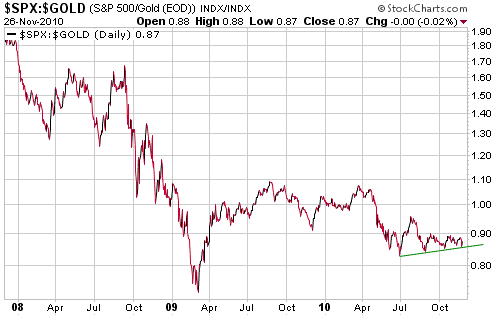
The US stock market in gold terms
In US$ terms, the S&P500's rebound from its March-2009 crash low
has been very impressive. Even in the event that it just ended, it
lasted 18 months and achieved a peak-to-trough gain of more than 80%.
This makes it look more like a new cyclical bull market than a
post-crash rebound within a cyclical bear market. However, it's a
different story if we look at the S&P500 in gold terms. Relative to
gold, it looks like the S&P500 completed a fairly routine
post-crash rebound way back in August of 2009 and then resumed its bear
market (refer to the following chart for details), although we won't
know for sure if this interpretation is correct until the
S&P500/gold ratio breaks below its March-2009 low.
Current Market Situation
The equity put/call ratio is a contrary indicator, meaning that this
indicator should be interpreted as bullish when it reflects a great
deal of concern about the market's downside potential and bearish when
it reflects minimal concern about the market's downside potential. It
works this way because the trading of equity options is dominated by
the "dumb money" (the public). The OEX put/call ratio works the
opposite way, though, because the trading of OEX options is dominated
by professional hedgers. That is, the OEX put/call ratio should be
interpreted as bearish when it reflects a high degree of concern about
downside risk and bullish when it reflects minimal concern about
downside risk.
Further to the above, we consider the put/call situation to be bullish
when the 10-day moving average (MA) of the OEX put/call ratio is near a
52-week low (indicating minimal fear on the part of the smart money) at
the same time as the 10-day MA of the equity put/call ratio is near a
52-week high (indicating a high degree of fear on the part of the dumb
money), and bearish when the opposite extremes occur. The vast majority
of the time the put/call situation is neither bullish nor bearish from
our perspective, because the OEX and equity put/call moving averages
are generally not at opposite extremes.
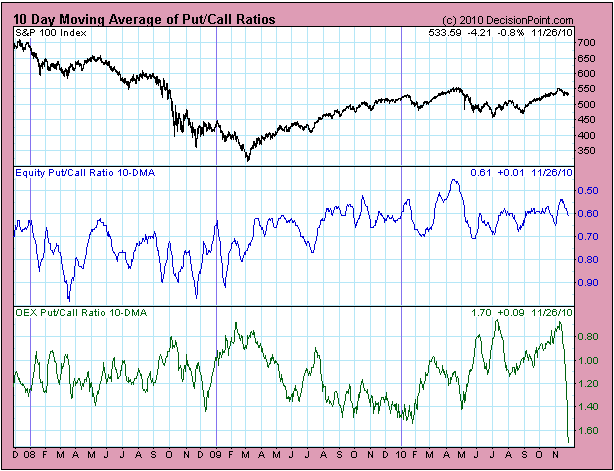
The current situation, which is depicted on the following
DecisionPoint.com chart, is both interesting and unusual in that the
10-day MA of the OEX put/call ratio (the green line) has just
experienced the quickest move from a 2-year low to a 2-year high that
we have ever seen (note that the chart's scale is inverted, so that a
rising put/call ratio is indicated by a falling line). As at the end of
last week, the 10-day MA of the OEX put/call ratio was at its highest
level since early-October of 2007 (the time of the major stock market
peak) while the 10-day MA of the equity put/call ratio was in the
bottom quartile of its 3-year range.
The upshot is that the put/call situation has gone from
neutral-to-bullish just two weeks ago to definitively bearish right
now.
When considered
alongside the other bearish signs mentioned in recent TSI commentaries,
the dramatic change in the put/call situation means that our short-term
stock market outlook has shifted from "neutral" to "bearish". Also, the
shift in our short-term stock market outlook prompts a similar shift in
our short-term outlooks for industrial metals and oil.
The aforementioned outlook change means that on a 1-3 month basis we
now consider the stock market's risk/reward to be skewed towards risk.
However, we do not have an opinion on the likely performance over the
next couple of weeks.
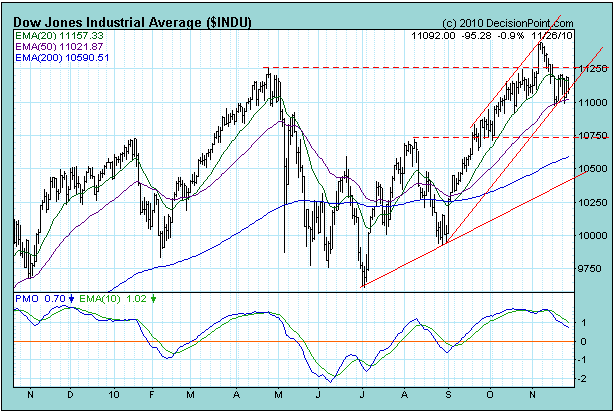
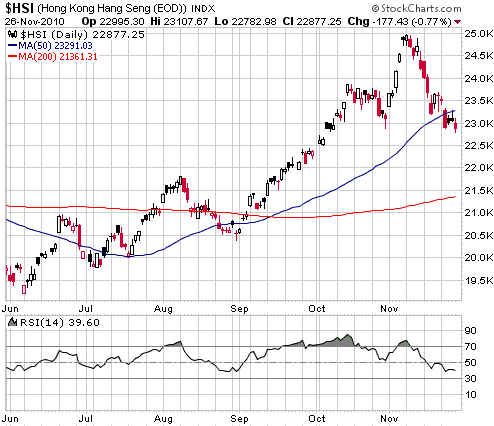
On a very short-term basis, the US stock market (represented on the
first of the following daily charts by the Dow Industrials Index) is in
quite a different position to the Hong Kong stock market (represented
on the second of the following daily charts by the Hang Seng Index -
HSI). Whereas the Dow is only just turning down from 'overbought' and
is therefore still a long way from being 'oversold' on even a
short-term basis, the HSI is now sufficiently 'oversold' to prompt a
1-2 week rebound. Also of consideration is that large moves generally
don't happen during December (according to Mike Burk, the best ever
December for the SPX was 2008 with a gain of 10.7% and the worst was
1931 with a loss of 13.4%).
With regard to the
intermediate-term outlook for equities, one of the most important
issues is the increasing social unrest in China stemming from rising
food prices. The specific example of this unrest discussed in the
article posted HERE
might seem trivial (high-school students vandalising the school canteen
to protest price hikes of only a few cents), but it is indicative of
burgeoning inflation-related tension throughout the country.
Furthermore, the article also notes that the prices of some vegetables
have experienced non-trivial increases of more than 60 percent this
year.
If food prices continue to rise then China's policy-makers will have no
choice other than to bring about tighter monetary conditions, which
would likely bring an end to China's property bubble and the upward
trends in cyclical markets such as equities and industrial commodities.
In fact, the upward trends may have already ended.
This week's
important US economic events
| Date |
Description |
Monday Nov 29
| No important events scheduled
| | Tuesday Nov 30 | Case-Shiller Home Price Index
Consumer Confidence
Chicago PMI
| | Wednesday Dec 01
| Q3 Productivity and Costs
ISM Index
Construction Spending
Motor Vehicle Sales
Fed's Beige Book
| | Thursday Dec 02
| Pending Home Sales Index
| | Friday Dec 03
| Monthly Employment Report
Factory Sales
ISM Non-Manufacturing Index
|
Gold and
the Dollar
Gold
The December gold futures contract has a confluence of support between
$1320 and $1350. Within this range there is lateral support defined by
the October and November pullback lows, support defined by the 50-day
moving average, and trend-line support that imaginative chart readers
could interpret as the "neckline" of a "head and shoulders" topping
pattern. If this support gives way then the price area just above the
June high ($1270) will become a likely near-term target.
We suspect that a correction low is either already in place or will be put in place over the next two weeks at around $1280.

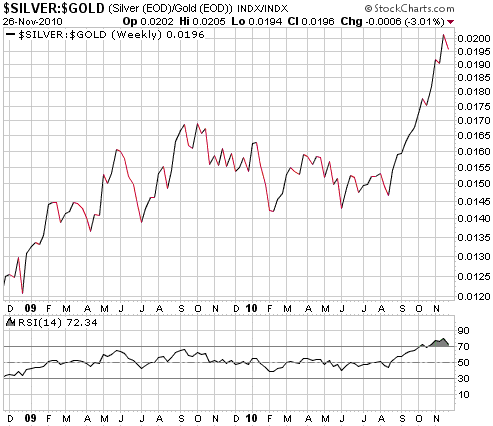
The most important
indicator continues to be the silver/gold ratio, a weekly chart of
which is presented below. The ratio fell 3% last week, which is the
largest weekly decline since the upward surge began in mid August. This
isn't enough to signal an intermediate-term reversal, but if the ratio
were to decline by 3% or more this week then we would be forced to
seriously consider -- and quite likely favour -- the possibility that
an intermediate-term peak is in place. Alternatively, if the ratio now
stabilises or resumes its advance then the odds will remain in favour
of the gold and silver rallies extending into early-2011. The reason is
that after the silver/gold ratio has embarked on the sort of
near-vertical advance that it has experienced over the past three
months, the first significant pullback on the weekly chart tends to
mark an important top.
So, at this stage it's the performance of gold relative to silver,
rather than the individual performances of gold and silver, that we are
most interested in.
Gold Stocks
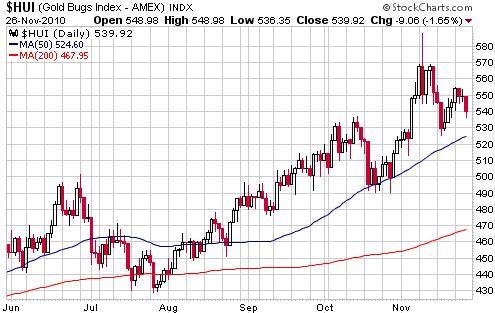
There's no evidence, yet, that the HUI's downward correction is over. A re-test of support in the 520s is likely.
As previously advised, a daily close above 570 would be a clear sign
that the correction was over and would suggest a short-term target of
650. However, scaling-in during pullbacks to support is a more sensible
approach than buying breakouts above obvious resistance.
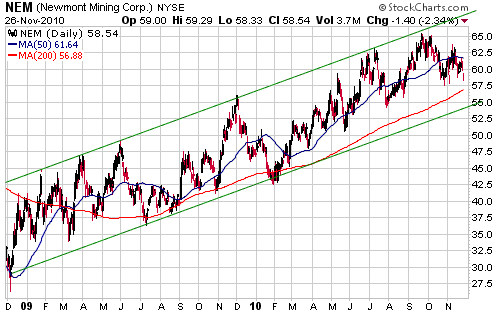
The following chart
shows that Newmont Mining (NEM), the world's premier large-cap gold
mining stock, has spent the past two years within an upward-sloping
channel. Every move to near the channel top has created a reasonable
short-term selling opportunity and every move to near the channel
bottom has created a good short-term buying opportunity. The last
decline to the channel bottom -- and the last really good buying
opportunity -- occurred 10 months ago.
At some point NEM will make a sustained break above the top or below
the bottom of this channel, but as things currently stand it would make
sense to view a decline to the channel bottom as a low-risk buying
opportunity. In other words, if you want increased exposure to
liquid/large-cap gold mining stocks then you should buy some NEM shares
if they drop back to around $56 within the next few weeks.
Currency Market Update
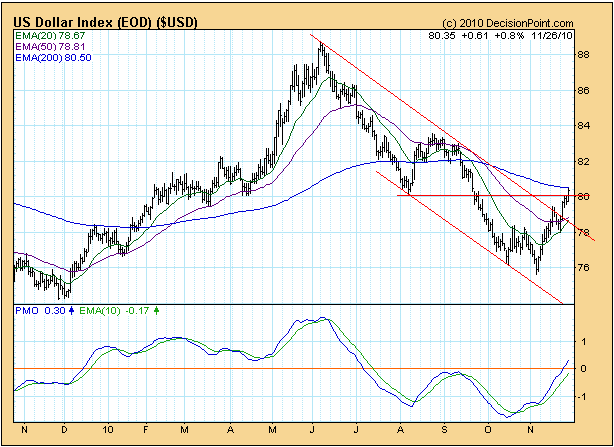
The following daily chart shows that the Dollar Index breached
intermediate-term lateral resistance at 80 last Friday. Resistance at
80 for the Dollar Index is equivalent to support at 1.33 for the euro,
which was also breached on Friday. Friday's market action therefore
provided additional evidence that intermediate-term extremes are in
place for the euro and the Dollar Index (a top for the euro, a bottom
for the US$).
Last week's evidence
that intermediate-term turning points likely occurred in early November
doesn't imply that the US$ will continue higher and the euro will
continue lower over the next few weeks. In fact, with the euro having
just fallen 10 points without a breather there's a good chance that a
counter-trend move will soon begin. A normal counter-trend move would
last 2-3 weeks and retrace 30%-50% of the preceding euro decline.
Whereas the euro and the Dollar Index have confirmed intermediate-term
reversals, the commodity currencies (the A$ and the C$) are yet to do
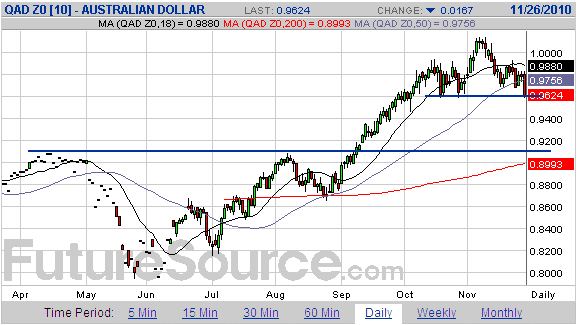
so. The December A$, for example, would have to break below support at
0.96 just to confirm a short-term trend reversal. As indicated by the
following daily chart, it ended last week right at this support, so any
additional weakness from here would signal a short-term trend change
and project a test of intermediate-term support at 0.91. A break below
0.91 would confirm an intermediate-term reversal.
The three main issues
affecting the currency market are Europe's government debt crisis, the
potential for the fragile up-trend in global growth to be derailed by
tighter monetary policy in China, and the Fed's attempts to devalue the
dollar. The first of these issues naturally puts downward pressure on
the euro against the US$, but doesn't have much effect on the commodity
currencies. The second issue puts downward pressure on the commodity
currencies against the US$, while the third issue puts downward
pressure on the US$ against all currencies. The third issue therefore
counteracts the other two, so the relative performances of the various
currencies during any multi-week period will largely be determined by
which of these issues the market happens to be focusing on at the time.
During September-October it was the Fed's inflation-promoting efforts,
but in early November the focus shifted to Europe's (primarily
Ireland's) debt problems and the possibility that global growth was
about to slow down.
Each of the aforementioned issues is bullish for gold, so gold is
capable of continuing its intermediate-term advance regardless of what
happens to foreign exchange rates.
Update
on Stock Selections
(Notes: 1) To review the complete list of current TSI stock selections, logon at http://www.speculative-investor.com/new/market_logon.asp
and then click on "Stock Selections" in the menu. When at the Stock
Selections page, click on a stock's symbol to bring-up an archive of
our comments on the stock in question. 2) The Small Stock Watch List is
located at http://www.speculative-investor.com/new/smallstockwatch.html)
Chart Sources
Charts appearing in today's commentary
are courtesy of:
http://stockcharts.com/index.html
http://www.futuresource.com/
http://www.decisionpoint.com/

|









