|
-- Weekly Market Update for the Week Commencing 30th January 2012
Big Picture
View
Here is a summary of our big picture
view of the markets. Note that our short-term views may differ from our
big picture view.
In nominal dollar terms, the BULL market in US Treasury Bonds
that began in the early 1980s will end by 2013. In real (gold)
terms, bonds commenced a secular BEAR market in 2001 that will continue
until 2014-2020. (Last
update: 23 January 2012)
The stock market, as represented by the S&P500 Index, commenced
a secular BEAR market during the first quarter of 2000, where "secular
bear market" is defined as a long-term downward trend in valuations
(P/E ratios, etc.) and gold-denominated prices. This secular trend will bottom sometime between 2014 and 2020. (Last update: 22 October 2007)
A secular BEAR market in the Dollar
began during the final quarter of 2000 and ended in July of 2008. This
secular bear market will be followed by a multi-year period of range
trading. (Last
update: 09 February 2009)
Gold commenced a
secular bull market relative to all fiat currencies, the CRB Index,
bonds and most stock market indices during 1999-2001. This secular trend will peak sometime between 2014 and 2020. (Last update: 22 October 2007)
Commodities,
as represented by the Continuous Commodity Index (CCI), commenced a
secular BULL market in 2001 in nominal dollar terms. The first major
upward leg in this bull market ended during the first half of 2008, but
a long-term peak won't occur until 2014-2020. In real (gold) terms,
commodities commenced a secular BEAR market in 2001 that will continue
until 2014-2020. (Last
update: 09 February 2009)
Copyright
Reminder
The commentaries that appear at TSI
may not be distributed, in full or in part, without our written permission.
In particular, please note that the posting of extracts from TSI commentaries
at other web sites or providing links to TSI commentaries at other web
sites (for example, at discussion boards) without our written permission
is prohibited.
We reserve the right to immediately
terminate the subscription of any TSI subscriber who distributes the TSI
commentaries without our written permission.
Outlook Summary
Market
|
Short-Term
(0-3 month)
|
Intermediate-Term
(3-12 month)
|
Long-Term
(1-5 Year)
|
| Gold
|
Bullish
(14-Dec-11)
|
Neutral
(24-Jan-11)
|
Bullish
|
| US$ (Dollar Index)
|
Neutral
(22-Nov-11)
| Neutral
(09-Jan-12)
|
Neutral
(19-Sep-07)
|
| Bonds (US T-Bond)
|
Neutral
(19-Sep-11)
|
Neutral
(18-Jan-12)
|
Bearish
|
| Stock Market (S&P500)
|
Bearish
(23-Jan-12)
|
Bearish
(28-Nov-11)
|
Bearish
|
| Gold Stocks
(HUI)
|
Bullish
(28-Dec-11)
|
Bullish
(23-Jun-10)
|
Bullish
|
| Oil | Neutral
(31-Jan-11) | Neutral
(31-Jan-11)
| Bullish
|
| Industrial Metals
(GYX)
| Neutral
(22-Nov-11)
| Neutral
(29-Aug-11)
| Neutral
(11-Jan-10)
|
Notes:
1. In those cases where we have been able to identify the commentary in
which the most recent outlook change occurred we've put the date of the
commentary below the current outlook.
2. "Neutral", in the above table, means that we either don't have a
firm opinion or that we think risk and reward are roughly in balance with respect to the timeframe in question.
3. Long-term views are determined almost completely by fundamentals,
intermediate-term views by giving an approximately equal weighting to
fundamental and technical factors, and short-term views almost
completely by technicals.
Oil (hedging the risk of a
Middle East conflagration)
In our 2012 Yearly Forecast, we wrote:
"This year's second biggest risk is that there will be much greater instability in the Middle East. We doubt that there will be open military conflict between Iran and the US or between Iran and Israel, but fear of such conflict could have a big effect on the markets. Also, the political situations in Egypt and Syria are likely to become more turbulent, and there is an outside -- but not insignificant -- chance that Saudi Arabia will get caught up in the 'revolutionary wave'.
The potential financial consequences of this risk could be mitigated via the purchase of long-dated oil call options. Ideally, the options would be accumulated during periods of weakness in the oil market."
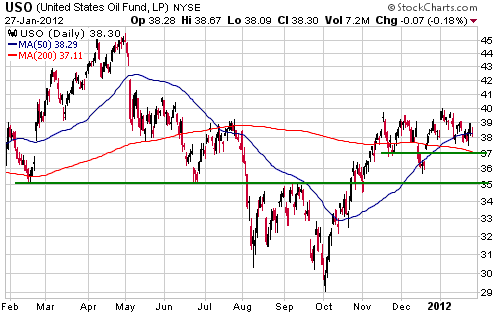
The following daily chart of the United States Oil Fund (NYSE: USO) shows that there has been a modicum of weakness in the oil market since the beginning of this year. Some additional weakness over the coming month would create a good opportunity to establish the above-mentioned oil-related hedge, via the purchase of USO $45-$50 call options that expire no earlier than January-2013.
We think that intermediate-term support at $35 defines USO's maximum short-term downside potential, which means that the optimum time to accumulate the call options would be when USO is trading in the low-$35 area. However, the price won't necessarily go that low. It could therefore make sense to start building the hedge position if/when USO drops to around $37.00.
By the way, the stocks of oil companies are generally not good hedges against conflict-induced moon-shots in the oil price, for two reasons. First, the average oil stock is positively correlated with the broad stock market and the broad stock market would almost certainly tank in response to such an event. Second, oil producers only gain a meaningful advantage from SUSTAINED gains in the oil price, and the financial markets would probably make the reasonable assumption that a rise in the oil price would prove to be temporary if it were caused by a Middle-East supply disruption.
The Stock
Market
The Secular Trend
The three best ways to view the secular stock market trend are via:
1. A long-term chart of the market's price/earnings ratio.
2. A long-term price chart with the price data adjusted for changes in money supply, productivity and population.
3. A long-term chart of the market's performance relative to gold.
One reason that these are effective methods of viewing the secular trend is that they remove changes in currency purchasing power from the picture. An alternative would be to look at a chart showing performance in nominal currency terms, but such a chart could be deceptive due to the real trend being masked by currency depreciation.
The US stock market's real trend was masked by currency depreciation from the mid-1960s through to the early-1980s. During this period, a large reduction in the US dollar's purchasing power transformed a major downward trend into a horizontal trading range. Something similar has happened over the past 12 years.
After we remove changes in the US dollar's purchasing power from the equation it not only becomes clear that the US stock market has been in a secular decline over the past 12 years, but also that the US stock market's most recent secular decline is unfolding in a similar way to the preceding episode (the secular bear market that lasted from the mid-1960s through to the early-1980s). The similarities are illustrated below via charts of the Dow/gold ratio.
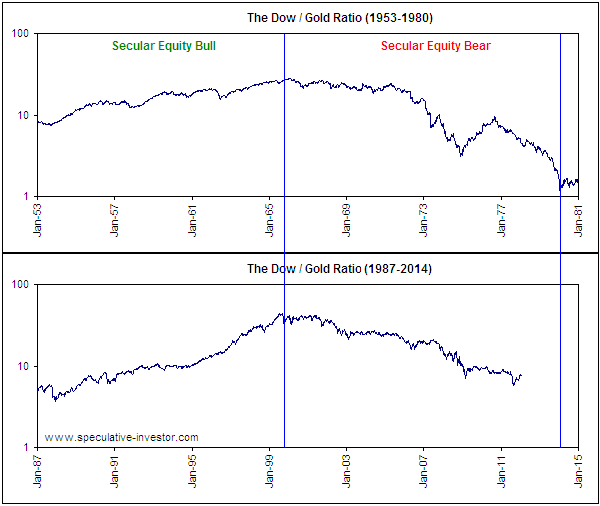
Considering the hugely different interest-rate backdrops and the other important differences between the past 12 years and the first 12 years of the previous secular decline, the Dow's similar performance in gold terms during the two periods is remarkable. We note, for instance, that the rate of decline has been roughly the same. There was greater volatility in the Dow/gold ratio during the 1970s than there has been over the past several years, but this is probably due to the gold price being fixed at an artificially low level up until 1971 and then making a rapid catch-up move.
If the duration of the current secular bear market turns out to be the same as the duration of the preceding one, then the Dow/gold ratio will reach its ultimate low during the first half of 2014. But whenever it occurs, the ultimate low will likely come at the end of an upside blow-off in the gold price.
Current Market Situation
The Dow Industrials Index fell over the course of last week, but it managed to rise by enough to test its May-2011 peak before pulling back.
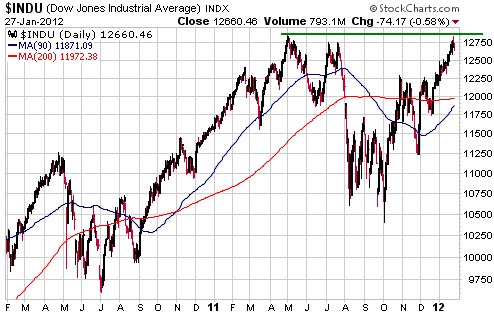
Aside from the fact that the Dow has now tested intermediate-term resistance defined by its May-2011 peak, there was no change in the US stock market's situation over the past week. It remains 'overbought' and at resistance, but it hasn't yet done anything to signal a top. Consequently, the following excerpt from the 23rd January Weekly Update still applies:
"Our guess is that if the market reverses downward immediately (within the next three days) without making much additional headway then we will get a 2-3 week correction followed by a rise to a new high for the year by March. The stage would then likely be set for an intermediate-term decline. Another plausible scenario is that the market will maintain its short-term upward bias for another couple of weeks, creating upside breakouts in the Dow Industrials and NASDAQ100 indices and allowing the S&P500 Index to test resistance at 1340-1370. This would set the scene for an intermediate-term decline.
Either way, the US stock market's short-term risk/reward now looks bearish to us."
This week's
important US economic events
| Date |
Description |
| Monday Jan 30 | Personal
Income and Spending
| | Tuesday Jan 31 | Employment
Cost Index
S&P Case-Shiller Home Price Index
Consumer Confidence
Chicago PMI
| | Wednesday Feb 01 | Motor
Vehicle Sales
ISM Manufacturing Index
Construction Spending | | Thursday
Feb 02 |
Q4 Productivity and Costs
|
| Friday Feb 03 | Monthly
Employment Report
Factory Orders
ISM Non-Manufacturing Index
|
Gold and
the Dollar
Gold
India to trade gold for Iran's oil?
A rumour has been doing the rounds that India is going to pay for Iranian oil using gold. The rumour was started by Debka.com.
It would be interesting and significant if oil exporters were starting to trade their oil for gold, but we are sceptical that the rumoured Iran-India gold-for-oil deal is true. One reason for our scepticism is the source of the rumour (we don't trust Debka.com). Also, it doesn't really make sense once you delve into the mechanics of such a trade.
There is a lot of gold in India, but India, the country, doesn't buy oil. The oil that is used in India is either bought by the Indian government or bought by private Indian companies. We can't imagine that large, private Indian companies would be keen to do deals with the Iranian government to swap gold for oil, so that leaves the Indian government.
The Indian government has a gold reserve of 615 tonnes, which at current market prices is the equivalent of about 300M barrels of oil. India's oil consumption amounts to about 3M barrels per day, so the Indian government has enough gold to meet the entire country's oil consumption needs for only a little more than three months. We don't know how far India's gold reserve would go if it only had to cover the oil consumption of the Indian government, but it seems unlikely that the Indian government would want to substantially reduce its gold reserve to obtain Iranian oil as long as it could easily obtain oil from elsewhere by paying US dollars.
There would also be logistical problems involved with India paying Iran in gold for a large quantity of oil, if we make the reasonable assumption that Iran would want to take delivery of physical gold.
Current Market Situation
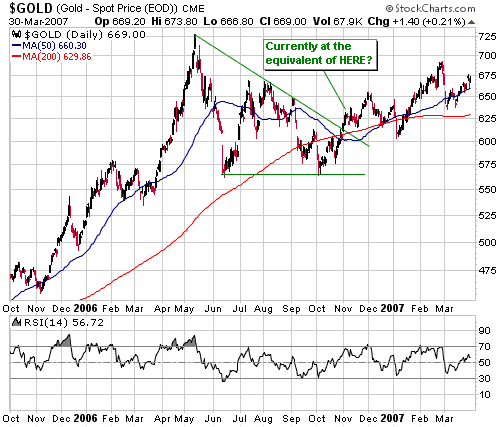
Due to the obvious similarities in the price action, over the past few months we have been comparing the gold market correction that began in August of last year with the gold market correction that occurred during 2006. As evidenced by the following two daily charts, the first of which shows the current situation and the second of which encompasses the 2006 correction, the similarities have persisted to this day.
If we take the comparison with the 2006 correction literally, there should be some consolidation during the first half of February followed by a rise to a new high for the year by early March. However, there is no good reason to assume that the price action will exactly follow the 2006 Model. There is some logic to the overall pattern of the recent correction and its aftermath having things in common with the 2006-2007 price action, but it is illogical to assume that all of the twists and turns of 2006-2007 will be duplicated over the months ahead.
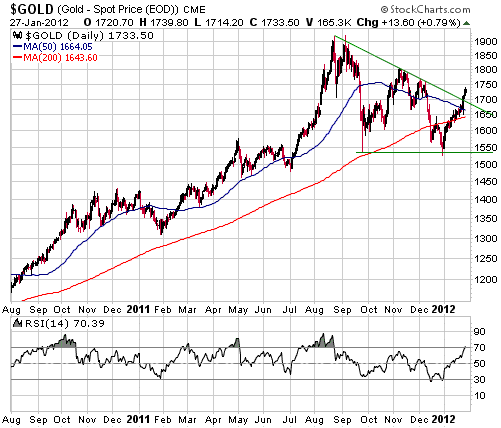
We aren't expecting gold to do much in US$ terms over the course of this year, but the risk that we aren't bullish enough is higher than the risk that we are too bullish. The risk of an upside surprise will increase as the bull market gets 'longer in the tooth', because the gold bull market is unlikely to end before there is a speculative surge of far greater proportions than anything we've seen to date.
In the short-term there still appears to be more upside than downside scope, primarily because the rally of the past few weeks doesn't appear to have generated much enthusiasm. The lack of enthusiasm means that there is still a large pool of disinterested spectators with the potential to be drawn into the market on the 'long' side. It could be argued that the disinterested spectators will end up being drawn into the market on the 'short' side, but that's not usually the way it works. Usually, when the price is rising and most traders are out of the market the price will continue to rise until many of these non-committed traders have been drawn into the market on the 'long' side.
Gold Stocks
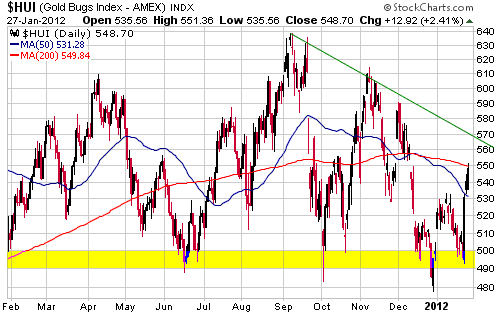
The following chart shows that the HUI rose by enough to reach its 200-day moving average late last week. It has trend-line resistance in the 560s.
The XAU clearly broke above its downward-sloping trend-line last week and ended the week marginally above its 200-day MA. The XAU has therefore gone further than the HUI towards confirming a correction low.
The gold-stock indices are not yet 'overbought', so we have no reason to anticipate anything more serious on the downside than a routine consolidation within a continuing short-term upward trend. For the HUI, support at around 530 stands a good chance of limiting any near-term pullback.
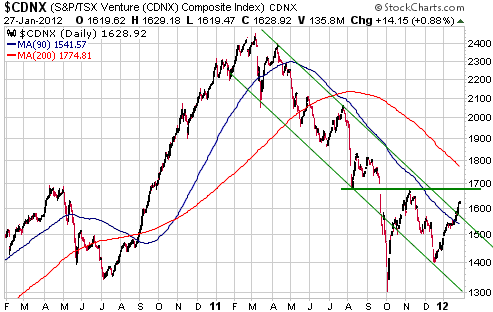
The evidence continues to mount that the CDNX, a proxy for junior resource stocks, has bottomed on an intermediate-term basis. As illustrated below, the CDNX has clearly broken above its 90-day moving average (the blue line on the chart) and the top of its downward-sloping channel. The only remaining obstacle of significance is the lateral resistance located just below 1700.
Currency Market Update
The ECB's "Long-Term Refinancing Operation" (LTRO), which involves pumping hundreds of billions of euros into commercial banks in exchange for securities of questionable value, appears to have worked in the only way that it could work: an immediate problem has been overcome at the cost of a much bigger problem later. In this case, "later" probably means 3-9 months from now.
Due largely to the ECB's money pumping, the news emanating from Europe has begun to have a more optimistic flavour. In particular, recent government bond auctions have been successful, the yields on Italian and Spanish government bonds have fallen sharply, and stock markets have been rebounding. Also, it seems that a deal will soon be reached between Greece's government and its private bondholders.
One of the issues that hasn't yet been 'put to bed' on even a temporary basis is the flight from Portuguese government bonds. The
yield on 10-year Portuguese government bonds
hit a new high of more than 15% on Friday, so if a Greece deal is soon finalised it will probably mean that Portugal's debt problem shifts to centre-stage.
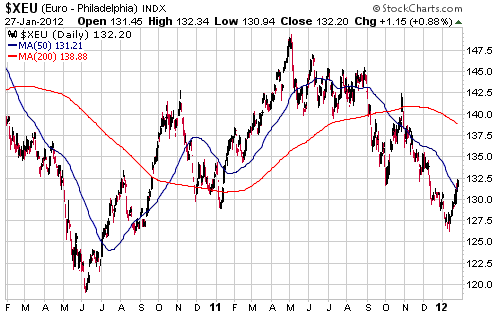
Blatant evidence of greater "inflation", or what politically-correct pundits refer to as "reflation", tends to be associated with short-term strength in the euro, even when the main reason for rising prices is an increase in the supply of euros. It is therefore not surprising that the recent euro rebound commenced shortly after the ECB began to inflate more aggressively. The rebound still doesn't look like much on the chart displayed below, but what we've seen to date is probably just the first phase of a multi-month correction. After all, as at last Tuesday (the date of the latest COT data) the huge speculative net-short position in euro futures hadn't even begun to shrink.
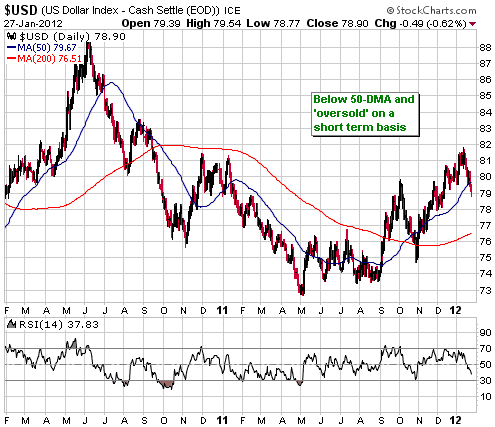
The euro's recent rebound has naturally coincided with a pullback in the Dollar Index. The dollar's downward correction probably won't end until after the stock market has clearly commenced its next intermediate-term decline, but by some measures the Dollar Index is now 'oversold' on a short-term basis. We therefore won't be surprised to see some US$ strength over the next couple of weeks.
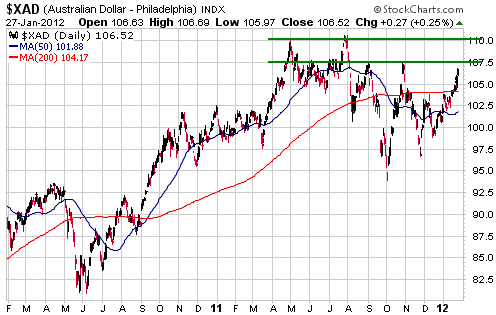
The Australian Dollar (A$) is extremely over-valued on a purchasing power parity basis and is gradually losing its interest rate advantage. It is holding up well, though, due to the recent global rebounds in equities and commodities. In fact, although it looks likely to pull back due to being 'overbought' on a short-term basis, the A$'s chart (see below) suggests significant upside potential. Specifically, the price action since the May-2011 peak could be interpreted as a "head and shoulders continuation pattern". The chart-based target following a break above resistance at 107.5-110.0 would be at least 120, but due to the A$'s current over-valuation and the likelihood that there won't be much additional strength in the equity and commodity markets we doubt that it will get anywhere near that high.
We are always 'long' the A$ due to our cash holdings and investments in Australia, but at times we hedge this long exposure via put options. Our A$ exposure is currently unhedged, but we will look for opportunities to add hedges over the next few months.
Update
on Stock Selections
Notes: 1) To review the complete list of current TSI stock selections, logon at
http://www.speculative-investor.com/new/market_logon.asp
and then click on "Stock Selections" in the menu. When at the Stock
Selections page, click on a stock's symbol to bring-up an archive of
our comments on the stock in question. 2) The Small Stock Watch List is
located at http://www.speculative-investor.com/new/smallstockwatch.html
 Keegan Resources (TSX: KGN, AMEX: KGN). Shares: 75M issued, 81M fully diluted. Recent price: US$4.26 Keegan Resources (TSX: KGN, AMEX: KGN). Shares: 75M issued, 81M fully diluted. Recent price: US$4.26
In our 16th January commentary we wrote that KGN was one of the best buys in the gold sector. The same comment still applies, because although KGN is now about 10% higher it has gained less than many other junior gold mining stocks. It remains under-valued on an absolute and relative basis.
Taking into account its.$200M cash hoard, KGN's advanced-stage high-quality gold resource at the Esaase project is currently being valued by the market at only $27/oz. Furthermore, the resource will get bigger as a result of a) the incorporation in the resource estimate of the previously discovered "E Zone", b) the conversion of Inferred resources to M&I resources via this year's planned infill drilling, and c) this year's planned step-out drilling.
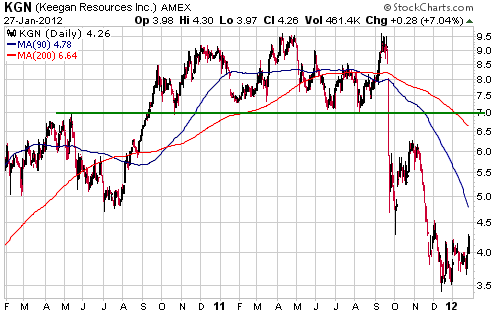
Turning to the chart displayed below, we see that KGN hasn't yet moved far from the 2-year low hit late last year. There is some resistance at US$4.50, but the most important resistance lies at $7.00. It's unlikely that the higher of the aforementioned resistance levels will be exceeded within the next 6 months in the absence of a major company-specific catalyst such as a takeover bid, but this still leaves a lot of scope for gains in the stock price.
Updates on short-term trades
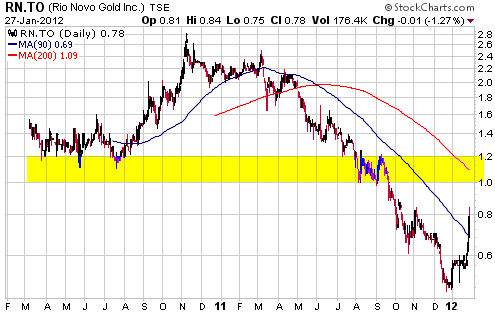
In mid December of last year we added Rio Novo Gold (TSX: RN) and Volta Resources (TSX: VTR) to the TSI Stocks List as short-term trading positions to reflect our view that there would be a strong Q1-2012 rebound at the junior end of the gold sector. These two stocks were chosen because they: a) had interesting projects with substantial defined gold resources, b) had lots of cash in the bank, c) were expected to have positive market-moving news during the first quarter, and d) were so 'oversold' that even a bear-market bounce could result in a large percentage gain.
The first of the following charts shows that RN has rebounded strongly from its December low. It is still well below resistance at C$1.00-C$1.20 (a good place to exit if reached over the next month or so), but it is no longer a candidate for new buying.
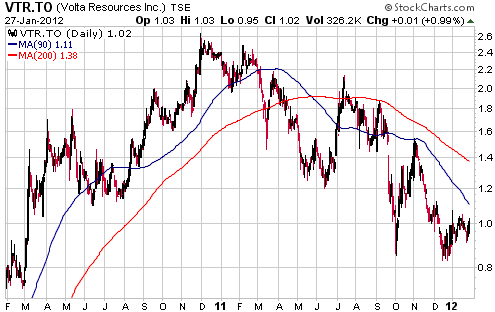
The second of the following charts shows that VTR hasn't yet rebounded far from last year's low. It is suitable for new buying near Friday's closing price of C$1.02.
A quick recap: VTR is developing the Kiaka project in Burkina Faso, West Africa. The project currently has a 4.3M-ounce gold resource, but a new resource estimate is scheduled to be complete in March along with a Pre-Feasibility Study
(PFS).
Andina Minerals (TSXV: ADM). Shares: 129M issued, 160M fully diluted. Recent price: C$0.88
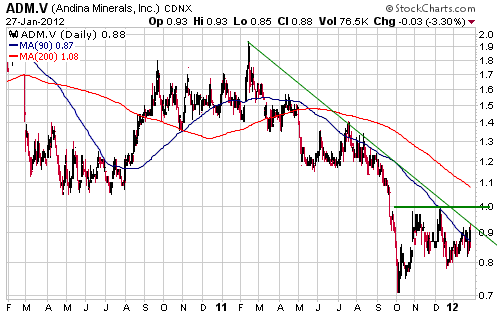
With sentiment beginning to turn positive at the junior end of the gold sector, ADM is worth revisiting. In terms of the value assigned by the market to in-ground gold resources, ADM is currently by far the cheapest stock in the TSI List (ADM's in-ground gold is being valued by the market at only $11/ounce).
Based on the very low value being put on its in-ground gold you'd be forgiven for concluding that ADM's Chile-based Volcan gold project was uneconomic at today's gold price, but this definitely isn't the case. As determined by the Pre-Feasibility Study (PFS) completed early last year, at a gold price of $1300/oz the Volcan project was estimated to have an after-tax NPV (5%) of around $860M. This equates to about $5.40 per fully diluted share. We doubt that the gold price will ever again trade below $1500/oz, so a long-term gold price assumption of $1300/oz is conservative.
There could be a resource update this quarter, but the next news of real significance will be the completion of the Feasibility Study that is currently scheduled for Q2-2012.
The chart (see below) suggests that ADM bottomed last October and is now in the process of completing a basing pattern. A break above C$1.00 would create a short-term chart-based target of C$1.20-C$1.30.
Dragon Mining (ASX: DRA). Shares: 74M issued, 75M fully diluted. Recent price: A$1.23
DRA is a 60K-oz/year gold producer listed in Australia with mines in Finland and Sweden. It hasn't participated in the recent gold-sector rally and has been in consolidation mode for about 16 months.
Of the Australian gold stocks we follow, DRA looks like the best buy at this time.
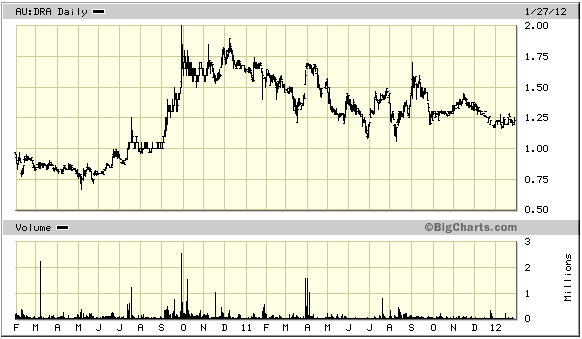
Chart Sources
Charts appearing in today's commentary
are courtesy of:
http://stockcharts.com/index.html
http://bigcharts.marketwatch.com/

|









