|
-- Weekly Market Update for the Week Commencing 30th April 2012
Big Picture
View
Here is a summary of our big picture
view of the markets. Note that our short-term views may differ from our
big picture view.
In nominal dollar terms, the BULL market in US Treasury Bonds
that began in the early 1980s will end by 2013. In real (gold)
terms, bonds commenced a secular BEAR market in 2001 that will continue
until 2014-2020. (Last
update: 23 January 2012)
The stock market, as represented by the S&P500 Index, commenced
a secular BEAR market during the first quarter of 2000, where "secular
bear market" is defined as a long-term downward trend in valuations
(P/E ratios, etc.) and gold-denominated prices. This secular trend will bottom sometime between 2014 and 2020. (Last update: 22 October 2007)
A secular BEAR market in the Dollar
began during the final quarter of 2000 and ended in July of 2008. This
secular bear market will be followed by a multi-year period of range
trading. (Last
update: 09 February 2009)
Gold commenced a
secular bull market relative to all fiat currencies, the CRB Index,
bonds and most stock market indices during 1999-2001. This secular trend will peak sometime between 2014 and 2020. (Last update: 22 October 2007)
Commodities,
as represented by the Continuous Commodity Index (CCI), commenced a
secular BULL market in 2001 in nominal dollar terms. The first major
upward leg in this bull market ended during the first half of 2008, but
a long-term peak won't occur until 2014-2020. In real (gold) terms,
commodities commenced a secular BEAR market in 2001 that will continue
until 2014-2020. (Last
update: 09 February 2009)
Copyright
Reminder
The commentaries that appear at TSI
may not be distributed, in full or in part, without our written permission.
In particular, please note that the posting of extracts from TSI commentaries
at other web sites or providing links to TSI commentaries at other web
sites (for example, at discussion boards) without our written permission
is prohibited.
We reserve the right to immediately
terminate the subscription of any TSI subscriber who distributes the TSI
commentaries without our written permission.
Outlook Summary
Market
|
Short-Term
(0-3 month)
|
Intermediate-Term
(3-12 month)
|
Long-Term
(1-5 Year)
|
| Gold
|
Bullish
(26-Mar-12)
|
Bullish
(26-Mar-12)
|
Bullish
|
| US$ (Dollar Index)
|
Neutral
(22-Nov-11)
| Neutral
(09-Jan-12)
|
Neutral
(19-Sep-07)
|
| Bonds (US T-Bond)
|
Neutral
(11-Apr-12)
|
Neutral
(18-Jan-12)
|
Bearish
|
| Stock Market
(DJW)
|
Neutral
(25-Apr-12)
|
Bearish
(28-Nov-11)
|
Bearish
|
| Gold Stocks
(HUI)
|
Bullish
(26-Mar-12)
|
Bullish
(23-Jun-10)
|
Bullish
|
| Oil | Neutral
(31-Jan-11) | Neutral
(31-Jan-11)
| Bullish
|
| Industrial Metals
(GYX)
| Neutral
(22-Nov-11)
| Neutral
(29-Aug-11)
| Neutral
(11-Jan-10)
|
Notes:
1. In those cases where we have been able to identify the commentary in
which the most recent outlook change occurred we've put the date of the
commentary below the current outlook.
2. "Neutral", in the above table, means that we either don't have a
firm opinion or that we think risk and reward are roughly in balance with respect to the timeframe in question.
3. Long-term views are determined almost completely by fundamentals,
intermediate-term views by giving an approximately equal weighting to
fundamental and technical factors, and short-term views almost
completely by technicals.
Can an economy prosper
through currency devaluation?
Many policymakers believe that their country's economy would benefit from a fall in the foreign exchange value of its currency. The line of thinking goes something like this: "A fall in the value of our currency relative to the currencies of our trading partners will make our manufacturers more competitive on the world stage, thus allowing us to have a more positive trade balance, stronger economic growth and a generally higher level of employment." The only problem with this line of thinking is that it is completely wrong.
The first of two keys to knowing why devaluing the currency won't achieve the intended result -- assuming that the intended result is a stronger economy -- is to understand that a sustained reduction in a currency's foreign exchange value can only happen via a comparatively high rate of monetary inflation. The second key is to fully understand how monetary inflation affects the economy.
With regard to the first key, exchange rates fluctuate for many reasons, but long-term trends in exchange rates are determined by changes in relative purchasing power. Provided that the economies in question are reasonably open to international trade it must be this way, otherwise a permanent zero-risk arbitrage opportunity would develop (and zero-risk arbitrage opportunities are never permanent). So, a sustained reduction in a currency's exchange rate must be linked to a relative decline in its purchasing power, which generally requires a relatively large increase in its supply.
Once you understand that bringing about a sustained reduction in a currency's foreign exchange rate necessitates reducing its purchasing power relative to the purchasing powers of other currencies, you should immediately get an inkling as to why currency devaluation can't make an economy more competitive. The fact is that any international trade advantage achieved via the lowering of the exchange rate will be offset by a domestic price increase. Taking a hypothetical example, widgets manufactured in Country XYZ that were priced at $100 prior to a 20% devaluation of XYZ's dollar would be priced at $120 after the devaluation. From the perspective of another country with a stable currency nothing appears to have changed, because the increase in the local price in Country XYZ is offset by the reduction in the XYZ dollar's exchange rate. From the perspective of Country XYZ there is also no change from an international trading perspective, because the prices of imported goods will still be the same relative to local prices. It's just that all prices within Country XYZ will now be 20% higher.
The above example is fine for illustrative purposes, but it is overly simple. In this example the competitiveness of the devaluing country's industries are neither helped nor harmed by the devaluation. In the real world, however, increasing the supply of a currency in order to devalue that currency will not result in a consistent change in prices throughout the economy. Instead, prices will change in a non-uniform and largely unpredictable way, causing damage to some sectors of the economy, conferring short-term benefits to other sectors, and making the economy as a whole less efficient due to the distorting of price signals. Consequently, a country that tries to become more competitive via currency devaluation will actually become less so in response to the measures that must be taken to bring about a sustained reduction in the foreign exchange rate. And the more the country devalues, the less competitive it will ultimately become.
In economics it is never possible to prove or disprove anything with data, but if the theory is good then the data should generally be consistent with the theory. When we compare the OECD's labour cost data for Germany and the US we find consistency with the logic outlined above. Of particular relevance, we find that over the past 10 years there has been a lot less monetary inflation and price inflation in Germany than in the US, and that over this period the German labour cost has fallen by about 20% relative to the US labour cost despite a 30% increase in the euro relative to the US$. And yet, many economists would have us believe that what the US needs to improve its competitiveness is more inflation and a weaker dollar. The reality is that the US needs more inflation like a wooden house needs more termites.
When it comes to policy-making, what should happen and what will happen are often very different. Currency devaluation is the last thing an economy needs to become stronger and more competitive, but currency devaluation remains one of the policy-making clique's favourite ways of responding to economic weakness and declining competitiveness.
Economic Numbers
During a typical month the only US economic numbers to which we give more than a cursory glance are the monthly employment statistics and ISM Index. The Employment Report is a lagging indicator and is based on assumptions -- the business birth/death adjustment, for example -- that are often wrong, but of all the regular economic reports it is the most politically sensitive and tends to provoke the biggest market reaction. The ISM Index is a coincident indicator that provides a realistic snapshot of how the US manufacturing sector is faring. It will usually signal an economic recession while the recession is still young.
This week we get to see the April ISM Index on Tuesday and the April Employment Report on Friday. There is a decent chance that one or both of these sets of numbers will be much weaker than anticipated by the markets, thus denting the optimism that has buoyed the US stock market over the past several months. The financial markets will probably pay more attention to the employment numbers than the ISM numbers, but we will be more interested in the ISM numbers because they are the more accurate real-time indicators of what's happening.
One reason to suspect that the US ISM numbers could be about to make a decisive turn for the worse is that Purchasing Management Indices (PMIs) have recently plunged throughout Europe. We note, for example, that the April-2012 PMI for the European Union (EU) came in at 47.4 (below 50 signals contraction). 12 months ago it was 57.8. Considering that the EU contains some 'basket cases', the significance of the EU PMI could be downplayed if not for the fact that Germany's manufacturing sector is also struggling. The April-2012 PMI for Germany was only 46.3. A year ago it was 62.
The Stock
Market
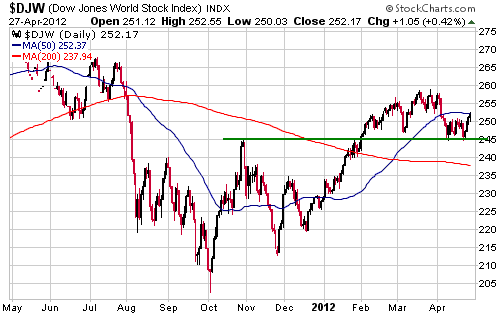
At this stage there is no evidence in the price action that either the Dow Jones World Index (DJW) or the S&P500 Index (SPX) have made intermediate-term peaks. Our guess is that six months from now both of these stock indices will be trading a long way below their current levels, but we won't be surprised to see them make new highs for the year before they roll over into intermediate-term declines.
The DJW has been weaker than the SPX and fell to support defined by its October-2011 peak during the downturn of the past month, but the support appears to have held for now despite the almost-constant stream of bad news emanating from Europe.
The SPX didn't come close to important lateral support during its April correction and has already moved back to within spitting distance of its peak.
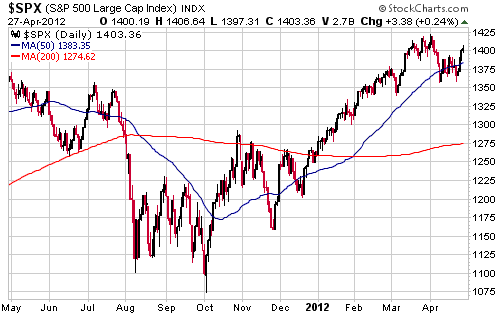
The US stock market is presently in fantasyland. There is an undercurrent of hope that there will soon be another round of QE, but at the same time it is widely believed that the economy is in reasonable shape and is set to improve over the quarters ahead. These hopes/beliefs are contradictory, because in order to get more QE there will first have to be serious weakness in the stock market and blatant evidence of an economic recession. Also, the overall market was given a hefty boost last week by the excellent financial results reported by Apple (AAPL), but Apple's results are only good news for Apple. They imply nothing about corporate profitability in general. During the final quarter of last year, for example, Apple achieved spectacular earnings growth while the rest of the companies in the S&P500 Index collectively achieved almost no growth.
At some point over the next few months the US stock market will probably be jolted out of its fantasy world and into the real world where contradictory opinions can't happily coexist. It's possible that an initial jolt will be provided this week by the ISM and/or employment numbers.
This week's
important US economic events
| Date |
Description |
| Monday Apr 30 | Chicago
PMI
Personal Income and Spending
Dallas Fed Manufacturing Survey
| | Tuesday May 01 | ISM
Manufacturing Index
Construction Spending
Motor Vehicle Sales
| | Wednesday May 02 | Factory
Orders | | Thursday
May 03 |
Q1 Productivity and Costs
ISM Non-Manufacturing Index
|
| Friday May 04 | Monthly
Employment Report
|
Gold and
the Dollar
Gold
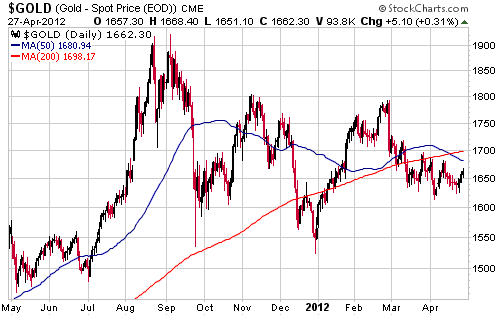
Since the second week of March, gold has oscillated within a narrow range and essentially gone nowhere. An end to the 'corrective' activity hasn't been signaled, but sentiment is sufficiently depressed to enable a $100-$200 rally. At the same time the depressed sentiment helps to limit the downside potential.
We continue to think that there is short-term downside risk to $1550-$1600, but the probability that this support range will be tested is lower today than it was two weeks ago.
Gold Stocks
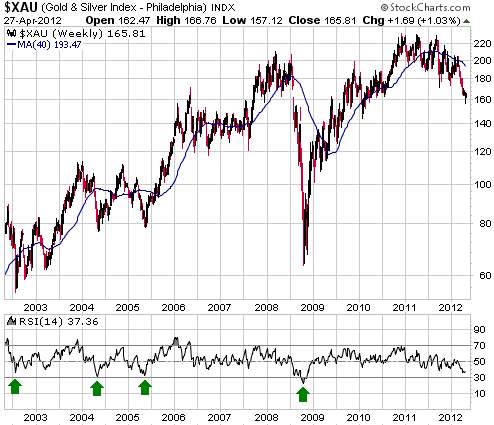
Displayed below is a weekly chart showing how the XAU has performed over the past 10 years. The weekly RSI(14), an intermediate-term momentum indicator, is shown at the bottom of the chart. The weekly RSI suggests that the XAU is presently as 'oversold' as it was at the July-2002 bottom, slightly less 'oversold' than it was at the May-2004 and May-2005 bottoms, and much less 'oversold' than it was at the October-2008 bottom. The probability of a 2008-style decline occurring within the next few months is almost zero, so the most relevant comparisons are with the 2002, 2004 and 2005 bottoms.
The next chart is the same, except that it zooms in on the past two years. This chart clearly shows last week's upward reversal.
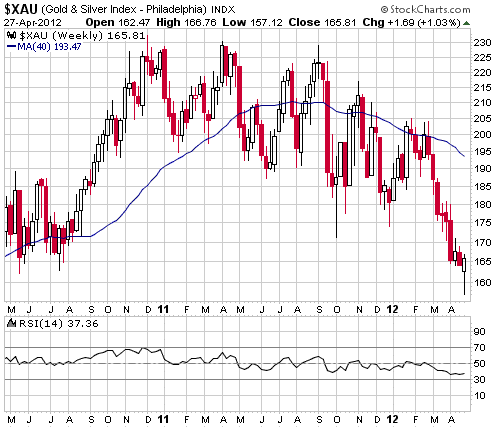
There's no way of knowing if last week's reversal marked the end of the decline. It probably did, bit we can't rule out a drop to a new low during the first half of May.
We don't know whether or not an important low has just been put in place, but we are confident that this is a good time to be accumulating gold mining stocks. The senior gold mining stocks are priced very lowly relative to gold bullion, and the junior gold mining stocks are, on average, priced very lowly relative to the seniors. This means that the best opportunities for gains lie within the ranks of the juniors, although it should be understood that the smallest stocks often don't do much in the early stages of sector-wide upward trends. If you want exposure to junior gold miners and you feel the need to own something that will immediately participate in a gold sector rally, then GDXJ is a reasonable choice.
Currency Market Update
The Dollar Index has been edging its way lower since early April. At the end of last week it was slightly 'oversold' (on a short-term basis) and at minor support. More significant support lies about half a point lower.
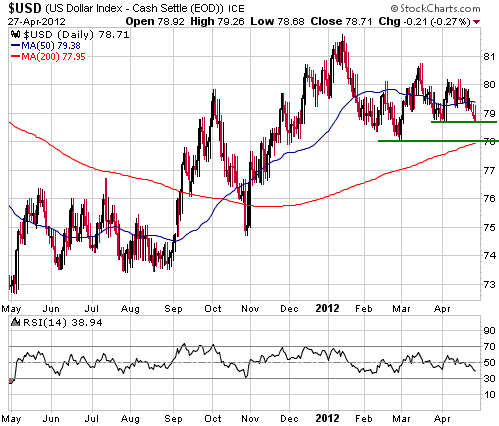
For all intents and purposes, the Dollar Index is the inverse of the euro. As the euro continues its rebound in response to the covering of the huge speculative short position in euro futures, the Dollar Index is likely to work its way lower. However, we don't perceive a lot of downside risk in the Dollar Index.
The Yen is now in an interesting position. It moved far enough below its 70-week moving average (the blue line on the following chart) during the first quarter of this year to signal the start of a downward trend that would probably -- based on past performance -- last two years or more, but at the same time it became sufficiently 'oversold' to set the stage for a multi-week counter-trend rebound. The Yen's history following decisive breaks below the 70-week MA suggests that a rebound peak is now close and that the next downward leg will soon begin.
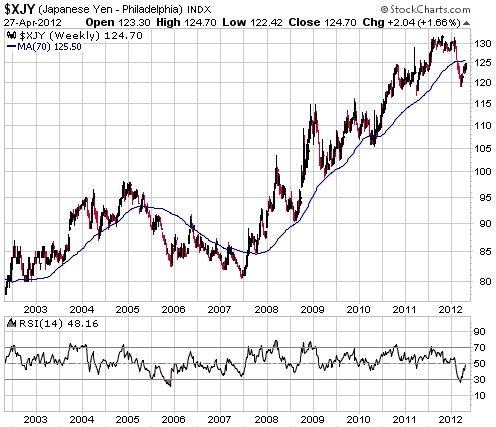
Another downward leg in the Yen should lead to strength in Japan's stock market. In US$ terms, the gains achieved by Japan's stock market will be offset by the decline in the Yen/USD exchange rate, but as was the case during the first quarter of this year the percentage rise in the stock market could be materially greater than the percentage decline in the Yen. It could therefore make sense to 'go long' the Japanese stock market within the next couple of weeks, especially if the Nikkei drops back to around 9100.
Update
on Stock Selections
Notes: 1) To review the complete list of current TSI stock selections, logon at
http://www.speculative-investor.com/new/market_logon.asp
and then click on "Stock Selections" in the menu. When at the Stock
Selections page, click on a stock's symbol to bring-up an archive of
our comments on the stock in question. 2) The Small Stock Watch List is
located at http://www.speculative-investor.com/new/smallstockwatch.html
 Sabina Gold and Silver (TSX: SBB). Shares: 161M issued, 170M fully diluted. Recent price: C$2.74 Sabina Gold and Silver (TSX: SBB). Shares: 161M issued, 170M fully diluted. Recent price: C$2.74
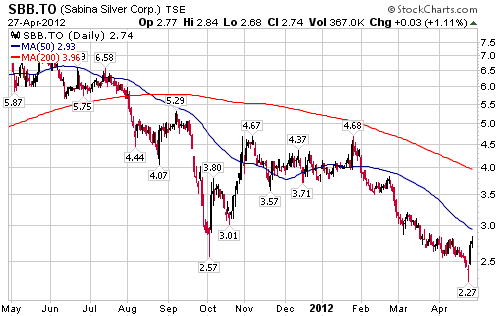
SBB's stock market performance has been very weak since late January. Some of this weakness was due to the sector-wide decline in prices, but some of it was company-specific. The company-specific portion was associated with concerns about the high cost of mining in Canada's north, which stemmed from the write-downs of Newmont's Hope Bay project and Agnico Eagle's Meadowbank project.
It is possible that the above-mentioned concerns will be partly allayed by the Preliminary Economic Assessment (PEA) for SBB's Back River project. The PEA was previously scheduled to be complete in April, but late-May is now the estimated completion time. There is, of course, a risk that the PEA will confirm rather than allay the market's fears, but considering the grade, size and 'open-pit-able' nature of the project we will be surprised if the PEA doesn't show robust economics.
SBB reversed upward last week after trading as low as C$2.27 on Wednesday. The reversal was helped along by some very good drilling results. A bottom is probably now in place, but note that it would be normal for the initial rebound from the low to be partially retraced.
On the plus side of the ledger, near current prices SBB is one of the best value propositions in the gold sector. Secondly, continued exploration of the Back River project will almost certainly produce more good drilling results over the months ahead, leading to another sizeable upgrade to the overall project resource. Thirdly, the upcoming PEA will most likely be positive.
On the minus side of the ledger, uncertainty about Xstrata/Glencore's plans for the Hackett River project will continue to result in the market applying a large discount to SBB's Hackett River royalty. Secondly, it appears that Dundee Corporation is still in the process of reducing its large stake in SBB. Thirdly, even if the PEA is positive there will be legitimate concerns about the risks involved in building and operating a mine in the far north.
Weighing the pluses and the minuses, we strongly believe that SBB is a good speculation at this time.
Call Option Speculations
We have indirect interests in Agnico Eagle (AEM) and Kinross Gold (KGC) via long-dated call options.
In the 18th April Interim Update, we wrote:
"AEM's chart currently has the look of a bottoming pattern, with an intermediate-term low in mid February and a successful test of the low in early April. Consecutive daily closes above $35 would shorten the odds that the stock had bottomed on an intermediate-term basis."
As illustrated below, AEM left $35 'in the dust' last week and zoomed straight to resistance at $40.
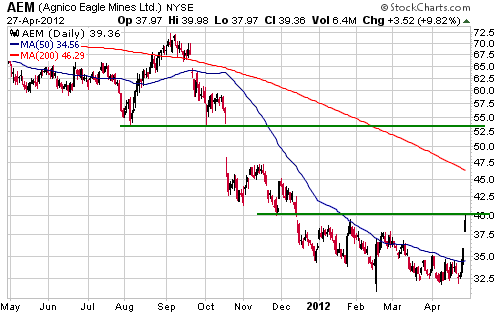
A bottom is almost certainly in place for AEM. This is not just because of the recent price action, but also because of the news that caused the stock price to 'pop' 10% last Friday. We are referring to the news that after the major disappointments of the past 7 months, AEM's gold-production business is now performing well.
There's a good chance that last week's surge will be partially retraced.
In the 18th April Interim Update, we also wrote:
"KGC's chart doesn't contain any evidence that a bottom is in place. It is simply a picture of a stock that has been sold...and sold...and sold. In its favour is a valuation that is low even relative to the low valuations of most other large and mid-tier gold producers. Its relatively low valuation should allow KGC to spring back after the gold-stock indices reverse upward."
KGC remains cheap and very 'oversold'. Also, the chart still contains no evidence that a bottom is in place.
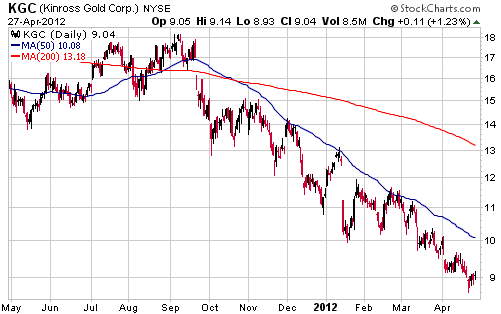
Chart Sources
Charts appearing in today's commentary
are courtesy of:
http://stockcharts.com/index.html

|









