|
-- Weekly Market Update for the Week Commencing 30th May 2011
Big Picture
View
Here is a summary of our big picture
view of the markets. Note that our short-term views may differ from our
big picture view.
In nominal dollar terms, the BULL market in US Treasury Bonds
that began in the early 1980s ended in December of 2008. In real (gold)
terms, bonds commenced a secular BEAR market in 2001 that will continue
until 2014-2020. (Last
update: 4 April 2011)
The stock market, as represented by the S&P500 Index, commenced
a secular BEAR market during the first quarter of 2000, where "secular
bear market" is defined as a long-term downward trend in valuations
(P/E ratios, etc.) and gold-denominated prices. This secular trend will bottom sometime between 2014 and 2020. (Last update: 22 October 2007)
A secular BEAR market in the Dollar
began during the final quarter of 2000 and ended in July of 2008. This
secular bear market will be followed by a multi-year period of range
trading. (Last
update: 09 February 2009)
Gold commenced a
secular bull market relative to all fiat currencies, the CRB Index,
bonds and most stock market indices during 1999-2001. This secular trend will peak sometime between 2014 and 2020. (Last update: 22 October 2007)
Commodities,
as represented by the Continuous Commodity Index (CCI), commenced a
secular BULL market in 2001 in nominal dollar terms. The first major
upward leg in this bull market ended during the first half of 2008, but
a long-term peak won't occur until 2014-2020. In real (gold) terms,
commodities commenced a secular BEAR market in 2001 that will continue
until 2014-2020. (Last
update: 09 February 2009)
Copyright
Reminder
The commentaries that appear at TSI
may not be distributed, in full or in part, without our written permission.
In particular, please note that the posting of extracts from TSI commentaries
at other web sites or providing links to TSI commentaries at other web
sites (for example, at discussion boards) without our written permission
is prohibited.
We reserve the right to immediately
terminate the subscription of any TSI subscriber who distributes the TSI
commentaries without our written permission.
Outlook Summary
Market
|
Short-Term
(0-3 month)
|
Intermediate-Term
(3-12 month)
|
Long-Term
(1-5 Year)
|
Gold
|
Neutral
(19-Apr-11)
|
Neutral
(24-Jan-11)
|
Bullish
|
US$ (Dollar Index)
|
Neutral
(07-Mar-11)
| Bullish
(02-May-11)
|
Neutral
(19-Sep-07)
|
Bonds (US T-Bond)
|
Neutral
(20-Sep-10)
|
Bearish
(21-Mar-11)
|
Bearish
|
Stock Market (S&P500)
|
Bearish
(09-May-11)
|
Bearish
(11-Oct-10)
|
Bearish
|
Gold Stocks (HUI)
|
Neutral
(24-Apr-11)
|
Bullish
(23-Jun-10)
|
Bullish
|
| Oil | Neutral
(31-Jan-11)
| Neutral
(31-Jan-11)
| Bullish
|
Industrial Metals (GYX)
| Bearish
(03-Jan-11)
| Bearish
(25-May-09)
| Neutral
(11-Jan-10)
|
Notes:
1. In those cases where we have been able to identify the commentary in
which the most recent outlook change occurred we've put the date of the
commentary below the current outlook.
2. "Neutral", in the above table, means that we either don't have a
firm opinion or that we think risk and reward are roughly in balance with respect to the timeframe in question.
3. Long-term views are determined almost completely by fundamentals,
intermediate-term views by giving an approximately equal weighting to
fundamental and technical factors, and short-term views almost
completely by technicals.
Will private banks take over where the Fed leaves off?
For the purpose of this
discussion, let's assume that the Fed ends its current QE program as
scheduled within the next few weeks. This means that we will soon reach
the point where the Fed is no longer directly ramping up the money
supply*. However, the private banking industry in the US has around
$1.5 trillion in excess reserves (the banks are collectively holding
1.5 trillion more dollars in reserve than they need to 'back up' the
dollars in demand deposits), which means that the private banks
theoretically have enough reserves to grow the US money supply by many
trillions of dollars without any further assistance from the Fed. The
question is: will they do it?
The short answer is: probably not. The huge volume of "excess" bank
reserves constitutes an inflation risk, but it's a risk that probably
won't materialise during the next 12 months. Instead, it's likely that
the private banks will continue to do what they have been doing over
the past 2.5 years and what they did throughout the 1930s, which is
'sit' on their excess reserves. Now for the longer answer.
The risk, or the opportunity if you think that more money creation out
of thin air is just what the US economy needs, is that the commercial
banks will attempt to generate greater profits by putting their excess
reserves to work. These reserves presently generate only 0.25%/year of interest income,
so it should certainly be possible for the banks to earn a better
return by making loans to credit-worthy borrowers. However, government
statistics tell us that the US economy has now been in recovery mode
for about two years, and yet the bottom section of the following chart
tells us that the year-over-year (YOY) percentage change in "Total
Loans and Leases in Bank Credit at Commercial Banks" has spent the bulk
of this 'recovery' in negative territory and recently moved back into
negative territory after turning positive for a few months. This
prompts the question: If the banks didn't use their "excess reserves"
to support additional lending during the statistical recovery of the
past two years, then why should they start to ramp up their lending now
that the statistical recovery has pretty much run its course?
Perhaps our economic outlook is too pessimistic and a period of much
stronger growth lies immediately ahead, in which case conditions could
soon become more conducive to bank lending. We doubt it, though. It
looks, to us, like the economic rebound from the 2007-2009 collapse has
seen its best days and that the banking trend is towards less, not
more, lending.
Now, even when banks aren't expanding their loan books they can still
increase the economy-wide supply of money by monetising securities such
as Treasury bonds. The middle section of the following chart
("Investment Securities in Bank Credit at Commercial Banks") shows that
this has, in fact, been happening to a significant degree since early
2009. Rather than making new loans, commercial banks have been
generating profits by using the money they create out of nothing to
purchase interest-bearing securities such as the debt securities issued
by the US government.
The monetisation of debt securities by the commercial banks partly
offset the deflationary effect of the post-financial-crisis contraction
in the banking industry's collective loan book, but the YOY percentage
change in overall bank credit (refer to the top section of the
following chart) tells us that it wasn't sufficient to enable the
private banking industry to have a net inflationary effect. Note, as
well, that the current trend in overall bank credit is downward.
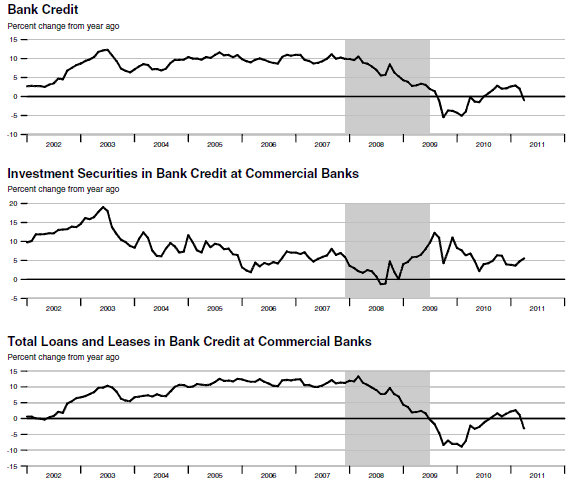
Chart Source: The Federal Reserve's monthly Monetary Trends newsletter
The fact that banks
haven't done more with their "excess reserves" up until now suggests
that they are being prevented from doing so by a reduction in the
private sector's desire to take on debt, or by financial constraints
such as large, but as yet unreported, holes in their balance sheets**.
We suspect that it's a combination of the two.
The bottom line is that there will most likely not be a substantial
expansion of US commercial bank credit over the next several months,
especially if we are right to assume that the economic rebound has seen
its best days. This means that if the Fed stops its "quantitative
easing" in June then the US monetary inflation rate will soon begin to
trend downward. Unfortunately, this doesn't mean that there is a
realistic chance of the US experiencing deflation.
Since the inauguration of the TSI web site more than 10 years ago we've
maintained that when the secular expansion in private sector
indebtedness ended, as it inevitably would at some point, the
government and the central bank would do whatever had to be done to
keep the money supply growing. Until 2008 this was a theory based only
on logic, but it is now a theory supported by both logic and empirical
evidence. This is because the secular expansion in private sector
indebtedness ended in 2008 (or, at least, it appears to have ended),
and yet the Fed-Treasury team has managed to grow the total supply of
US dollars by about 40% since August of 2008.
There is almost no chance of deflation, because if the commercial banks
don't take over where the Fed 'leaves off' (as we expect) then the
stock market will begin to trend downward and this will prompt the Fed
to embark on a new round of QE. The sad truth is that under the current
monetary system there is no limit to the amount of new money that can
be created by the Fed, so the inflation will continue as long as the
Fed's masters in government and banking desire more inflation.
*Despite the
assertions of some analysts to the contrary, "QE", as practiced by the
US Federal Reserve, most definitely adds to the total supply of money
within the economy, as opposed to just adding to bank reserves (bank
reserves are not counted in the money supply). This is because QE
results in the creation of new bank deposits as well as new bank
reserves.
**There are probably large holes in bank balance sheets associated with
foreclosed residential properties. According to a NYT article
on 22nd May, the biggest banks and mortgage lenders in the US "own more
than 872,000 homes as a result of the groundswell in foreclosures,
almost twice as many as when the financial crisis began in 2007,
according to RealtyTrac, a real estate data provider. In addition, they
are in the process of foreclosing on an additional one million homes
and are poised to take possession of several million more in the years
ahead." It's a good bet that the foreclosed houses that are assets on
bank balance sheets have not been marked to market.
Uranium Update
The
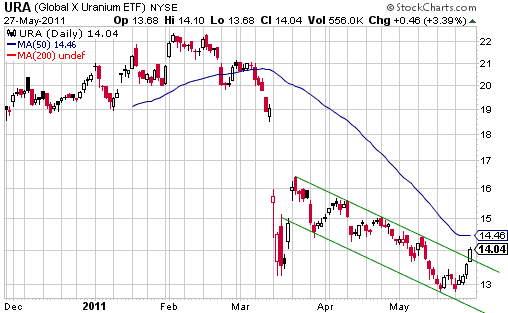
following daily chart shows that the Global X Uranium ETF (URA), a
proxy for the uranium sector of the stock market, tested its low for
the year at the beginning of last week and then reversed upward.
There was significant strength in uranium equities during the final two days of the week on the back of news
that Traxys, a large commodity-trading and commodity-related-investment
company, had agreed to purchase all of the uranium that the US
Department of Energy (DOE) was planning to sell to pay for the cleanup
of the former Portsmouth enrichment plant. This deal affects more than
10M pounds of U3O8 supply. It doesn't mean that the supply won't hit
the market; it means that the supply will likely hit the market in a
more controlled and commercially astute manner.
For those who wish to avoid the hassle of having to analyse and track
individual uranium miners, URA would be a reasonable way to obtain
uranium-mining exposure. An initial position in URA could be taken near
the current price.
Interesting quotes
*From the article "Global Warming Fraud Creates Third World Food Crisis":
"Honest scientific
inquiry serves the single purpose of advancing human knowledge and
understanding free of any bias or ulterior motivation and it is clear
that promoting "human caused global warming" a full nine years after
the world had already started cooling serves no such lofty purpose.
Kalmanovitch accuses a
small clique of self-serving climate researchers for violating the
fundamental ethics of science protocol and propagating the false
science that made the Kyoto Accord the international vehicle for crimes
against humanity. Listening to his arguments you cannot help but see he
has a point.
So what was the root
catalyst for this cataclysm? Astonishingly, you can pin a lot of it on
one well-intentioned but misguided do-gooder. His name: Professor James
Hansen. Hansen was NASA's bright-eyed scientist back in 1988. The eager
climate modeler appeared before a Congressional Committee and
prophesized that mankind would kill the planet if it continued to burn
coal and gasoline at modern industrial rates.
Kalmanovich explains,
"When you look closely at the climate change issue it is remarkable
that the only actual evidence ever cited for a relationship between CO2
emissions and global warming is climate models."
Hansen made unfounded and
highly alarmist claims based on his computer forecasts. He predicted
doomsday scenarios that panicked Congress and that wave of fear
stampeded the world into believing in a non-existent crisis. Global
temperatures have never rocketed as Hansen forecast. In fact all five
global temperature datasets show zero net global warming over the past
decade in spite of record increases in CO2 emissions from fossil fuels
(climate scientists have now grudgingly conceded no statistically
significant rise in temperatures has occurred since 1998 from their
doomsaying). But once the stampede was launched it caused a rush to
biofuels that stripped millions of crop acreage from the worldís
food basket."
The "Anthropogenic Global Warming" (AGW) hoax isn't the sole cause of
the so-called "Third World Food Crisis". Third World countries always
have major political problems (a lack of freedom) and usually have
major monetary problems (rampant inflation) that act to stunt their
economic progress. That's why they have the "Third World" moniker to
begin with. However, a bad situation has certainly been made worse by
First World governments passing laws that force 6% of the world's grain
supply to be used in the production of fuel. Even if there were some
validity to AGW alarmism, forcing people to use food as fuel for cars
would be a really stupid thing to do.
*From "The Economist":
"FAITH in the free market
is at a low in the world's biggest free-market economy. In 2010, 59% of
Americans asked by GlobeScan, a polling firm, agreed "strongly" or
"somewhat" that the free market was the best system for the world's
future. This has fallen sharply from 80% when the question was first
asked in 2002. And among poorer Americans under $20,000, faith in
capitalism fell from 76% to 44% in just one year. Of the 25 countries
polled, support for the free market is now greatest in Germany, just
ahead of Brazil and communist China, both of which have seen strong
growth in recent years. Indians are less enthusiastic despite recent
gains in growth. Italy shows a surprising fondness for markets for a
place that is uncompetitive in many sectors. In France under a third of
people believe that the free market is the best option, down from 42%
in 2002."
As government intervention in the economy and central bank manipulation
of money cause ever-increasing economic problems, faith in "free
markets" declines and the cry goes out for still more government and
central-bank intervention. At the same time, economic problems are
prompting people to protest in many parts of the world, but in general
the protestors aren't demanding less costly and less intrusive
government; rather, the typical protestor appears to be most worried
about reduced access to the government 'money trough' and is only in
favour of "austerity" if the austerity affects someone else's financial
situation.
It's hard to be optimistic when the foremost desire of the politicians,
the central bankers and the voting public is the avoidance of
short-term pain at any cost, even when the cost will be a much weaker
economy five years from now.
The Stock
Market
The US stock market will have
very positive 'seasonality' at its back during this holiday-shortened
week. This could pave the way for the senior US stock indices to make
new 52-week highs within the next several trading days. However, such a
move to new highs would likely coincide with some bearish divergences,
one of the most important being a divergence between the S&P500
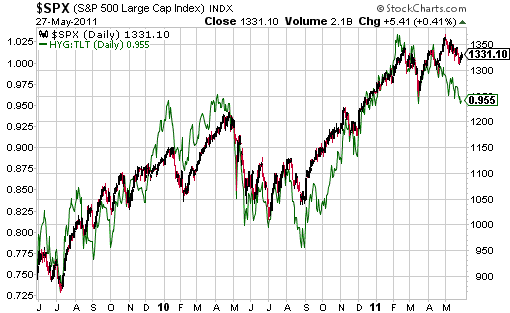
Index and the HYG/TLT ratio.
The HYG/TLT ratio is an indicator of risk aversion (the ratio rises as
market participants become increasingly willing to accept risk) and
usually moves in the same direction as the broad stock market. The
relationship we are referring to is illustrated by the following chart.
Everything was normal until mid April, when the S&P500 resumed its
short-term upward trend while HYG/TLT continued to pull back. We now
have the situation where HYG/TLT is testing its low for the year while
the S&P500 is threatening to make a new high for the year.
This week's
important US economic events
| Date |
Description |
Monday May 30
| US markets closed
| | Tuesday May 31 | Case-Shiller Home Price Index
Chicago PMI
Consumer Confidence
| | Wednesday Jun 01
| ISM Manufacturing Index
Construction Spending
Motor Vehicle Sales
| | Thursday Jun 01
| Q1 Productivity and Costs
Factory Orders
| | Friday Jun 01
| Monthly Employment Report
ISM Non-Manufacturing Index
|
Gold and
the Dollar
Gold and Silver
In our opinion, the most beautifully logical entity in the financial
world is the gold/CCI -- or, in more general terms, the gold/commodity
-- ratio. On an intermediate-term basis this ratio almost always does
what it should do given the economic/financial-market backdrop. As
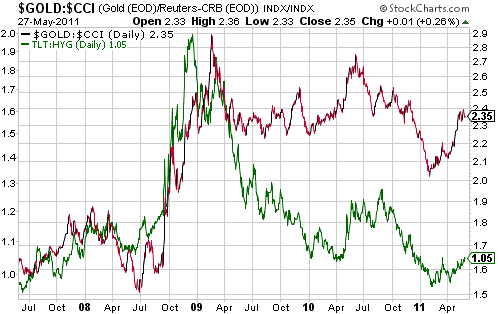
evidence we cite the following chart-based comparison of the gold/CCI
ratio and the TLT/HYG ratio. The TLT/HYG ratio trends in the same
direction as credit spreads, which, in turn, trend in the opposite
direction to economic confidence and/or financial market liquidity. In
other words, an upward trend in TLT/HYG will generally be associated
with a downward trend in economic confidence and/or financial market
liquidity.
Gold, being the ultimate 'monetary commodity', should do better than
commodities in general when economic confidence is declining and worse
than commodities in general when economic confidence is on the rise.
This should result in a positive correlation between the gold/CCI ratio
and the TLT/HYG ratio, which is exactly what we observe on the
following chart.
An important trend
change appears to have occurred during the first two months of this
year, with both gold/CCI and TLT/HYG reversing upward. This trend
change is an intermediate-term bearish omen for the broad stock market.
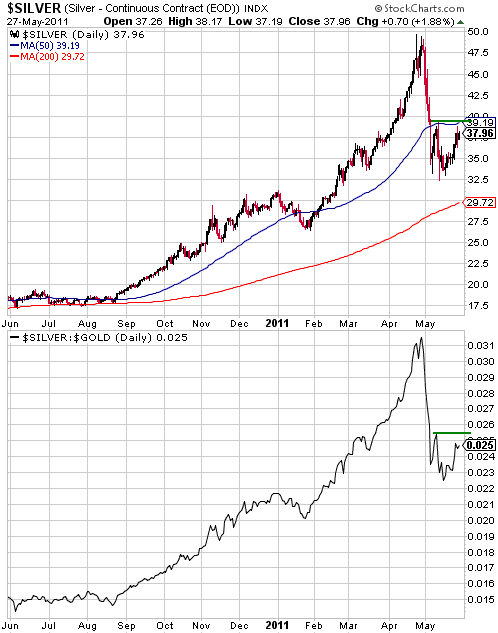
The top section of the chart displayed below shows the US$ silver price and the bottom section shows the silver/gold ratio.
The importance of silver/gold's performance over the past few months
should not be under-estimated. Silver/gold's huge run-up and ferocious
downward reversal was a very clear signal that peaks of at least
intermediate-term significance in the US$ prices of both gold and
silver were either put in place at the beginning of May or would be put
in place within the ensuing few weeks.
We are now well into a rebound that was almost obligatory following the
crash that occurred during the first week of May. This rebound could
lead to a new all-time high for gold bullion, but a new high by gold
within the next couple of weeks would likely be accompanied by lower
highs for silver, the silver/gold ratio, the HUI and the HUI/gold
ratio; that is, it would likely bring about a situation that is rife
with bearish divergences.
On a very short-term basis, there was a minor bearish divergence during
the second half of last week due to gold breaking above its early-May
rebound peak while silver and the silver/gold ratio remained below
their equivalent peaks. However, there will hopefully be enough
strength over the coming week or so to push silver back to the
low-$40s, as this would create a good hedging/selling opportunity.
Gold Stocks
The main reason we expect the gold-stock indices to break below their
May lows is that intermediate-term corrections in gold and silver
bullion have very likely just begun, or if they haven't yet begun they
will soon do so. The gold-stock indices sometimes lead at turning
points, but it would be unprecedented for them to bottom near the START
of an intermediate-term correction in the bullion. Another reason to be
cautious is that the broad stock market is probably nearing an
intermediate-term peak.
That being said, the likely downside isn't substantial. With the
exception of the 2008 collapse, a repeat of which has almost zero
chance of happening during 2011 due to the supportive monetary backdrop
(regardless of what the Fed does with its QE, there is already enough
monetary inflation in the system to preclude a 2008 repeat), no
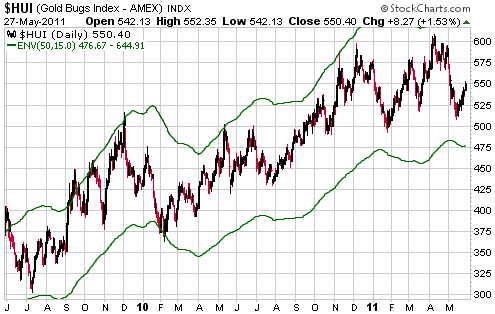
intermediate-term gold-sector correction over the past 10 years has
resulted in the HUI dropping far below the bottom of the moving-average
envelope shown on the following daily chart. In each historical case,
the correction low was at or just below the bottom of the envelope.
That's why we have picked 475 as a likely downside target for the HUI.
While the HUI stands
a good chance of trading below its May low before the overall
correction comes to an end, some individual gold stocks have probably
already bottomed. For example, Catalpa Resource (ASX: CAH), Jaguar
Mining (JAG) and Pretium Resources (TSX: PVG) probably bottomed during
the first half of May at A$1.36, US$4.11 and C$7.89, respectively.
It is normal for many individual stocks to peak and trough at different
times to an index that purportedly represents the stocks in question.
That's one reason why buy/sell decisions should generally be made on a
stock-by-stock basis, without placing a lot of weight on anyone's
short-term forecasts for the associated indices. Another reason not to
place a lot of weight on any short-term forecast is that doing so
involves taking unnecessary risk. Rather than trying to buy at the
bottom and sell at the top, which is an approach that often goes
horribly wrong, it is much better to gradually build up positions on
weakness and harvest gains into strength. Along these lines, we've been
putting cash to work in the gold sector over the past three weeks due
to below-the-market buy orders getting filled.
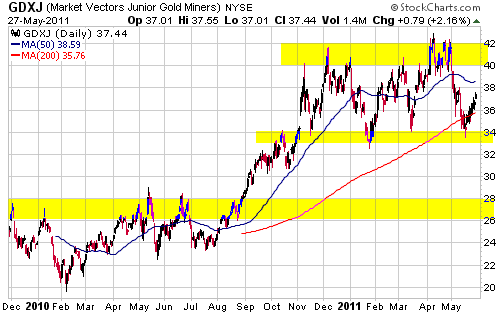
Moving on, the following chart shows the Junior Gold Miners ETF (GDXJ).
Upside targets for the current rebound are the 50-day moving average at
$38.50 and resistance at $40-$42. A rise to the $40-$42 resistance
range within the coming fortnight would create an excellent short-term
selling opportunity, although we'll be surprised if it gets that high.
A drop back to the low-$30s would create a decent buying opportunity
and a spike down to the $26-$28 support range would create a great
buying opportunity.
Below is an
interesting chart from Canaccord's latest "Junior Mining Weekly"
report. The chart, which compares the gold price (the red line) with
the P/NAV ratio (price divided by net asset value) for the universe of
senior and mid-tier gold producers tracked by Canaccord (the black
line), shows that the average valuation assigned by the stock market to
gold producers has trended downward since Q3-2009. Over the same
period, the gold price has trended upward. By the P/NAV measure, senior
and mid tier gold producers are now, on average, about half as
expensive as they were almost two years ago and almost as cheap as they
were at the bottom of the 2008 crash. By other measures gold stocks are
nowhere near as cheap today as they were at the 2008 bottom, but the
P/NAV graph indicates that there is scope for a general upward
re-rating of gold stocks.
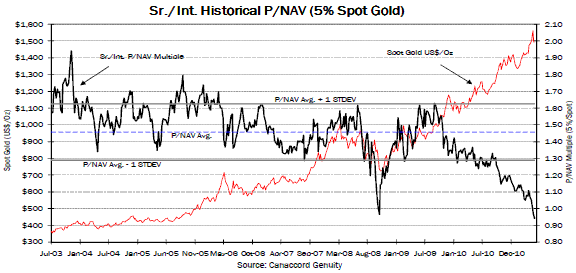
Valuation usually isn't the most important short-term price driver, but low valuation limits downside risk.
Currency Market Update
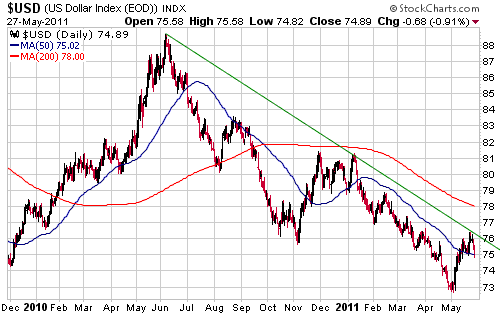
The Dollar Index pulled back over the final two days of last week,
partly due to suggestions that the ECB would continue with its
rate-hiking program. The ECB should, of course, continue with its
rate-hiking program, because artificially low interest rates can't
possibly provide a net economic benefit. However, with two of the four
largest euro zone economies (Spain and Italy) in recession, a few of
the smaller economies in recession and several governments within the
Monetary Union careening towards debt default, we suspect that the
political pressure not to hike will become irresistible.
The US dollar's intermediate-term bottoming process was always likely
to entail an initial rally followed by a decline to test the low. Last
week's market action could mean that the initial rally is complete,
especially considering that the Swiss Franc made a new high on Friday,
although we can't yet rule out the possibility that the initial rally
is still in progress. What we can say is that we would be buyers of US
dollars, or sellers/hedgers of most other major currencies, if the
Dollar Index dropped back to the vicinity of its early-May low.
Update
on Stock Selections
(Notes: 1) To review the complete list of current TSI stock selections, logon at http://www.speculative-investor.com/new/market_logon.asp
and then click on "Stock Selections" in the menu. When at the Stock
Selections page, click on a stock's symbol to bring-up an archive of
our comments on the stock in question. 2) The Small Stock Watch List is
located at http://www.speculative-investor.com/new/smallstockwatch.html)
 An example of how an equity financing SHOULD be done An example of how an equity financing SHOULD be done
Exploration-stage uranium miner Hathor Exploration (TSX: HAT) announced
late last week that it had raised $13M via an equity financing.
Everything about this financing was right. In particular, the new
shares were issued at a 10% premium to the current market price with no
warrants attached, and the financing was arranged in the aftermath of
news that had driven the stock price sharply higher.
HAT didn't need to do a financing at this time because it had more than
enough cash in the bank to fully fund its activities over the coming 12
months, but the best time to negotiate a debt or an equity financing is
when you don't need the money. This is when you are likely to get the
best deal. So often we see junior mining companies that are reliant on
equity financing do nothing in response to large run-ups in their share
prices, and then some time later with the stock price near a 52-week
low and almost nothing left in the bank go 'cap in hand' to brokers in
search of more money. The guideline that applies to
investors/speculators also applies to company managements, in that
shares should be sold when they are relatively expensive not when they
are relatively cheap.
Last week's C$3.00/share financing will help to underpin the price of
HAT shares. Absent a large fall in the uranium price, support in the
C$2.20s probably now defines the maximum downside potential.
Chart Sources
Charts appearing in today's commentary
are courtesy of:
http://stockcharts.com/index.html

|