|
-- Weekly Market Update for the Week Commencing
30th June 2014
Big Picture
View
Here is a summary of our big picture
view of the markets. Note that our short-term views may differ from our
big picture view.
In nominal dollar terms, the BULL market in US Treasury Bonds
that began in the early 1980s ended in 2012. In real (gold)
terms, bonds commenced a secular BEAR market in 2001 that will continue
until 2018-2020. (Last
update: 20 January 2014)
The stock market, as represented by the S&P500 Index,
commenced
a secular BEAR market during the first quarter of 2000, where "secular
bear market" is defined as a long-term downward trend in valuations
(P/E ratios, etc.) and gold-denominated prices. This secular trend will bottom sometime between 2014 and 2020.
(Last update: 22 October 2007)
A secular BEAR market in the Dollar
began during the final quarter of 2000 and ended in July of 2008. This
secular bear market will be followed by a multi-year period of range
trading.
(Last
update: 09 February 2009)
Gold commenced a
secular bull market relative to all fiat currencies, the CRB Index,
bonds and most stock market indices during 1999-2001.
This secular trend will peak sometime between 2014 and 2020.
(Last update: 22 October 2007)
Commodities,
as represented by the Continuous Commodity Index (CCI), commenced a
secular BULL market in 2001 in nominal dollar terms. The first major
upward leg in this bull market ended during the first half of 2008, but
a long-term peak won't occur until 2014-2020. In real (gold) terms,
commodities commenced a secular BEAR market in 2001 that will continue
until 2014-2020.
(Last
update: 09 February 2009)
Copyright
Reminder
The commentaries that appear at TSI
may not be distributed, in full or in part, without our written permission.
In particular, please note that the posting of extracts from TSI commentaries
at other web sites or providing links to TSI commentaries at other web
sites (for example, at discussion boards) without our written permission
is prohibited.
We reserve the right to immediately
terminate the subscription of any TSI subscriber who distributes the TSI
commentaries without our written permission.
Outlook Summary
Market
|
Short-Term
(1-3 month)
|
Intermediate-Term
(6-12 month)
|
Long-Term
(2-5 Year)
|
|
Gold
|
Bullish
(10-Jun-14) |
Bullish
(26-Mar-12) |
Bullish
|
|
US$ (Dollar Index)
|
Bearish
(16-Apr-14) |
Bearish
(27-Jan-14) |
Neutral
(19-Sep-07) |
|
Bonds (US T-Bond)
|
Bullish
(11-Dec-13)
|
Neutral
(18-Jan-12)
|
Bearish |
|
Stock Market
(DJW)
|
Bearish
(07-Apr-14) |
Bearish
(28-Nov-11) |
Bearish
|
|
Gold Stocks
(HUI)
|
Bullish
(10-Jun-14) |
Bullish
(23-Jun-10) |
Bullish
|
|
Oil |
Neutral
(02-Jun-14) |
Neutral
(31-Jan-11) |
Bullish
|
|
Industrial Metals
(GYX)
|
Neutral
(17-Feb-14) |
Bullish
(28-Apr-14) |
Bullish
(28-Apr-14) |
Notes:
1. The date shown below the current outlook is when the most recent outlook change occurred.
2. "Neutral", in the above table, means that we either don't have a
firm opinion or that we think risk and reward are roughly in balance with respect to the timeframe in question.
3. Long-term views are determined almost completely by fundamentals,
intermediate-term views by
fundamentals, sentiment and technicals, and short-term views by sentiment and
technicals.
Temporary change to TSI
format
We will be travelling over the next two
weeks and will therefore be unable to post the usual TSI reports. We will,
however, keep subscribers updated regarding our thoughts on the financial
markets by posting comments in a "blog" format at http://www.speculative-investor.com/new/weekly060714.asp.
This page will probably be updated every 3-4 days, although the actual frequency
of updates will depend on market action and whether we have anything meaningful
to say. We will notify subscribers by email whenever new comments are posted.
Note that the above-linked page currently doesn't exist. It will be uploaded to
the web site with our first set of comments.
The next regular commentary will be the Weekly Market Update on 13th July.
What are China and the US
doing?
Is China buying gold? Can the US print dollars to
pay for goods produced in other countries? The answers are no and no. To be more
accurate, the questions can't be answered because they don't make sense.
Countries are not entities that buy, sell, or act in any way.
Writers of gold-related articles, newsletters and blog posts routinely claim
that China is buying gold. Do they mean that China's government is buying gold?
If so, that's what they should say, because the government of a country is not
the country. Perhaps they mean that all the buying and selling of gold in China
by individuals, corporations and government results in a net flow of gold from
outside to inside China. Fine, but from an investing/speculating viewpoint that
doesn't tell us anything useful. In gold bull markets and gold bear markets
there will always be net flows of gold between geographical areas.
Also, writers of financial articles, newsletters and blog posts occasionally
make a claim that goes something like this: "The US dollar's reserve currency
status means that the US is able to buy valuable goods from other countries
using money it creates out of nothing." Really? So, the average American can
print US dollars whenever he feels like it to buy stuff from other countries?
Obviously, it doesn't work like that. There is no entity called "the US" that
can print dollars. The reality is that people in the US have to obtain money in
the same ways that people everywhere obtain money. Only a single US institution
known as the Federal Reserve has the power to buy anything it wants with dollars
that it creates out of nothing, but this institution does not buy imported
goods. Furthermore, when this institution creates dollars out of nothing it puts
downward pressure on the dollar's purchasing power and exchange rate, which
ultimately makes it harder, not easier, for everyone in the US to purchase goods
made in other countries.
To summarise the above, it is ridiculous to think that there is an entity called
"the US" that prints money to buy imported goods. In more general terms, it is
ridiculous to do any economic analysis by lumping all the individuals and
organisations in a country into an amorphous mass that buys and sells.
Reserves Confusion
One of the reasons that some commentators on
the monetary system make statements that are plainly wrong is their belief that
bank reserves deposited at the Fed are essentially the same as money deposited
in accounts within the economy. They aren't. Reserves held at the Fed are not
money that can be withdrawn and spent. That's why bank reserves are not counted
in the money supply. Instead, reserves 'back' the money that exists in bank
accounts within the economy. Part of the confusion undoubtedly stems from the
fact that dollars are backing dollars, but that's the way today's monetary
system works.
As at the end of May-2014, the US money supply was about $10.1T and US
depository institutions had about $2.6T of reserves. This means that about 26%*
of the dollars in the US economy were, at that time, backed by reserves.
Although each reserve dollar is not linked to a specific dollar in the economy,
it could be helpful to think of it that way if you are having trouble getting
your head around the idea that reserves cannot be used like ordinary money. In
other words, think in terms of each reserve dollar being attached to a dollar
within the economy.
Due to the fact that banks can neither lend their reserves into the economy
(reserves can only be loaned from one reserve account to another) nor withdraw
and spend their reserves, the Fed's QE wouldn't have any effect on the dollar's
purchasing power if it only resulted in additions to bank reserves. In this
case, the S&P500 Index would almost certainly be a lot lower. Alternatively, if
the Fed's QE injected money into the economy (via additions to the bank accounts
of Primary Dealers) without adding an equivalent amount to bank reserves, that
is, if the Fed added 'unbacked' money to the economy, then each purchase of
assets by the Fed would boost the liabilities of commercial banks (bank deposits
are liabilities of the banks) and therefore weaken the balance sheets of
commercial banks. That's why for every dollar of assets purchased by the Fed
under its QE programs, one dollar gets added to demand deposits within the
economy (that is, to the money supply) and one dollar gets added to bank
reserves. In this way, the Fed boosts prices within the economy without
increasing the leverage of the commercial banking system.
As an aside, we get the impression that the Bank of Japan's QE adds to reserves,
but not the money supply. That is, the mechanics of the BOJ's QE appear to
differ from the mechanics of the Fed's QE. This would explain why the Yen supply
continues to grow at a relatively slow pace despite the BOJ's huge QE program.
*This is an unusually high percentage by the standards of
the past few decades. Six years ago, only about 1% of the US money supply was
backed by reserves.
The Stock
Market
Contemplating the probability of a US
stock market crash
Crashes are always low-probability events and we are not forecasting a crash for
the US stock market. However, the combination of sentiment, valuation and the
fact that the market has made it to the middle of the year without experiencing
a significant correction has created the potential for a 1987-style US stock
market crash during August-October.
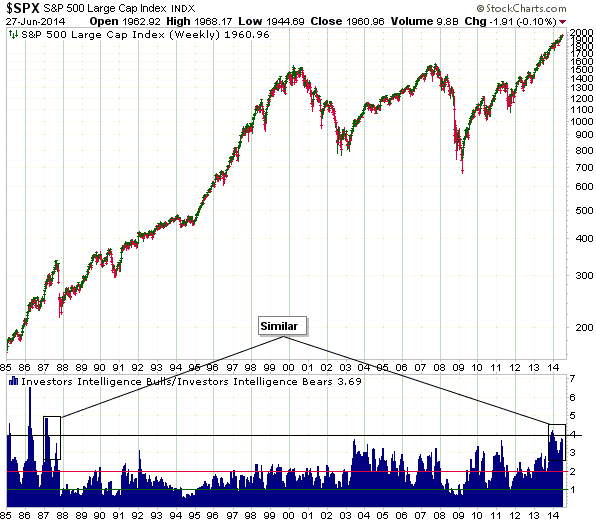
To illustrate the similarities between the sentiment backdrops of 2014 and 1987
we present the following long-term chart of the S&P500 Index and the Investors
Intelligence (II) bull/bear ratio. This chart shows that the bull/bear ratio
extreme reached at the end of last year was the highest level for this ratio
since early-1987. It also shows that the 1987 ratio extreme preceded the crash
by about 8 months and that a lower bull/bear high was made just prior to the
start of the 2-month crash pattern.
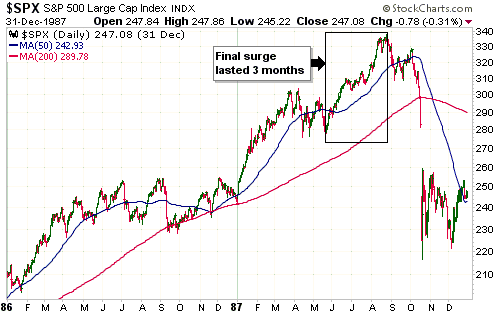
Next, we present a daily chart showing the S&P500's performance from the
beginning of 1986 through to the end of 1987. Notice that the final short-term
advance in 1987 lasted three months.
Lastly, we present a daily chart showing the S&P500's performance over the past
two years. The S&P500's current short-term advance began on 14th April, so a
duplication of the final phase of the rally that culminated in the 1987 stock
market crash would result in a mid-July peak this year.
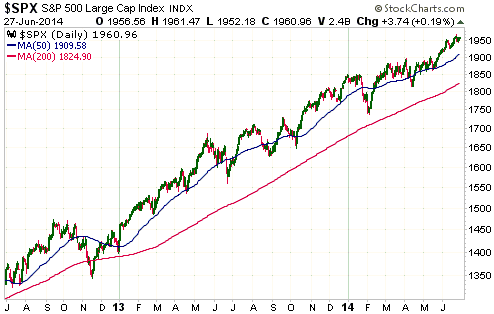
A comparison of the above two charts shows significant differences between the
1-2 years leading up to the 1987 crash and the past 1-2 years. In particular,
the SPX traded sideways through most of 1986 and then experienced an upside
blow-off during the first 8 months of 1987, whereas the SPX's performance since
the beginning of 2013 can best be described as a consistent upward trend. This
difference neither reduces nor increases the probability of a crash this year.
The main argument against a large stock market decline (a crash or a cyclical
bear market) at this time is the monetary backdrop. Last year, US monetary
inflation was almost 100% dependent upon the Fed, in that the commercial banking
system created almost no new money. If last year's banking trends had extended
into this year, then as a result of the Fed's "tapering" the US monetary
inflation rate would now be at a level that would likely bring on the next
financial-market crisis, but this didn't happen. Instead, the US monetary
inflation rate actually increased slightly during the first half of this year
due to the Fed's reduced rate of money pumping being more than offset by a
faster pace of commercial-bank credit creation (rather than lending existing
money, commercial banks usually add new money to demand deposits when they make
loans).
Easy monetary conditions will never prevent an
overbought/over-bullish/over-valued stock market from suffering a 15%-20%
intermediate-term correction, but if they persist they will substantially reduce
the risk of a far more serious decline.
Current Market Situation
It has now been about 10 weeks since the S&P500 Index last had a daily move of
at least 1%. Such a long period of small daily price swings creates the
impression that there will be minimal volatility for the foreseeable future,
which is why S&P500 option premiums -- as indicated by the VIX -- are very low.
Volatility is likely to soon pick up.
In last week's Interim Update we noted that the CRX/SPX ratio (the
Commodity-Related Equity Index relative to the S&P500 Index) had done enough to
signal a reversal of its multi-year trend (from down to up). This suggests that
commodity-related equities are beginning to outperform. However, it subsequently
occurred to us that the recent outperformance of the CRX could mostly be due to
the oil sector and that most non-oil commodity stocks were yet to show much
strength relative to the broad market.
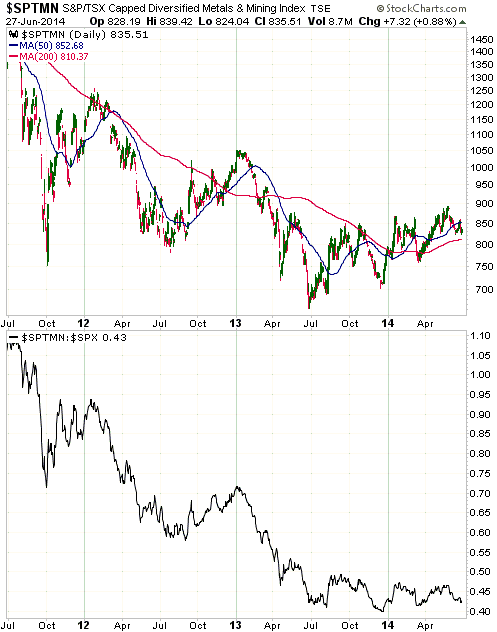
The commodity-related stocks represented by the Diversified Metals and Mining
Index (SPTMN) are examples. As illustrated by the following daily chart, SPTMN
has trended upward in nominal dollar terms over the past 12 months, but hasn't
yet turned higher relative to the broad market. To be more specific, the bottom
section of the chart shows that while the SPTMN/SPX ratio stopped trending
downward in mid-2013, it hasn't yet begun to trend upward. A definitive upward
reversal in the mining sector's relative strength is still to come.
This week's
important US economic events
| Date |
Description |
| Monday Jun 30 |
Chicago PMI
Pending Home Sales Index
Dallas Fed Mfg Survey | | Tuesday
Jul 01 |
Motor Vehicle Sales
ISM Index
Construction Spending | | Wednesday
Jul 02 |
Factory Orders | | Thursday
Jul 03 |
Monthly Employment Report
International Trade Balance
ISM Non-Manufacturing Index
|
| Friday Jul 04 |
US markets closed for public holiday |
Gold and
the Dollar
Gold
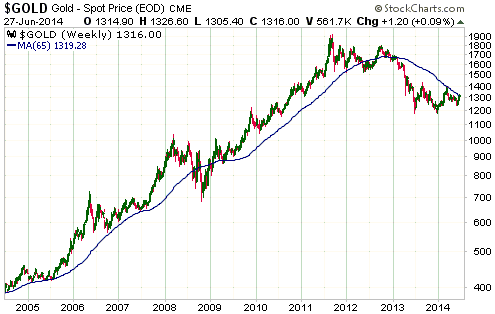
Long-time TSI reader SP drew our attention to the fact that in addition to other
resistance near $1320, gold has resistance near this price in the form of the
310-day MA. The 310-day MA is roughly the same as the 65-week MA, which is shown
on the following weekly price chart. It is presently at $1319. Notice that the
65-week MA regularly limited declines during the cyclical bull market and
coincided with the short-term top in March of this year.
A solid weekly close above this MA would therefore be significant.
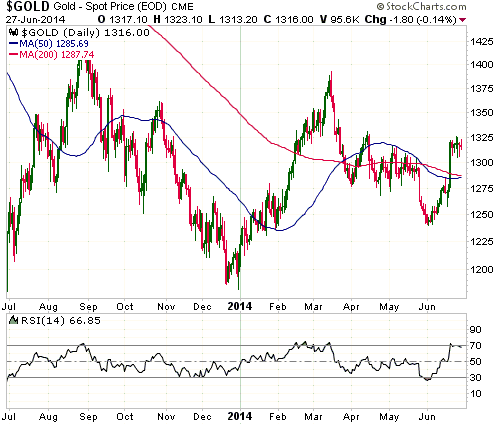
Since moving sharply higher, breaking out to the upside and becoming short-term
'overbought' on Thursday 18th June, gold has drifted sideways. This leaves us
without an opinion on what the price will do over the coming fortnight. A 1-2
week pullback to the $1280s would not be surprising, but neither would a quick
move up to $1350.
Looking out a bit further, price action, intermediate-term sentiment indicators,
comparisons with previous recoveries from cyclical bear markets and fundamentals
(the fundamentals that matter, not the ones that most gold-market commentators
focus on) all point to $1400 being challenged within the next three months.
Silver
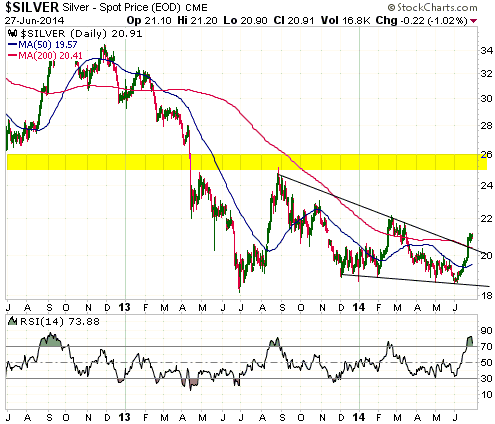
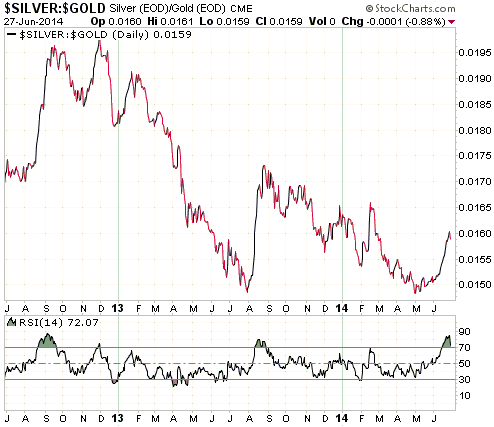
On a short-term basis, silver and the silver/gold ratio are very 'overbought'.
This is indicated by the unusually high current level of the daily RSI shown at
the bottom of each of the following charts. This doesn't preclude sharp
additional gains in the near future, with a surge to as high as $23 being
possible, but it does mean that silver's risk/reward is no longer skewed towards
reward as far as the next few weeks are concerned.
In a similar vein to gold, however, the recent upside breakout combined with
intermediate-term sentiment indicators and comparisons with previous recoveries
from cyclical bear markets points to materially higher prices within the next
three months. Our view is that silver will trade at least as high as $23 by
September and will probably challenge major resistance at $25-$26 before
year-end.
Gold Stocks
Current Market Situation
We suspect that the gold-mining sector is immersed in a 2-3 week consolidation
that will continue until the HUI's daily RSI (refer to the bottom section of the
following chart) drops to around 50. That's the message being sent by the
downward reversal in the GDXJ/GDX ratio that occurred during the week before
last. However, due to the fact that the HUI itself hasn't yet signaled an
interim top, there is a realistic chance of the HUI moving quickly up to around
250 before embarking on a multi-week correction.
What would surprise us is a move to well beyond the 225-250 range over the next
couple of weeks.

At the start of this year our 2014 upside target for the HUI was 300. Based on
the historical record we thought that this target would be reached by the middle
of the year, after which there would be many months of essentially trendless
trading. 300 is still our 2014 upside target for the HUI, but it is obviously
going to take longer than expected to get there. Our best guess is that it will
happen by the end of September.
Gold stocks are influenced more by the expected future price of gold than the
current price of gold. That's why the gold-stock indices don't automatically
follow the daily moves in the bullion market. Currently, there isn't much
optimism about gold's prospects. Most people, including most of the analysts at
banks and brokerages, have low expectations and probably won't believe that
there was a major turning point in the gold market late last year until after
the gold price breaks decisively above $1400. Although it will only take an 8%
increase to get the gold price back to $1400, due to the change in expectations
that such an event would prompt it's likely that by the time gold achieves a
weekly close above $1400 the TSI gold stocks will, on average, be trading at
least 50% above their current levels.
Basing Patterns
As is the case with the HUI and GDXJ, basing patterns of 12 months or longer are
clearly evident in the charts of many individual gold stocks. A bunch of
examples is presented below. As always there are no guarantees, but it doesn't
get any better than this.
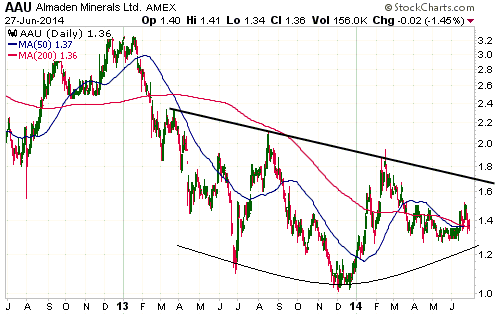
Example 1: Almaden Minerals (AAU)
The top of AAU's basing pattern appears to be near US$1.70. The stock will
encounter resistance near US$2.00, but US$2.50-$2.60 will be the chart-based
target following a break above the top of the base.
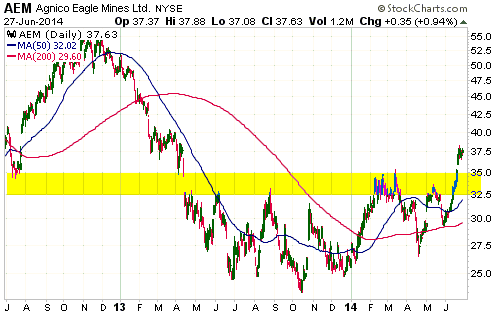
Example 2: Agnico Eagle (AEM)
AEM has been a relatively strong gold stock since last October and has already
broken upward from its basing pattern. The TSI Stocks List has exposure to AEM
via long-dated (January-2015) call options that will be exited if -- as is
likely -- the stock moves up to the low-$40s within the coming three months.
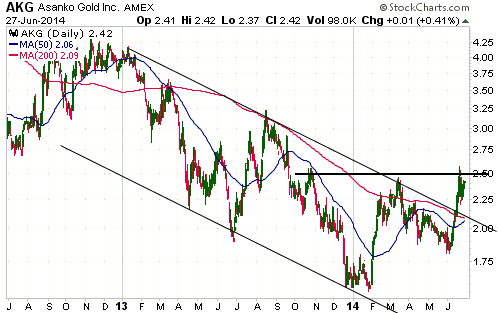
Example 3: Asanko Gold (AKG)
AKG recently broke out to the upside from a long-term channel, but the top of
its basing pattern lies at US$2.50. US$3.25-$3.50 will be the target following a
breakout.
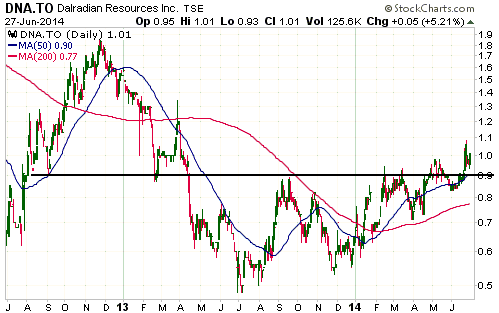
Example 4: Dalradian Resources (DNA.TO)
DNA has already broken upward from its basing pattern. The TSI Stocks List has
exposure to DNA via February-2015 C$0.90 warrants, which, unless advised
otherwise, will be exited if they trade at C$0.50. For the warrants to trade at
C$0.50, the stock will probably have to move up to at least C$1.35. We expect
that this will happen within the next three months.
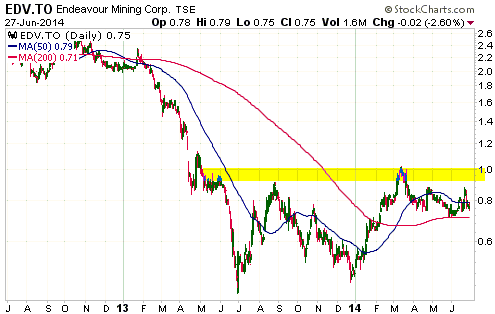
Example 5: Endeavour Mining (EDV.TO)
The top of EDV's basing pattern lies at C$0.90-C$1.00. An upside breakout would
suggest a target of C$1.60-$1.80.
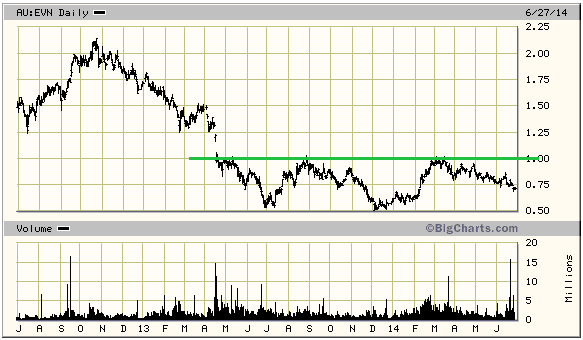
Example 6: Evolution Mining (EVN.AX)
EVN is in the process of completing a base that encompasses a double bottom. A
break above the top of the base (A$1.00) would suggest a target of A$1.50.
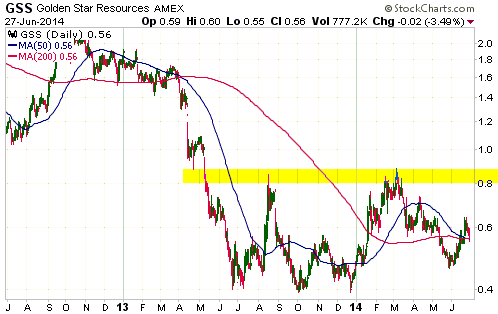
Example 7: Golden Star Resources (GSS)
The top of GSS's base is at US$0.80-$0.90. The base appears to have encompassed
a rare triple bottom.
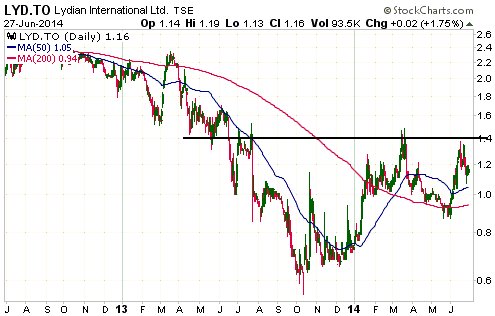
Example 8: Lydian International (LYD.TO)
It looks like LYD is close to completing a major base, with the top of the base
at C$1.40. Although the chart looks bullish, a revised FS is due shortly and we
would hold off on new buying until after the results of the FS are assessed.
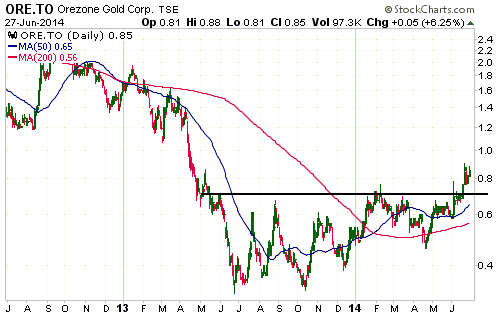
Example 9: Orezone Gold (ORE.TO)
ORE has already broken upward from its basing pattern. C$1.00-C$1.20 is the
initial target suggested by this breakout.
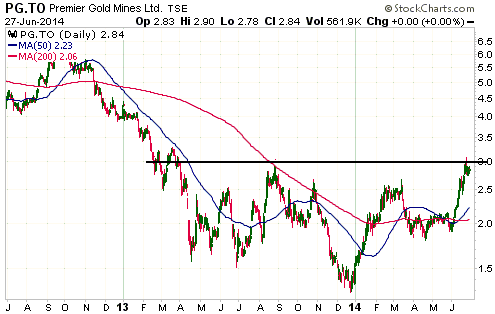
Example 10: Premier Gold (PG.TO)
PG tested the top of its 16-month basing pattern last week. It is short-term
'overbought' and could pull back as far as its 50-day MA, but an upside breakout
from its base is likely within the coming three months. Such a breakout would
suggest that the stock was on its way to C$4.00-$4.50.
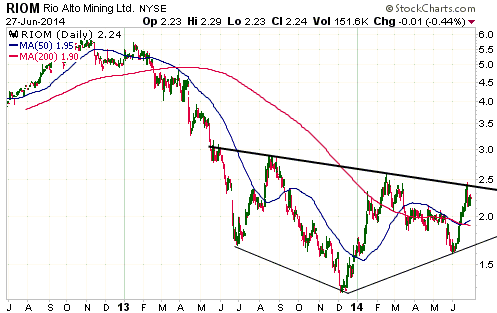
Example 11: Rio Alto Mining (RIOM)
Fortunately, the stock market is less concerned than we are about the high price
being paid by RIOM for Sulliden's Shahuindo project. RIOM tested the top of its
basing pattern last week and will probably break out to the upside within the
next couple of months.
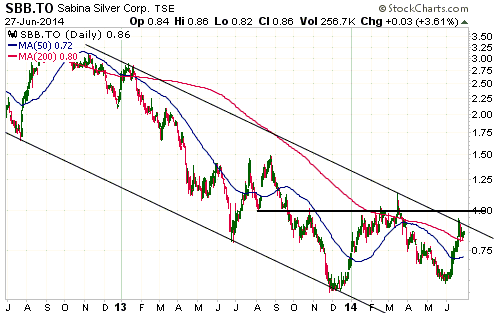
Example 12: Sabina Gold and Silver (SBB.TO)
SBB appears to have made a double bottom as part of a major basing pattern. The
top of the base lies at C$1.00, although there is also important channel
resistance at around C$0.90. An upside breakout from the base would suggest that
the stock was on its way to C$1.50.
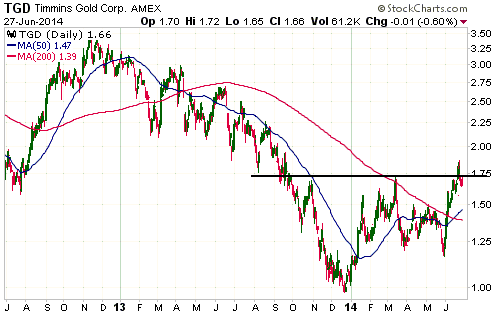
Example 13: Timmins Gold (TGD)
TGD came within a few cents of hitting our suggested buy price in late-May, but
then suddenly reversed course and almost managed to break upward from its basing
pattern. The top of the base lies at around US$1.75. A breakout would suggest a
target of US$2.50.
The Currency Market
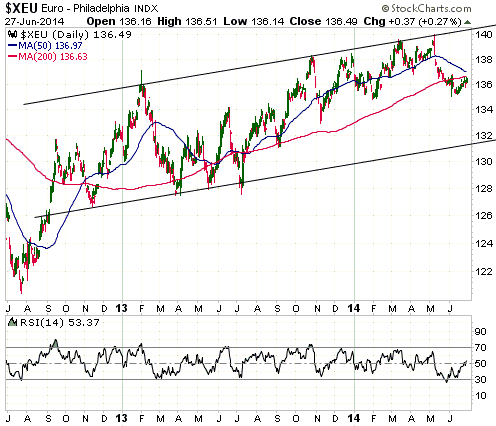
The euro has managed to work off its short-term 'oversold' condition by making
only a small net gain from its early-June low. It has been unable to make enough
progress to get back above its 200-day MA, which means that the recent small
advance currently looks more like a counter-trend rebound than the start of a
rally to new highs for the year.
The following daily chart suggests that the euro has short-term downside risk to
its channel bottom. This means that if the rebound of the past few weeks proves
to be the counter-trend variety, it could be followed by a decline to as low as
132.
However, the sentiment backdrop encourages us to maintain our short-term
euro-bullish/US$-bearish outlook. The speculative net-short position in euro
futures dropped a little last week, but it remains close to its highest level
since May of 2013. The substantial net-short position in euro futures means that
if the euro breaks below its lows of the past few months, there probably won't
be much follow-through to the downside. It also means that there is ample
short-covering fuel to power a rally to new highs for the year.
Updates
on Stock Selections
Notes: 1) To review the complete list of current TSI stock selections, logon at
http://www.speculative-investor.com/new/market_logon.asp
and then click on "Stock Selections" in the menu. When at the Stock
Selections page, click on a stock's symbol to bring-up an archive of
our comments on the stock in question. 2) The Small Stock Watch List is
located at http://www.speculative-investor.com/new/smallstockwatch.html
 Company
news/developments for the week ended Friday 27th June 2014: Company
news/developments for the week ended Friday 27th June 2014:
[Note: AISC = All-In Sustaining Cost, FS = Feasibility Study, IRR =
Internal Rate of Return, MD&A = Management Discussion and Analysis,
M&I = Measured and Indicated, NAV = Net Asset Value, NPV(X%) = Net
Present Value using a discount rate of X%, P&P = Proven and
Probable, PEA = Preliminary Economic Assessment, PFS =
Pre-Feasibility Study]
*Endeavour Mining (EDV.TO, EVR.AX) reported that production has
commenced at the Segala underground mine in Mali. The Segala mine
will provide relatively high-grade feed for the Tabakoto mill and
should help to lower overall production costs for the Tabakoto
operation.
EDV also reported that it has received mining permits covering all
eight of the known deposits on the Kofi property. These deposits
have about 1M ounces of currently-defined gold resources and will
provide feed for the Tabakoto mill beginning in 2015.
EDV's stock-market performance has recently been sluggish, but
operationally it continues to perform well.
*Premier Gold (PG.TO) issued a technical press release about pit
wall slopes and inter-ramp slope angles for the proposed open pit
mine at its Hardrock project in Ontario. In our opinion these design
details did not warrant a press release.
*Ramelius Resources (RMS.AX)
announced a rights issue that creates a good money-making
opportunity for current RMS shareholders or the buyers of RMS shares
prior to 4th July (the date that the shares trade "ex" the rights
entitlement), especially considering the evidence that the gold
sector's intermediate-term advance has resumed. Unfortunately, it is
only an opportunity that applies to shareholders with registered
addresses in Australia or NZ. According to RMS's 24th June
announcement, this is because the company has decided that "it is
unreasonable to make the Offer to shareholders who have a registered
address in a country outside of Australia or New Zealand having
regard to the number of shareholders in such places, the number and
value of the new shares that would be offered and the substantial
costs of complying with the legal and regulatory requirements in
those jurisdictions."
The Rights Issue will enable eligible shareholders to buy new shares
at A$0.065/share (well below the current market price) on the basis
of 1 new share for every 4 existing shares. Also, subscribers to the
Rights Issue will receive 1 free option, exercisable at A$0.12 on or
before 1 August 2015, for every 2 new shares subscribed for. The
free options, which should trade on the stock market following
completion of the Rights Issue, constitute a significant additional
'kicker'.
Unless there is an unforeseen fundamental change over the next three
weeks it will make sense for eligible RMS shareholders to subscribe
for their full entitlement to the new shares and perhaps even to
apply for additional shares under the Offer. The current schedule is
for the Offer documents to be dispatched to shareholders on 11th
July and for the Offer to close on 25th July.
For TSI record purposes we will assume that the rights are
exercised, with new shares purchased on a 1-4 basis at
A$0.065/share.
*True Gold (TGM.V) advised that it has awarded the engineering,
procurement and construction management (EPCM) contract for the
Karma gold mine (Burkina Faso) to SENET, a South African engineering
firm. SENET is well regarded and is very familiar with the Karma
project due to its involvement in the FS.
TGM plans to be in production by the end of next year. We suspect
that it will be taken over well before it goes into production,
although a takeover is more likely to happen next year than this
year.
List
of candidates for new buying
From within the ranks of TSI stock selections, the best candidates for new
buying at this time are:
1) AAU (last Friday's closing price: US$1.36).
2) EDV.TO (last Friday's closing price: C$0.75).
3) EVN.AX (last Friday's closing price: A$0.71).
4) TGM.V in the low-C$0.40s (last Friday's closing price: C$0.43).
Chart Sources
Charts appearing in today's commentary
are courtesy of:
http://stockcharts.com/index.html

|









