-- 2014 Forecast
Yearly
Forecast
 Random Thoughts
1) The monetary backdrop continues to
be very different in the US today than it was in earlier post-bubble
periods. This is slowing the corrective process and introducing new
price distortions that will have to be 'resolved' via another
devastating economic bust. When will they ever learn?
2) Economic declines will become progressively more serious and
economic recoveries will become progressively weaker until there is
wide recognition that the central bank is a big part of the problem
as opposed to part of the solution.
3) At this time last year, we wrote: "It has become clear that
the Fed's policy of throwing new money at the economy in a horribly
misguided effort to generate real growth is not only going to
continue in 2013, but also going to be applied more aggressively
than was the case in 2012. This money-pumping could prevent
widespread recognition of recessionary economic conditions for
several more months, but only at a substantial long-term cost. For
an economy to function efficiently, price signals must be genuine;
that is, price signals must accurately reflect sustainable
consumption and production trends."
The Fed is now beginning to slow the pace of its money-pumping, but
the damage has been done. The seeds of the next economic bust have
been sown.
4) The economic data will probably be OK during the first few months
of 2014, but if commercial-bank credit growth continues at its
present slow pace then by the third quarter of this year there will
probably be enough stock market weakness and enough signs of
economic deterioration to prompt the Fed to step away from its
"tapering" plan.
5) At the beginning of 2013, we wrote: "China has huge economic
problems, but these problems will come to the fore gradually over
the space of a few years and won't likely be the cause of big moves
in global financial markets during 2013." The same statement
applies to this year.
6) At the beginning of 2013 we thought that the euro-zone's
government debt disaster would return to "Page 1" during the second
half of the year. It didn't. Another euro-zone banking/debt crisis
is inevitable, but there are currently no signs that it is imminent.
For example, the yield on 10-year Spanish government bonds is near a
5-year low and the EURO STOXX Banks Index recently made a 2-year
high. We will monitor European bonds and bank shares in an effort to
determine the timing of the inevitable crisis. All we can say right
now is that it probably won't happen during the first half of 2014.
7) Last year we thought that unexpected weakness in the US economy
was an intermediate-term threat worthy of attention, but not one of
the top three risks. Unexpected weakness in the US economy is now
one of the top three risks, although it is a risk that probably
won't materialise until the second half of the year.
8) As 2013 got underway we considered greater instability in the
Middle East to be one of the biggest intermediate-term risks facing
the financial markets. We also thought that if this risk was going
to materialise it was more likely to do so during the second half
than the first half of the year. Our reasoning was that the US
government (by far the greatest threat to world peace) would be more
inclined towards aggressive military intervention in the Middle East
after it became clear that the US economy had sunk into recession,
something that was unlikely to happen prior to the second half of
2013. To further explain, governments tend to view external threats
as useful distractions during periods of economic weakness.
Additionally, in a world dominated by "Keynesian" policy-makers and
political advisors, large-scale military action can be perceived as
a convenient excuse for more government spending and more monetary
inflation.
The threat that the pot of territorial disputes, religious hatreds,
political grievances and economic problems known as the Middle East
will boil over is ever-present. However, with a deal now in the
works regarding Iran's nuclear program, with the start of the next
US recession still lying more than 6 months into the future and with
US mid-term elections scheduled for this November, the next Middle
East 'boil over' of global importance is probably not going to
happen in 2014.
9) Last year we wrote: "There's a new big intermediate-term risk
facing the financial world as 2013 gets underway: the risk that the
government bond bubble will burst. The bursting of the government
bond bubble is a more pressing concern today than it was, say, 6
months ago due to the immense political pressure being put on the
Bank of Japan (BOJ) to reduce the purchasing power of the Yen."
The government bond bubble probably did burst last year, but the
other financial markets took the first phase of the new secular bond
bear in stride. Furthermore, despite the actions taken by the BOJ to
bring about higher "inflation" in Japan, the JGB market recovered
from a sharp April-May sell-off to end the year with a gain. That
is, the JGB yield was lower at the end of the year than at the start
of the year.
Even though a secular bond bear has probably begun, for the reasons
outlined in our 20th January commentary we don't perceive much
intermediate-term downside risk for US Treasury bonds. In fact, we
suspect that the T-Bond market will end 2014 with a gain.
There is a lot more risk in Japanese Government Bonds. This is
mostly because they have a much higher valuation (lower yield), but
it is also because the JGB market is much further along in its
long-term topping process.
10) Due to the downward trend in the US monetary inflation rate and
the valuation-related downside potential in the US stock market, a
US deflation scare is a realistic possibility for the second half of
the year.
11) For speculators in commodities and commodity-related equities it
will be much easier to make money on the 'long' side during 2014
than it was during 2012 and 2013. This is especially so for the
year's first half (the second half could contain a deflation scare)
and for speculators in gold and gold-related equities.
The US Stock Market
At the beginning of last year we had no
opinion about what the stock market would do over the ensuing 12
months. We thought that risk outweighed reward, but pointed out that
this risk/reward assessment didn't translate into a forecast. It
didn't even translate into a view that the market was more likely to
fall than to rise. It only meant that we thought the potential cost
of being wrongly bullish was greater than the potential cost of
being wrongly bearish.
For better or worse, as 2014 gets underway we do have a 12-month
forecast for the US stock market (S&P500 Index). At least, we have
two favoured scenarios that have the same intermediate-term
implication.
The first scenario is that a major peak is forming right now. Under
this scenario the ultimate price high will occur this month, after
which the market will gradually roll over to the downside. Weakness
during the first half of the year will be relatively minor, but
downward acceleration will occur during the second half of the year
after it becomes clear that "QE" has failed to bring about a
sustained economic recovery.
This scenario is consistent with a) the extreme optimism reflected
by sentiment indicators over the past month, b) the market's high
average valuation, and c) the past year's decline in the rate of
money-supply growth. It is also consistent with the likelihood of
economic data remaining generally supportive for at least a few more
months.
The second scenario involves some 'corrective' activity during the
first two months of the year followed by a final surge to the
ultimate high during April-May. In addition to being consistent with
the same influences as the first scenario, this scenario also meshes
with the Presidential Cycle Model.
Under both of these scenarios the S&P500 Index would likely end the
year with a decline of at least 10%, but the bulk of the bear
market's downside would wait until 2015-2016. Given the market's
high average valuation and the uncommonly long duration of the
cyclical bull (the bull will be 5 years old in March), the decline
from the bull-market peak to the following bear-market trough will
probably be at least 40%.
Of our two scenarios, at this time we favour the second. The main
reason is that although the US monetary inflation rate has trended
lower over the past year, it has not yet dropped to levels that
preceded the bursting of previous investment bubbles. Unfortunately,
the economic underpinnings have been sufficiently damaged by
price-distorting monetary policies that the next bust could begin at
a higher monetary inflation rate than previous busts. We therefore
can't blindly assume that everything will remain superficially fine
until/unless there is a significant additional tightening of
monetary conditions.
Lastly, as we've done in every yearly forecast beginning with the
2010 edition we again state our belief that the S&P500's March-2009
low will prove to be its ultimate bear-market bottom in nominal
dollar terms. This is due to previous and expected-future
Fed-promoted depreciation of the US$.
A floor has effectively been placed under the US stock market's
dollar-denominated price by the virtual certainty that the Fed will
be a lot quicker to crank up the money pumps in reaction to stock
market weakness in the future than it was during 2007-2008. Based on
the Fed's actions over the past 18 months a rational observer could
no longer doubt that this is the case. After all, the Fed introduced
new money-pumping schemes in late-2012 and early-2013 for no reason
other than the high unemployment rate, as if counterfeiting money
could possibly bring about sustainable gains in employment.
The US Dollar
The following daily chart
creates the impression that there was plenty of movement in the
Dollar Index over the past two years, with large near-vertical
rallies followed by sharp declines.
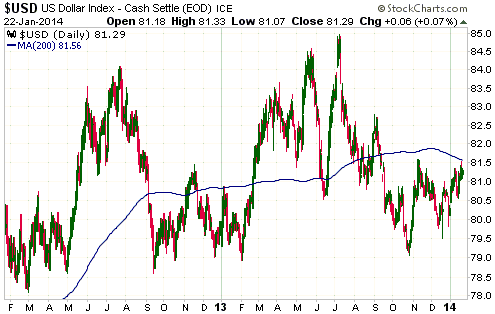
But when we step back and look at the much longer-term weekly chart
displayed below we see that in actual fact the market was unusually
quiet over the past two years. What we see is that the Dollar Index
has essentially spent two years trading sideways within a 5-point
range.

We expect that the Dollar Index will break out of its 5-point
(79-84) range this year and move at least 5 additional points in the
direction of the breakout. However, we don't have a clear-cut
opinion on the most likely direction.
The performance of the Dollar Index is largely determined by the
performance of the US$ relative to the euro, and at this time we see
no decisive reason to favour one of these currencies over the other.
Sentiment is close to neutral, as are momentum and price action. The
current rates of supply change (the respective monetary inflation
rates) are in the same ballpark, and the current US$/euro exchange
rate is about right on a purchasing power parity basis.
It will most likely be relative stock market performance that
determines whether the Dollar Index breaks upward from its 2-year
range and makes its way to the 90s or breaks downward from its
2-year range and makes its way to the low-70s. European equities
currently offer better value, on average, than US equities, which
gives them more intermediate-term upside potential at a time when
monetary inflation rates are roughly the same in the US and Europe.
On the other hand, there's a greater intermediate-term risk of
another debt/banking crisis in Europe than in the US, and despite
their relative expensiveness US equities would probably hold up
better than their European counterparts during a global equity bear
market.
This leads us to the vague conclusion that a) European equities are
likely to be strong relative to US equities, leading to strength in
the euro and weakness in the Dollar Index, during periods when most
major stock markets are strong or at least stable, and b) European
equities are likely to be weak relative to US equities, leading to
weakness in the euro and strength in the Dollar Index, during
periods when most major stock markets are trending downward.
Taking into account the 2014 stock market outlook described above,
one realistic scenario entails moderate strength in the euro (and
weakness in the Dollar Index) during the first half of the year
followed by the opposite during the second half of the year.
Also worth noting is that due to the extent to which these
currencies are 'oversold', if most major stock markets are strong or
at least stable for several more months then we are likely to get
tradable bear-market rebounds in the Australian and Canadian dollars
during the first half of the year.
T-Bonds
Although we believe that
30-year T-Bonds and 10-year T-Notes are now about 18 months into a new secular
bear market, we don't expect them to have a bad year in 2014. In fact, our best
guess at this time is that T-Bond and T-Note futures will end the year slightly
above where they began it. Here are our reasons:
1. The T-Bond is coming off an 'oversold' momentum extreme on both a short-term
and an intermediate-term basis.
2. Speculators have a large net-short position in T-Notes.
3. Inflation expectations probably won't rise by much in 2014.
4. Stock market weakness will prompt a flight to the perceived safety of
Treasuries during the second half of the year.
5. The performance of the US Treasury market during the 1940s-1950s and the
performance of the Japanese Government Bond market since 2003 suggest that the
end of the 1980s-2000s secular bull market in US government bonds will be
followed by several years of horizontal range-trading. This means that even if
the T-Bond falls far enough at some point over the next three months to provide
the confirmation of a secular trend reversal mentioned above, there probably
won't be much follow-through to the downside.
A strong multi-month rebound could entice us into establishing a bearish T-Bond
position, but we view the bond market more as an indicator than as a market to
be traded.
Gold
To arrive at our 2014 forecast for the gold
mining sector [see below] we first made the reasonable assumption that the
cyclical bear market had either ended or would end following a quick spike to a
new low in the near future. To get an idea of what to reasonably expect over the
next 12 months we then looked at how the gold-mining indices performed following
the three most comparable lows of the past 50 years. Our conclusion, based on
the historical record, was that there would probably be a strong first half and
a choppy second half.
To arrive at our 2014 forecast for the gold market we are going to begin with
the same assumption. This is reasonable, because: a) while the fundamental
backdrop is not yet bullish, it is no longer bearish, b) we expect the
fundamentals to become increasingly gold-bullish over the course of the year,
and c) sentiment indicators suggest that a very gold-bearish scenario has been
discounted by market participants, thus paving the way for any surprises to be
of the bullish kind.
As we did with the gold-mining sector, for a clue as to what we can
realistically expect from the bullion market over the year ahead we'll take a
look at weekly charts showing what happened following the comparable lows of the
past 50 years. Unfortunately, our historical sample size is only two (over the
past 50 years there were only two cyclical gold bear markets that have much in
common with the 2011-2013 bear market). This is partly because the gold price
was fixed until 1971.
The first of our two weekly charts shows gold's performance during the 1970s,
our assumption being that gold's current position is similar to its position
near the September-1976 bottom.
Unlike the gold-mining sector, which gained about 50% during the 6 months
immediately following the 1976 bottom and then didn't make much progress for
more than two years, gold bullion trended steadily upward from its 1976 bottom.
If the post-1976 bottom is a valid roadmap then the gold price will move up to
around $1600 during 2014 and test its 2011 peak by mid-2015.

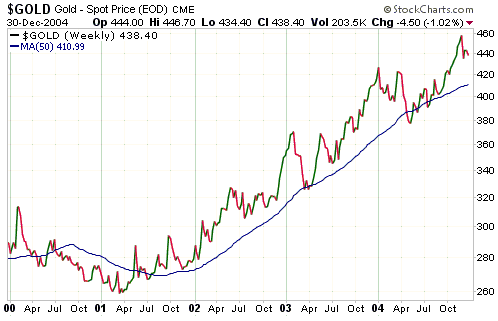
Our second weekly chart shows gold's performance from the beginning of 2000
through to the end of 2004. It therefore covers the final year or so of a bear
market and approximately the first four years of a bull market. In this case we
are assuming that gold's current position is similar to its position in
early-2001.
If the post-2001 bottom is a valid roadmap then the gold price will peak in the
$1400s during 2014 and perform very well during 2015. A test of the 2011 peak
would occur in late-2015 or early-2016.
Based on the small historical sample size, which is all we have to go on, you
should ignore the predictions that gold will zoom straight back to its 2011 top.
This is particularly so considering that gold's true fundamentals are mixed at
this time (no longer bearish, but not yet bullish). Gold is likely to provide a
good return in 2014, but even if a major bottom is in place the gold price is
unlikely to trade significantly above $1600 and could have trouble getting
beyond the $1400s.
Gold Stocks
The assumption that underlies our 2014
forecast for the gold mining sector is that the cyclical bear market has either
ended or will end following a quick spike to a new low in the near future. This
is a big assumption, but it's a reasonable one considering that the 2011-2013
decline was a) equal in magnitude to the largest decline and longer than the
longest decline of the 1960s-1970s secular bull market, and b) almost equal in
magnitude to and a lot longer than the first major decline of the 1980-2000
secular bear market. Also of importance, the Fed has been busily laying the
groundwork for another devastating economic bust that will no doubt be met by
another flood of new money.
With this assumption as our premise, for a clue as to what we can realistically
expect from the gold-mining sector over the year ahead we'll take a look at
weekly charts showing what happened following the three cyclical gold-stock bear
markets of the past 50 years that have the most in common with the 2011-2013
bear market.
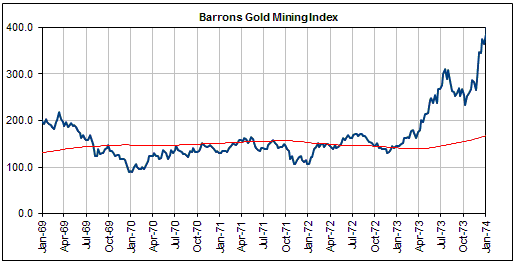
Our first chart shows the final 12 months of the 1968-1970 cyclical bear market
and the ensuing 4 years, using the Barrons Gold Mining Index (BGMI) as the
sector proxy. The red line on the chart is the 200-week MA.
Notice that the BGMI rebounded by about 50% to its 200-week MA during the first
6 months of its new bull market, but that after this initial surge it
essentially traded sideways for more than two years before commencing a huge
rally. In fact, a huge rally didn't get underway until about 3 years after the
bear-market bottom.
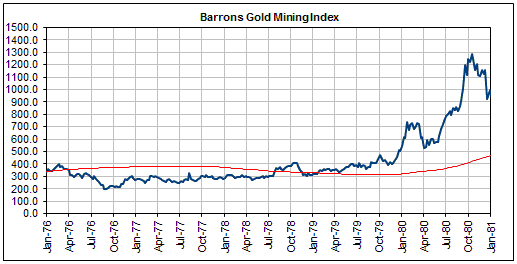
Our second chart shows the final 8 months of the 1974-1976 cyclical bear market
and the ensuing 4-and-a-bit years, again using the BGMI as the sector proxy.
In this case there was also a 50% surge within the first 6 months of the new
bull market, but due to having experienced a steeper decline it took the BGMI
about 2 years to return to its 200-week MA. Furthermore, as was the case during
the first half of the 1970s a huge rally didn't get underway until about 3 years
after the bear-market bottom.
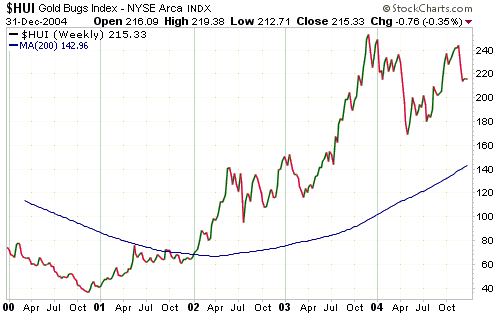
Our third chart shows the final year of the late-1990s cyclical bear market and
the ensuing 4 years, this time using the HUI as the sector proxy. The blue line
on the chart is the 200-week MA.
In this case the initial rebound was stronger (100% instead of 50%), but the
overall pattern during the first 12 months of the new bull market was similar.
Specifically, there was a rally lasting about 6 months followed by 6 months of
sideways trading. Note: The cyclical bull market that began in 2000 was
considerably stronger during its first few years than the cyclical bull markets
that began in 1970 and 1976, probably because it was the first cyclical bull
market in a new secular bull market.
With regard to the gold sector's performance during 2014, the message from the
historical record is that there will probably be a strong first half and a
choppy second half. The message about the longer-term outlook is that it could
be three years (early-2017) before the market takes off to the upside, but there
is no point looking that far ahead.
With regard to price targets, the historical cases discussed above suggest that
the HUI will trade at least 50% above its bear-market bottom at some point
during the year (most likely before mid-year). Also, in two of the cases the
upside during the first year of the bull market was limited by the 200-week MA
and in the other case the price high during the first year was well below the
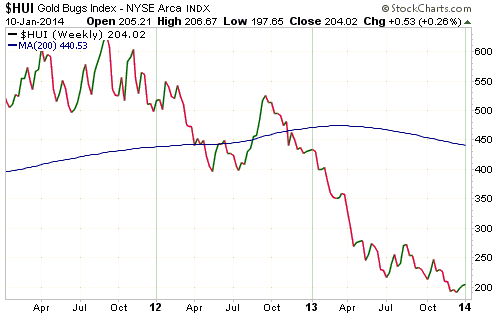
200-week MA. This suggests to us that the 200-week MA could reasonably be viewed
as defining the MAXIMUM upside potential for the HUI during 2014. As illustrated
by the following weekly chart, the 200-week MA is presently at 440 and trending
downward.
Further to the above, our guess is that the HUI's 2014 high will be at least 300
and could be as much as 400.
|






