2015 Yearly
Forecast
 The US Stock Market
The biggest error we made last year was
being bearish on the US stock market. It was our biggest error
because our other significant error (being bullish on gold-related
investments) was largely a consequence of our intermediate-term
bearish outlook for the US stock market.
At the beginning of last year we had two scenarios in mind for the
S&P500 Index (SPX), with the scenario considered the most likely
involving some strength during the first 4-5 months of the year
followed by a rolling over into a 2-3 year bearish trend. Under both
of our scenarios the S&P500 Index would end the year with a decline
of at least 10%, although the bulk of the anticipated bear market's
downside would wait until 2015-2016. Given the market's high average
valuation and the long duration of the cyclical bull, the decline
from the bull-market peak to the ultimate bear-market trough was
expected to be at least 40%.
What actually happened was that the SPX began last year at 1848 and
ended the year at 2059 for an annual gain of 11%. This was a
remarkably good performance considering the high starting valuation,
the weak earnings growth and the gradual removal of Fed monetary
support. However, with regard to future prospects it has skewed the
risk/reward even further towards risk.
The old bull market is now even 'longer in the tooth', the average
valuation is now even higher and the Fed's money-pumping has
(temporarily) come to an end. Furthermore, unlike this time last
year we now have evidence that a major top is either in place or
will soon be put in place. We are referring to the downward reversal
in the SPX/USB ratio (most recently discussed in the 12th January
Weekly Update) and the inability of NYSE Margin Debt to exceed its
February-2014 peak. On the equity-bullish side of the ledger: other
important central banks have ramped up their money pumps, ZIRP
continues in the US and elsewhere, and the pace of credit creation
by the US commercial banking industry has accelerated over the past
12 months.
Because monetary conditions remain very easy, the sort of stock
market collapse that occurred in 2008 is not a realistic possibility
for 2015. A down year for the US stock market is very likely,
though.
Our best guess at this time (guess is another word for forecast) is
that what we had in mind for 2014 will happen in 2015. In
particular, we expect the high for the year to occur within the
first few months (it's possibly already in place), after which the
market will gradually roll over to the downside. A choppy decline
that leaves the S&P500 with a loss of around 10% by year-end 2015 is
far more likely than a crash, with greater downside in store for
next year if the start of a bear market is signaled this year.
Lastly, as we've done in every yearly forecast beginning with the
2010 edition we again state our belief that the S&P500's March-2009
low will never be breached in nominal dollar terms. This is due to
previous and expected-future Fed-promoted depreciation of the US$.
A floor has effectively been placed under the US stock market's
dollar-denominated price by the virtual certainty that the Fed will
be a lot quicker to crank up the money pumps in reaction to stock
market weakness in the future than it was during 2007-2008. Based on
the Fed's actions over the past 2-3 years a rational observer could
no longer doubt that this is the case.
The US Dollar
When we penned our 2014 forecast for the currency market we had no
firm opinion on whether the Dollar Index would break out to the
upside or the downside from the 5-point horizontal range in which it
had oscillated over the preceding two years. However, we did have an
opinion on what would drive the direction of the eventual breakout.
Here's what we wrote:
"It will most likely be relative stock market performance that
determines whether the Dollar Index breaks upward from its 2-year
range and makes its way to the 90s or breaks downward from its
2-year range and makes its way to the low-70s. European equities
currently offer better value, on average, than US equities, which
gives them more intermediate-term upside potential at a time when
monetary inflation rates are roughly the same in the US and Europe.
On the other hand, there's a greater intermediate-term risk of
another debt/banking crisis in Europe than in the US, and despite
their relative expensiveness US equities would probably hold up
better than their European counterparts during a global equity bear
market."
We were right about what would drive the Dollar Index during 2014,
in that dramatic strength in US equities relative to European
equities (with performance measured in terms of a common currency)
propelled the US$ sharply higher on the foreign exchange market
during the second half of last year. This is confirmed by the
following chart. However, we didn't anticipate the relative strength
in US stocks and failed to react to it in a timely fashion.
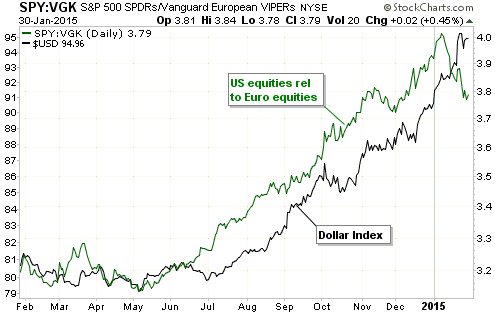
We don't see any reason why the Dollar Index, which is dominated by
the USD/EUR exchange rate, should stop trending with relative
equity-market performance. We therefore view the shift in relative
stock-market strength that occurred in early-January as a bearish
omen for the Dollar Index. Furthermore, last year's relatively poor
performance by European equities makes it less likely that they will
underperform over the months ahead, especially considering that
euro-zone monetary inflation has recently accelerated and will
likely be given an additional boost when the ECB's new QE program
kicks off in March. Therefore, the euro will probably have an upward
bias and the Dollar Index will probably have a downward bias during
the first half of this year.
That's as far ahead as we are prepared to look at this time.
T-Bonds
Our 2015 forecast for the
US Treasury market was essentially summarised in the list of "2015 surprises"
included in the 7th January Interim Update. Surprises 1) and 2) covered US
interest rates and the US government bond market. Here they are again, with
minor changes to the wording:
1) We expect that the Fed will continue to make noises about 'normalising'
monetary policy, but will end up doing almost nothing. At most, there will be a
single 0.25% rate hike. One reason is the fear that economic weakness elsewhere
in the world, primarily the euro-zone, will weigh on the US economy. Another
reason is the absence of an obvious "price inflation" problem. A third reason is
the Fed's unwavering commitment to the absurd Keynesian idea that an economy can
be strengthened by punishing savers.
2) We expect US Treasury yields to defy the majority view by ending the year
flat-to-lower. More specifically, we expect the 30-year T-Bond yield to be
roughly unchanged over the course of the year, but that yields will decline in
the middle and at the short end of the curve. Of all the Treasury securities,
the 5-year T-Note should experience the largest decline in yield as traders
belatedly realise that the Fed will not be taking any significant steps towards
'policy normalisation' during 2015 or 2016.
In addition to the absence of an obvious "price inflation" problem, there are
two current reasons and one potential reason to expect flat-to-lower Treasury
yields (flat-to-higher Treasury prices) over the course of this year. The
current reasons are sentiment (surveys and the COT data indicate that bullish
sentiment is not yet close to an extreme) and the good value offered by US
Treasury securities relative to the value on offer in Europe and Japan. The
potential reason is stock market weakness, in that a lengthy downward trend in
the stock market would likely boost the demand for Treasury debt. This is a
"potential" reason because a lengthy downward trend in the stock market is not a
sure thing.
The reason to expect Treasury securities with 5-10 year durations to do better
than 30-year T-Bonds is the extent to which the T-Bond out-performed over the
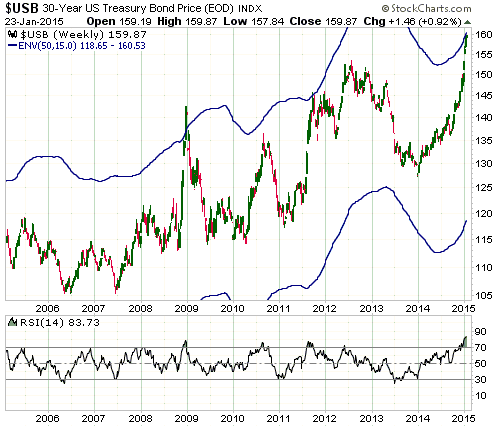
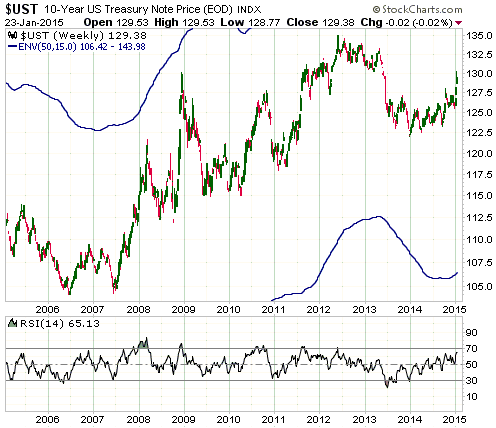
past 12 months and is now stretched to the upside. The following two weekly
charts illustrate what we mean.
The first chart shows that the 30-year T-Bond has reached the top of the
moving-average (MA) envelope that limited the powerful rallies of 2008 and 2011,
and that the T-Bond's weekly RSI is now at its highest level in more than 10
years. The second chart shows that the 10-year T-Note is only slightly
'overbought'.
Gold
Here's the conclusion of our 2014 gold forecast:
"Based on the small historical sample size, which is all we have to go on,
you should ignore the predictions that gold will zoom straight back to its 2011
top. This is particularly so considering that gold's true fundamentals are mixed
at this time (no longer bearish, but not yet bullish). Gold is likely to provide
a good return in 2014, but even if a major bottom is in place the gold price is
unlikely to trade significantly above $1600 and could have trouble getting
beyond the $1400s."
We were wrong about gold providing a good return in 2014, at least relative to
the US$. In US$ terms gold was flat in 2014, although it did provide a good
return in terms of every other currency.
In 2014 gold performed roughly as expected in US$ terms during the first half of
the year, but then fell to a new bear-market low during the second half. The
problems for the US$ gold price during the second half of 2014 were the
perceived strength of the US economy (linked to the continuing upward trend in
the S&P500 Index), the flattening of the US yield-curve (related to the
perceived US economic strength), and the Dollar Index's upside breakout from a
long-term basing pattern.
The gold market has come to ignore the strength in the Dollar Index, because the
US dollar's rise on the foreign exchange market has come to be seen as more of a
reflection of declining confidence in the ECB and weakening global growth than a
reflection of improving US$ fundamentals. However, there is no evidence, yet,
that the S&P500 has peaked. Also, the US yield-curve hasn't yet signaled a trend
reversal from flattening to steepening, and despite the problems in the 'oil
patch' the general belief is that the US economy will make real progress this
year.
There is never a good time to make a 12-month forecast, since forecasting is for
the birds. But right now is a particularly bad time to make a gold forecast, the
reason being that changes in other markets are needed to turn the gold market
higher on a sustained basis and the needed changes may or may not be about to
happen. Of primary importance, a sustained turn to the upside in gold almost
certainly requires a sustained turn to the downside in US equities. Some
long-term indicators are warning that such a change is in the works, but the
S&P500's price action hasn't yet signaled anything of the sort. The first sign
would be a daily S&P500 close below 1970.
If the S&P500 is in the process of rolling over to the downside on a long-term
basis then it's highly probable that gold bottomed last November and will
generate the sort of performance in 2015 that we originally expected to happen
in 2014. That is, gold will probably work its way higher over the course of this
year with a top most likely occurring in the $1400s and with an outside chance
of making it as high as $1600. The most plausible alternative is that the S&P500
will make some additional headway over the next few months and gold will drop to
test its 2014 bottom during the second quarter of this year prior to a long-term
reversal.
Gold Stocks
Gold-mining stocks will normally outperform gold bullion by a wide margin
during the first 2 years of a new cyclical gold bull market. This is due to the
fact that the cost of mining gold follows the gold price with a lag of 1-2
years. Due to this and depending on the length of the preceding gold bear
market, the cost of mining gold will probably be in a downward trend at the
start of a new cyclical bull market in gold bullion and will probably continue
to fall during the first 1-2 years of a new bull market in gold bullion. A
rising trend in the gold price combined with depressed stock valuations and
falling production costs equals substantial profit-margin expansion and large
gains in stock prices. Consequently, if gold made its ultimate bottom last
November then the HUI should achieve a large percentage gain over the next 18
months in both nominal price terms and relative to gold bullion.
Of course, that's a big "if". Preliminary signs have emerged that the US$ gold
price did indeed make its ultimate bottom last November (the non-US$ gold price
having almost certainly bottomed way back in December of 2013), but we have been
disappointed before. Last year, to be specific.
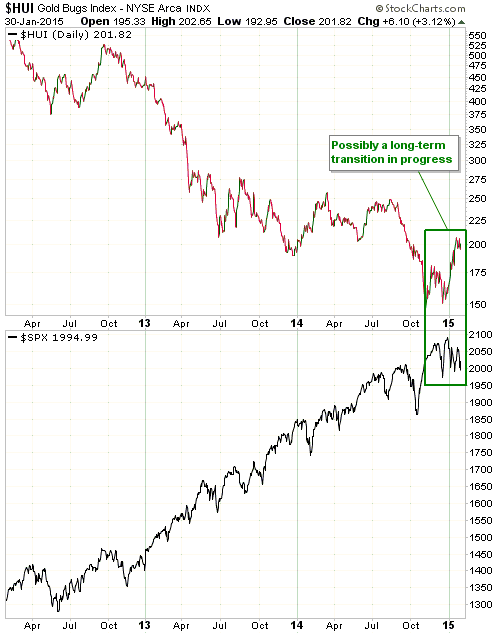
A long-term (that is, multi-year) bullish trend in gold mining stocks (as
represented by the HUI) naturally requires a long-term bullish trend in gold
bullion, which probably requires a long-term bearish trend in the US stock
market (as represented by the S&P500 Index). A transition from a long-term
bearish to a long-term bullish trend in the HUI and an associated transition
from a long-term bullish to a long-term bearish trend in the S&P500 Index is our
favoured possibility at this time.
There is, however, another realistic possibility that would lead to substantial
gains in gold mining stocks this year, but would not involve a long-term trend
shift. Specifically, a further 6-12 month extension of the cyclical bull market
in US equities would likely coincide with a very profitable 6-12 month rally in
the gold-mining sector if the extension of the old bull market encompassed a
rotation into commodity-oriented and other basic-material stocks. This would be
similar to what happened during the final quarter of 1986 and the first three
quarters of 1987.
Industrial Commodities
Oil
As everyone knows, the oil price crashed during the second half of last year.
This crash was due to a number of bearish forces coming together at the one
time. First, oil was expensive relative to commodities in general. Second, oil's
supply/demand fundamentals were price-bearish as the result of slowing economic
activity and rising US supply. Third, the US$ was getting stronger. Fourth,
there was broad-based weakness in the commodity markets. And fifth, the
supply/demand situation became even more bearish when Saudi Arabia decided not
to reduce supply in response to the falling price.
As a consequence of the price crash, over the past two months the oil market not
only became extremely 'oversold' in US$ terms, with oil's weekly RSI hitting its
lowest level since 1986 and Market Vane's bullish percentage for oil achieving
the lowest reading we've ever seen in any market (9%), it also became extremely
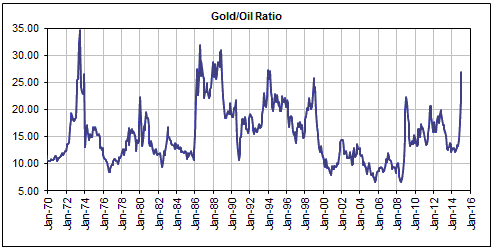
cheap relative to other commodities. In particular, oil dropped to a 15-year low
relative to copper, to a multi-decade low relative to gold, and to within a few
percent of a 15-year low relative to the Continuous Commodity Index. Oil's
long-term position relative to gold is illustrated by the following monthly
chart. Also, relative to the S&P500 Index the oil price fell to its lowest level
since 2002.
This sets the stage for oil to outperform over the next 12 months.
We expect that oil will soon turn upward on a sustained basis relative to
industrial metals such as copper, but that in US$ terms and relative to gold a
sustained up-turn won't get underway until the second half of this year. In US$
terms, we expect that during the first half of the year the oil price will build
a base, with the likely pattern involving a rebound during the first quarter
followed by a second-quarter test of the January bottom.
By the way, our inflation-adjusted (IA) calculations suggest maximum downside
risk during the first half of this year to the mid-to-high-$30s, which is the
current-dollar equivalent of the major price bottom in 1986. We do not expect
that oil will get this cheap, but that level of weakness cannot yet be ruled
out. If oil does get that cheap it will be one of the best buys of the past 50
years.
One reason to believe that it's too early to start speculating on a SUSTAINED
turn to the upside is that although Market Vane's bullish percentage for oil
recently hit an extraordinarily low level and almost everyone seems to be
bearish on oil, which is exactly what would be expected near a major price
bottom, speculators in oil futures haven't yet capitulated. Incredibly,
speculators (as a group) have maintained a sizable net-long position in NYMEX
oil futures over the past four months.
A second reason is that although there has been a large decline in the quantity
of US drilling rigs over the past three months, US oil production hasn't yet
begun to decline. Instead, what's happening is that heavily-indebted US oil
producers are trying to extract oil from their existing wells as quickly as
possible to generate the cash-flow needed to meet their monthly expenses. That
is, they are trying to make up for the large fall in the per-barrel price by
producing more barrels.
Industrial Metals
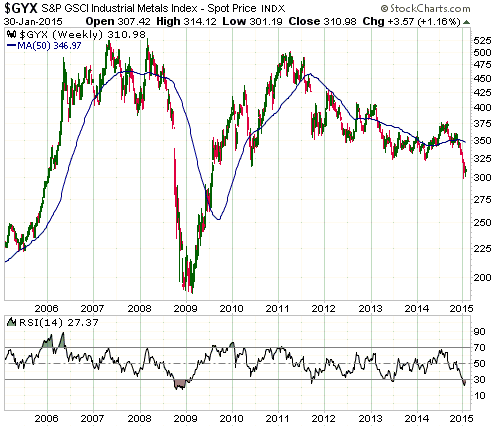
We expect that copper and the Industrial Metals Index (GYX) will commence new
cyclical bull markets from price bottoms during the first half of this year.
This forecast assumes that gold bottomed last November (gold is the leader) and
that central banks will continue to react to economic weakness by increasing the
money supply.
Even if we are right about new bull markets getting underway within the next few
months, the ultimate price lows could be well below current levels. In
particular, we perceive downside risk in the copper price to the low-US$2 area,
which is where the inflation-adjusted copper price would roughly match its 2008
low. $2.00-$2.10 for copper would likely equate to about 250 for GYX.