|
-- for the Week Commencing 6th May 2002
Forecast
Summary
 The
Latest Forecast Summary The
Latest Forecast Summary
Big Picture
View
Here is a summary of our big picture
view of the markets. Note that our short-term views may differ from our
big picture view.
Bond yields (long-term interest
rates) will move higher during 2002.
The US stock market will make
new bear market lows in 2002.
The Dollar commenced a bear
market in July 2001, but will rally to a secondary peak during the first
half of 2002 before beginning a major descent.
A bull market in gold stocks
commenced in November 2000 and is likely to extend into 2003.
Commodity prices, as represented
by the CRB Index, will rally during 2002 and 2003.
The oil price will resume its
major uptrend during the first half of 2002.
I only
know what I read in the papers
Want to know a quick and easy way to
improve your understanding of what is happening in the financial markets?
Stop reading the mainstream financial print media (eg, The Wall St Journal)
and stop watching mainstream financial television (eg, CNBC and Bloomberg).
More than 90% of the content of these publications/programs can be classified
as either noise (random signals with no informational value) or misinformation.
The misinformation might be unintentional, that is, the result of an honest
mistake, or it might be planted with the aim of getting you to see things
differently from how they really are.
The time and effort required to wade
through the noise and misinformation far outweighs any benefits that can
be gained by stumbling across useful information. In any case, it is often
impossible to immediately distinguish the useful content from the useless
and misleading content. This means that someone who goes to the trouble
of reading the Wall St Journal or watching CNBC every day is not just wasting
their time, they are increasing the probability that they will misinterpret
what is happening in the markets. In other words, their chances of making
correct investment and/or trading decisions will likely be reduced
as a result of their efforts to keep up with the latest news.
Of course, the vast majority of people
involved in the financial markets do try to keep abreast of the latest
developments by reading the daily financial publications or watching financial
TV. And, we sincerely hope they continue to do so because it gives a definite
edge to those of us who avoid these popular 'noise generators'.
The US
Stock Market
Washing away the excesses
On several occasions in the past we've
argued that the US credit expansion became a 'bubble' in mid-1997. This
was the time when:
a) Stocks and bonds began trending
in opposite directions
b) The S&P500/XAU ratio exploded
upwards out of its long-term trend
c) The rate of growth in some measures
of money supply accelerated. For example, the year-over-year growth rate
in "money of zero maturity" (currency + checking accounts + money market
funds) rose from 7.5% in mid-1997 to 15% near the end of 1998 to 21% at
the end of last year.
It was also, perhaps not coincidentally,
the time that the Asian debt crisis burst onto the scene. The problems
in Asia during 1997 and 1998 helped with the growth of the US bubble by
driving capital towards the perceived safety of US$-denominated investments.
One of the major beneficiaries of the
US credit bubble, at least until the first quarter of 2000, was the NASDAQ.
One of the biggest losers in the credit bubble world, at least until the
final quarter of 2000, was the gold sector. The credit bubble continues
to this day, but at least one of the excesses created by the bubble - the
extremely high valuations of tech stocks (represented by the NASDAQ Composite)
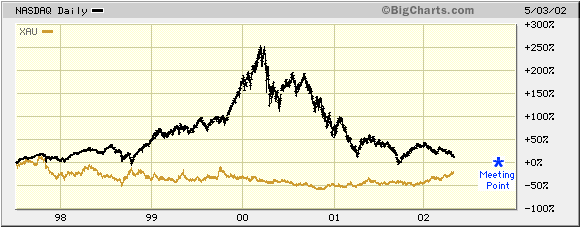
relative to gold stocks (represented by the XAU) - has almost disappeared.
As the following chart shows, an additional 10% decline in the NASDAQ Composite
combined with an additional 20% gain in the XAU would bring these indices
back to where they were when the bubble began in mid-1997.
Gold stocks began to benefit from the
bubble, rather than suffer as a result of it, after the US$ peaked against
the major European currencies in October of 2000. Since the bubble lives
on and the dollar is still in the early stages of its retreat it is certainly
possible that gold stocks will, over the next 12 months, reach similar
extremes to those reached by the NASDAQ in early-2000.
Current Market Situation
Within the next 6 months there is a
high probability that all the major US stock indices will trade at, or
below, their September-2001 lows. Here are some of the reasons why:
a) Many bellwether stocks, Microsoft,
Intel and GE being three good examples, are still extremely over-priced
based on historical standards.
b) The S&P500 has dropped to the
1070s but the commercial traders have not yet begun to cover their huge
net-short position in S&P500 futures contracts. The smart money therefore
seems to believe that the market has much further to fall.
c) The money supply growth rate began
trending lower at the end of last year and is likely to continue trending
lower for the remainder of this year. Rapid money supply growth has underpinned
asset prices over the past 18 months, allowing many stocks and stock market
sectors to move higher even as tech and internet stocks were crashing to
the ground. This support is in the process of being removed.
d) Long-term interest rates are headed
higher.
So, taking a 6-month view we remain
bearish. In the short-term, however, we are beginning to lean towards the
bullish side of the fence. As stated in the latest Interim Update: "Our
view is that a rally has either already begun or will begin during the
next 2 weeks following another test of this week's lows (based on our assessment
of sentiment indicators another test of the lows is the more likely scenario)."
Another test of the lows happened at
the end of last week as far as the S&P500 was concerned while the weakest
indices - the NASDAQ100 (NDX) and the NASDAQ Composite - dropped to new
lows for the year. Some additional weakness will probably occur in the
short-term - either in the form of a washout during this week or a bounce
followed by a drop to re-test last week's lows - but we think a medium-term
bottom is close at hand. Here's why:
1. Until the final two days of last
week there had been scant evidence of any real panic despite the substantial
declines suffered by many high-profile stocks. However, last Thursday and
Friday there was panic selling of technology stocks. On Thursday there
were as many advancing stocks as there were declining stocks on the NASDAQ
while the declining volume was 6-times greater than the advancing volume.
In other words, the decline was concentrated in a small number of stocks,
a sign of indiscriminate "get me out of this loser at any price" selling.
The concentration of selling in the leaders of the last bull market has
been apparent since the beginning of this year as evidenced by the 55-day
moving-average of the NASDAQ Arms Index (see chart below), but it now appears
to be reaching a climax. Note - a high Arms Index reading occurs when declining
volume divided by advancing volume is high relative to the number of declining
stocks divided by the number of advancing stocks. Thursday's reading for
the single-day NASDAQ Arms Index was the highest since the beginning of
the bear market.
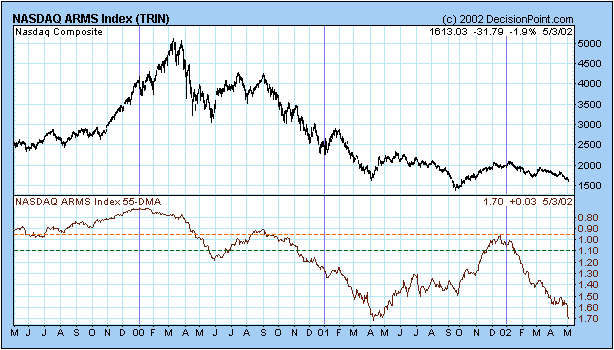
The above chart indicates that, by
one measure at least, the NASDAQ is now as oversold as it has been at any
time since its bear market began in March of 2000.
2. In addition to the panic liquidation
evident in the NASDAQ Arms Index, the overall CBOE put/call ratio was greater
than 0.90 on both Thursday and Friday last week.
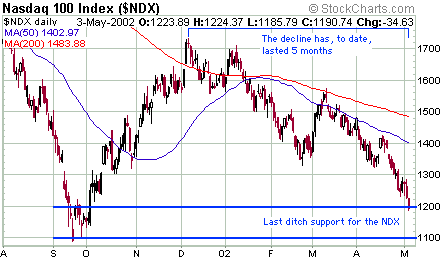
3. As the following chart shows, the
NASDAQ100 (the leader to the downside) has now been falling for about 5
months. Since the bear market began on 24th March 2000 this is the longest
this index has gone without putting together a rally of at least 20%. Also,
the NDX is now near major support dating back to last September's panic.
Rather than trying to pick the exact
bottom or the exact top of a market and then issuing an all-out BUY or
SELL signal on the market, we prefer a scale-in/scale-out approach. We
start to scale-in when our analysis suggests that a market is near a medium-term
bottom and start to scale-out when a market appears to be approaching a
top. At least, that is usually the plan. In accordance with this approach
we are going to add the QQQ July $35 call options (QQQ GI-E) to the Portfolio
at $0.45. We will probably add one or two more positions (stocks or options)
over the next 2 weeks depending on market action.
As noted in last week's Interim Update,
a reasonable plan for those who prefer to limit themselves to longer-term
positions would be to remain on the sidelines during the coming rally (assuming
we do actually get a rally) and use any significant strength in the market
to add to medium-term bearish positions.
This week's important economic/market
events
| Date |
Description |
| Monday April 29 |
No significant events |
| Tuesday April 30 |
FOMC Meeting
Labour Productivity and Costs
Consumer Credit |
| Wednesday May 01 |
No significant events |
| Thursday May 02 |
Import and Export Prices |
| Friday May 03 |
Producer Price Index |
Click
here to read the rest of today's commentary

|









