|
-- for the Week Commencing 8th July 2002
Forecast
Summary
 The
Latest Forecast Summary (no change from last week) The
Latest Forecast Summary (no change from last week)
Big Picture
View
Here is a summary of our big picture
view of the markets. Note that our short-term views may differ from our
big picture view.
Bond yields (long-term interest
rates) will move higher during 2002.
The US stock market will reach
a major bottom (well below the September-2001 lows) during the second half
of 2002.
The Dollar commenced a bear
market in July 2001 and will continue its decline into 2003.
A bull market in gold stocks
commenced in November 2000 and is likely to extend into 2003.
Commodity prices, as represented
by the CRB Index, will rally during 2002 and 2003.
The oil price will resume its
major uptrend during the first half of 2002.
Inflation,
Prices and Interest Rates
Defining our terms
There may not be anything that is as
universally misunderstood as inflation. Even those analysts who understand
the link between money supply growth and prices usually talk about inflation
as if it is an increase in prices, that is, as though inflation is a consequence
of money supply growth. They hence confuse cause and effect, a mistake
that leads to other analytical errors. Inflation is simply an increase
in the supply of money and it results in prices being higher than
they would be in the absence of the inflation.
Here is a quote from a 1951 article
written by the great Ludwig von Mises on the topic of inflation:
"To avoid being blamed for the nefarious
consequences of inflation the government and its henchmen resort to a semantic
trick. They try to change the meaning of the terms. They call "inflation"
the inevitable consequence of inflation, namely, the rise in prices.
They are anxious to relegate into oblivion the fact that this rise is produced
by an increase in the amount of money and money substitutes. They never
mention this increase."
The popular and totally misleading
definition of inflation (that inflation is an increase in prices) is perpetuated
on a daily basis in the press, more through ignorance than malice. For
example, if the oil price rises then this is deemed to be "inflationary"
or to be creating "inflationary pressures", but a rise in the oil price
cannot possibly cause a rise in the general price level unless the Fed
monetises the increase in the oil price. If the total supply of money remains
the same then a higher oil price must be offset by lower prices elsewhere.
In other words, if consumers are forced to spend more money on oil and
the money supply remains constant then they will need to cut down on other
expenditures. Other prices will hence fall. It is only when the Fed facilitates
an increase in the total supply of money (the Fed does this by holding
interest rates too low) that an increase in the oil price can lead to an
increase in the general price level. However, if OPEC pushes the oil price
sharply higher and if this oil price increase is followed by a rise in
the general price level, who will get the blame for causing the 'inflation
problem'? The answer is obviously OPEC, but the true culprit in this case
is the Fed.
Here's another quote from the same
von Mises article:
"What the bureaucrats have in mind
when talking about "fighting" inflation is not avoiding inflation,
but suppressing its inevitable consequences by price control."
The bureaucrats that von Mises refers
to have become a lot more sophisticated over the years. They no longer
attempt to directly control prices using draconian measures such as price
caps because such policies blew-up in their faces during the 1970s. These
days they focus on managing perceptions. This involves, in part,
perpetuating the lies that a) inflation is an increase in prices, and b)
the CPI accurately represents the increase in prices. Over the past 7 years
it has also involved the "strong Dollar policy". In fact, the government
bureaucrats and politicians in the US have enjoyed considerable success
in managing inflation perceptions over the past several years primarily
because the Dollar has been in a powerful up-trend. With the Dollar now
in a bear market the effects of inflation are going to become progressively
more obvious as the months go by and a point will be reached when it will
no longer be possible to conceal these effects by simply reporting a low
CPI.
By the way, the above-quoted von Mises
article can be read at: http://www.mises.org/efandi/ch19.asp
Prices and interest rates
Reuters Business Report, July 05: "I
don't think there is any inflation danger that's worrying the Fed at this
point," former Fed governor Lyle Gramley said. "At this juncture the Fed
does not want to see the inflation rate going any lower, it does not want
to see us flirt with deflation."
Of course, when Lyle Gramley talks
about inflation and deflation he is incorrectly referring to changes in
prices. He is either deliberately or accidentally oblivious to the fact
that last year's inflation rate (money supply growth rate) was the highest
it has been since 1973. He has a lot of company.
Our bullish view on commodity prices
is helped a lot by the fact that the consensus view still seems to be that,
out of deflation and inflation, deflation represents the bigger threat.
The longer that those who set monetary policy and who influence monetary
policy remain unconcerned about the rise in commodity prices or believe
there are other more pressing concerns, the greater the eventual rise in
commodity prices will be. We doubt that there will be any need to deviate
from our inflation thesis until most people have become intensely worried
about inflation and the Fed has come under enormous pressure to do something
to stop the inflation.
As inappropriate as the commonly-accepted
definition of inflation is, it is this definition that determines monetary
policy. In other words, the rate of money supply growth can soar to incredible
heights but it will not be until the inflation causes certain prices to
rise that there will be a perceived inflation problem that requires
some action on the part of the central bank.
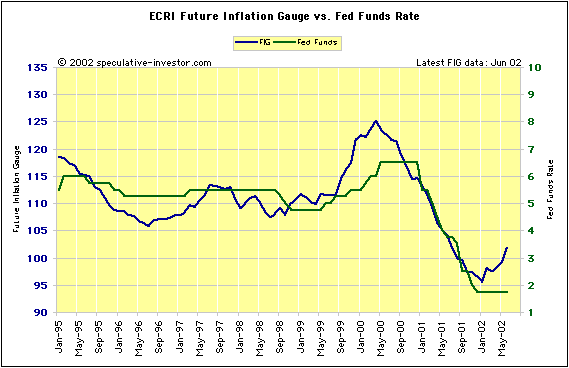
The following chart, which shows the
ECRI's Future Inflation Gauge (FIG) in blue and the Fed Funds Rate (FFR)
in green, illustrates the relationship between prices and monetary policy.
The "Future Inflation Gauge" would be more aptly called the "Future CPI
Gauge" since it is designed to predict changes in the CPI rather than changes
in inflation. The chart only goes back to 1995, but trend changes in the
FFR have followed trend changes in the FIG with remarkable consistency
since Greenspan became Fed Chairman in 1987. Over the past 10 years the
lag between a directional change in the FIG and a directional change in
monetary policy has been 6-8 months. On this basis, since the FIG turned
higher in February we should expect the Fed to commence a series of rate
hikes by October at the latest.
Due to the problems in the tech and
telecom sectors and the consequential problems faced by the large commercial
banks, we would not be surprised if this year's lag between changes in
the FIG and changes in the FFR turns out to be longer than usual. That
is, it is probably going to take a lot more evidence of the effects of
inflation, this time around, to push the Fed into action.
The US
Stock Market
Bottom Fishing
In his book "The Education of a Speculator"
Victor Niederhoffer defines a stock market panic as any time when a daily
Dow Jones Industrials closing price falls by at least 10% from the highest
close during the preceding 30 calendar days (with no overlapping allowed).
Such panics are quite rare. For example, during the 47-year period from
1950 to 1996 there were 19 panics, or an average of one every 2.5 years.
However, between April 16, 1931, when the Dow was at 163, and July 4, 1932,
when it hit 43, there were 16 non-overlapping 10% panic declines.
Many of the traders and investors who
were smart enough to make it through the crash of 1929 relatively unscathed
were eventually wiped out during the devastating and relentless decline
of 1931-1932. Looking back from the present it isn't hard to imagine that
each 10% panic decline during 1931-1932 would have been greeted with calls
of "this is the bottom!" and would have sucked-in more speculators eager
to get on board for the next bull run. However, it was only after the 16th
such decline that a sustainable bottom was reached.
There are certainly some similarities
between the current environment and the early-1930s, such as the chart
pattern of the NASDAQ Composite Index and the crash in corporate profits
in the tech/telecom sectors. However, there are also some enormous differences.
For example, during the early-1930s the total supply of US Dollars was
contracting at a rapid rate and the Dollar was becoming more valuable,
while today we have rampant inflation and the Dollar is becoming less valuable.
Therefore, although today's Dow will not escape falling to much lower levels,
it won't fall by anywhere near as much as it fell during the 1930s (we
think the final bottom will be somewhere in the 7,000-8,000 range). In
our view, those who are predicting a total collapse in the Dow to 2,000
or lower aren't taking into account the devaluation of the Dollar.
One of the lessons from the 1930s'
bear market is that it can be very dangerous to try to pick the bottom
if you are speculating with money you can't afford to lose. A lot of tech
stocks have fallen by 90% or more and, as mentioned in past commentaries,
it is becoming very easy to identify good value in the tech sector. However,
the stocks are still falling fast and we haven't yet seen any evidence
that a sustainable bottom has been reached. As such, the risks are
still great. Remember, the difference between buying a stock when it is
down by 90% from its high and when it is down by 95% from its high isn't
5%, its 50%.
Current Market Situation
Our short-term forecast, as outlined
in last week's Interim Update, was for:
a) Some follow-through to the upside
last Friday and perhaps early this week if the July 4 holiday in the US
passed without a terrorist attack
b) A subsequent drop to new lows that
would probably create an opportunity to 'go long' for a 1-2 month trade
We certainly got some follow-through
to the upside on Friday. The increases in the indices on Friday were impressive,
but even more impressive was the breadth of the rally. For example, on
both the NYSE and the NASDAQ the number of advancing stocks was almost
three times the number of declining stocks. Furthermore, the ratio of up-volume
to down-volume on the NYSE was almost 7:1 whereas on the NASDAQ it was
a phenomenal 17:1. In fact, Friday's rally was strong enough to make us
seriously consider the prospect that last Wednesday's low will hold for
the next few months.
The market has been in a capitulation
phase for the past several weeks and although we haven't yet seen outright
panic we've certainly seen a healthy degree of fear. As noted in last week's
Interim update the 10-DMA of the Arms Index recently hit its highest level
in many years (perhaps even an all-time high). This indicates that the
selling pressure has been narrowly-focussed and extreme ("get me out of
this loser at any price!"). Also, Market Vane's bullish consensus has been
18% for each of the past 2 weeks. This is the lowest 2-week total over
the past 5 years (our records for this sentiment survey only go back to
1997).
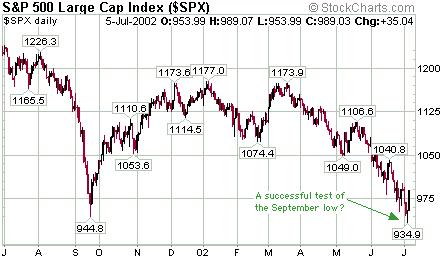
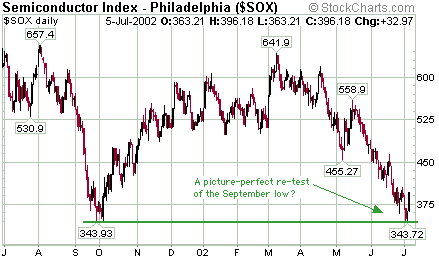
From a chart perspective the market
is also showing some signs of having bottomed. For example, below are charts
of the S&P500 and the Semiconductor Index (SOX). Friday's surge increases
the probability that these indices have just completed successful re-tests
of their September lows. The NASDAQ Composite Index moved well below its
September-2001 low during the first half of last week, but closed the week
well above last year's low so this index has also potentially completed
a successful re-test of last September's bottom.
The NASDAQ100 Index blew right through
last year's low during the recent decline and remains below this support
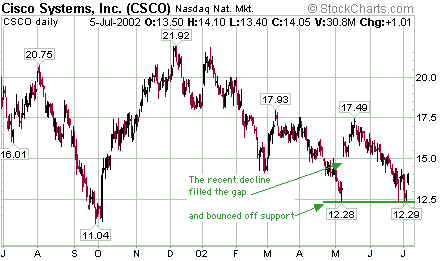
(now resistance) level. However, the stock price of Cisco (we consider
CSCO to be a leading indicator of the tech sector) remains well above last
year's low. In fact, CSCO appears to have just completed a successful test
of its May-2002 low with the recent decline having filled the huge gap
created during the early-May surge.
Further to the above there is a chance
that the stock market has just completed an intermediate-term bottom, although
the probability that last week's low will be the ultimate low or even the
low for this year is close to zero.
Unfortunately, one important piece
of the puzzle - the Commitments of Traders Report - wasn't released last
week as per its usual schedule. Therefore, we don't yet know if the decline
during the early part of last week prompted the commercials to cover a
lot of their S&P500 'shorts' and the small traders to liquidate a substantial
portion of their 'longs'. The COT Report will be released on Monday and
we'll probably put out a Market Alert e-mail after we've had a chance to
review the data.
Between now and September there is
likely to be a decent (1-2 month) counter-trend rally in the stock market,
with the main question in our minds being whether this rally has already
begun or if it will begin following a drop to new lows over the next 2
weeks. The next fortnight is a risky time because it is the tail-end of
the earnings pre-announcement season, so whatever negative surprises are
still out there are likely to emerge during this period. We expect that
once the actual earnings reports start to flow the selling pressure will
abate.
Investors should continue to accumulate
the stocks of commodity producers. Our view is that a bull market in commodities
is in its embryonic stage and that the commodity stocks are going to move
MUCH higher over the coming 12 months. Weakness in the overall market has
caused many of these stocks to mark time or consolidate previous gains,
thus allowing investors to accumulate at attractive prices. Currently,
our three selections are MIM Holdings in Australia (ASX: MIM), BHP Billiton
(BHP trades on several of the major stock exchanges including the ASX and
the NYSE), and Chesapeake Energy (NYSE: CHK).
Before initiating any new short-term
trades we'd wait for either a plunge below last week's lows (in which case
we'd look at buying the QQQ and/or QQQ call options) or a sizeable counter-trend
rally (in which case we'd look at buying QQQ or Dow put options).
This week's important economic/market
events
| Date |
Description |
| Monday July 08 |
Consumer Credit |
| Tuesday July 09 |
No significant events |
| Wednesday July 10 |
Import and Export Prices |
| Thursday July 11 |
PPI |
| Friday July 12 |
Retail Sales |
Click
here to read the rest of today's commentary

|









