|
-- for the Week Commencing 15th July 2002
Forecast
Summary
 The
Latest Forecast Summary The
Latest Forecast Summary
Big Picture
View
Here is a summary of our big picture
view of the markets. Note that our short-term views may differ from our
big picture view.
Bond yields (long-term interest
rates) will move higher during 2002.
The US stock market will reach
a major bottom (well below the September-2001 lows) during the second half
of 2002.
The Dollar commenced a bear
market in July 2001 and will continue its decline into 2003.
A bull market in gold stocks
commenced in November 2000 and is likely to extend into 2003.
Commodity prices, as represented
by the CRB Index, will rally during 2002 and 2003.
The oil price will resume its
major uptrend during the first half of 2002.
Next Year's
Headlines
When it comes to economics we don't
know very much, but this usually works to our advantage because it forces
us to rely on a few simple and reliable leading indicators. Our simplistic
approach has, in turn, met with some success.
The leading indicators that we watch
can be put into two categories - monetary and financial market. The most
important of the monetary leading indicators is the CPI-adjusted M2 growth
rate while the main financial market leading indicators are bond yields,
the yield spread (the difference in yield between shorter-term and longer-term
debt instruments), and the performances of economically-sensitive stocks.
Today we are going to have a quick look at what the CPI-adjusted M2 growth
rate and the stock prices of economically-sensitive companies are doing
in an attempt to figure out what next year's news headlines are going to
be.
Money Supply Growth
Paul Kasriel, the head of economic
research at Northern Trust, has demonstrated that the CPI-adjusted M2 growth
rate is not just a good leading indicator of economic growth, it is probably
the single best leading indicator. In fact, in his 1st March 2002 commentary
at http://www.ntrs.com/library/econ_research/weekly/us/020301.html
PK shows that, over the past 42 years, there has been a correlation of
0.71 between the CPI-adjusted (sometimes called the "real") M2 growth rate
and "Final Sales to Domestic Purchasers" when the real M2 growth rate
is advanced by 6 months. For those with no grounding in statistics,
a correlation of 0.71 is very significant.
Below is a chart showing the CPI-adjusted
year-over-year M2 growth rate since the beginning of 1998. We don't like
to use the CPI numbers reported by the US Government in any of our analyses
because they have been manipulated well beyond the point of usefulness,
but in those cases when we must use the CPI we will typically use the median
CPI reported by the Cleveland Fed (refer to http://www.clev.frb.org/Research/mcpi.htm
for a description of the median CPI). This is simply because changes in
the "median CPI" more accurately represent changes in the cost of living
than do changes in the more popular "core CPI". The M2 growth rates used
to construct the below chart have therefore been adjusted for annualised
percentage changes in the median CPI.
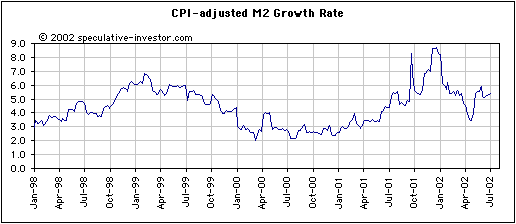
The surge in the real M2 growth rate
during the second half of 1998 and the maintenance of a robust M2 growth
rate during the first 10 months of 1999 ensured that economic growth would
be strong throughout 1999 and during the first half of 2000. The plunge
in the real M2 growth rate between October-1999 and March-2000 and the
continued low growth rate throughout 2000 ensured that the economy would
slow dramatically during the second half of 2000 and the first half of
2001. The pick-up in real M2 growth during the first half of 2001 would
have ensured that an economic rebound was well under way by the fourth
quarter of 2001 if not for the events of Sep-11, but in any case the phenomenal
surge in real M2 growth during the final quarter of last year all but guaranteed
strong economic growth during the first half of this year.
The real M2 growth rate plunged during
the first 4 months of this year. However, thanks to a bear market rally
in bond prices real M2 has rebounded somewhat over the past 2 months (the
bond market is the major influence on money supply growth). The current
level of 5%, while down a long way from last year's peak, is still consistent
with moderate economic growth over the remainder of this year (the economy
didn't hit a brick wall in 2000 until the real M2 growth rate fell to around
2%).
We expect the US economy to expand
throughout the remainder of this year, but if our forecasts for bonds and
commodities come to fruition then the real M2 growth rate will have fallen
to 2% or lower by the end of 2002 (rising commodity prices will put upward
pressure on consumer prices at the same time as rising interest rates are
crimping money supply growth). As such, we doubt that the US economy will
experience any significant growth during the first half of next year.
The Stock Market
We don't consider the stock market,
as a whole, to be a good leading indicator of the economy. However, the
stock prices of those companies that are highly leveraged to economic growth
(eg, General Motors and Caterpillar) are good leading indicators
of economic growth. These companies are called "cyclicals".
We track the performance of cyclical
stocks as a group via the Morgan Stanley Cyclicals Index (CYC). The below
chart shows the performance of CYC since the beginning of 1998.
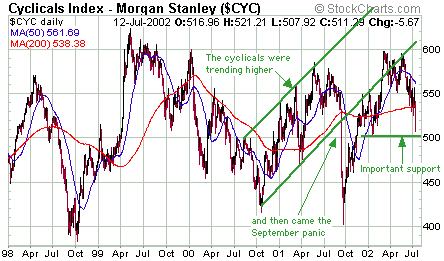
CYC surged by 50% between October 1998
and mid-1999, thus foreshadowing the strong economy of 1999 (economic growth
peaked during the final quarter of 1999). CYC then trended lower until
October of 2000, thus warning of an economic slowdown during the second
half of 2000 and the first quarter of 2001. CYC moved within an upward-sloping
channel during the first 8 months of 2001, suggesting that the US economic
slowdown of 2001 would be short-lived. As it turned out, any thoughts of
recovery were temporarily obliterated on the morning of September-11 and
the economically-sensitive stocks were hard-hit. However, the rebound during
the final quarter of 2001 was so dramatic that by early-2002 CYC had moved
back into its pre-September-11 channel, thus foreshadowing strong economic
growth during the first half of 2002. Then, CYC began to grind lower.
CYC has been very weak over the past
2 months, but at this stage the technical damage is minimal. However, a
decisive move below 500 would break its intermediate-term up-trend and
would be a very clear warning of another pronounced slowdown in economic
growth. Note that a breakdown in CYC at this time would not contradict
the message currently being sent by the real M2 growth rate since it is
not uncommon for CYC to change direction 6-9 months in advance of a change
in the economy.
Debt Deflation
We regularly hear the argument that
it doesn't matter how much money the Fed prints because a much larger amount
of money will be destroyed as a result of debt defaults and bankruptcies.
Putting aside the fact that the Fed is responsible for creating only a
very small portion of the money that comes into existence each year, the
above-mentioned argument contains some big logical flaws.
If a company goes bankrupt, no money
is destroyed. If someone defaults on a loan, no money is destroyed.
To illustrate this point lets look at a hypothetical case involving Bob,
Al and Ted. Bob lends Al $1M which Al promptly spends buying optical networking
equipment from Ted. Al subsequently runs into financial trouble and notifies
Bob that he cannot repay the loan. Bob, realising that the equipment purchased
by Al from Ted is essentially worthless and that Al has no other assets,
decides to write-off 100% of the loan. So, in this example Al is now bankrupt,
Bob has taken a loss of $1M and Ted has gained $1M. There is no change
in the total supply of money.
Now assume that Bob is actually a major
bank called Citimorgan. If the size of Al's loan is large or there are
a lot of people in Al's predicament, then Citimorgan's ability to make
future loans could be impaired and the money supply growth rate could therefore
plunge. If people like Al keep defaulting there is even a chance that Citimorgan
could become technically insolvent. The chairman of Citimorgan, a well-connected
gentleman named Sanford Rubin, is concerned about his company's plight
and how the entire economy could be adversely affected so he calls his
friend Alan Greenspan at the Fed. Greenspan, of course, is well aware that
the money supply must be continually expanded lest the whole pyramid scheme
collapse and comforts his friend by saying something like "Don't worry
Sandy. As I said in January 1997 and on numerous other occasions, central
banks can issue currency, a non-interest-bearing claim on the government,
effectively without limit. They can discount loans and other assets of
banks or other private depository institutions, thereby converting potentially
illiquid private assets into riskless claims on the government in the form
of deposits at the central bank. So, we'll take those bad loans off your
books at 90% of face value with payment being made immediately via a transfer
of funds to Citimorgan's account at the Federal Reserve Bank of your choice."
In this example Citimorgan gets enough
new money to enable them to continue their lax lending practices and, in
the process, keep the total supply of money growing. And, as a result,
the US$ falls in value relative to other national currencies, relative
to hard money (gold), and relative to tangible assets such as commodities
and real estate. And, everybody lives happily ever after. Well, not quite.
The US
Stock Market
The Big Picture
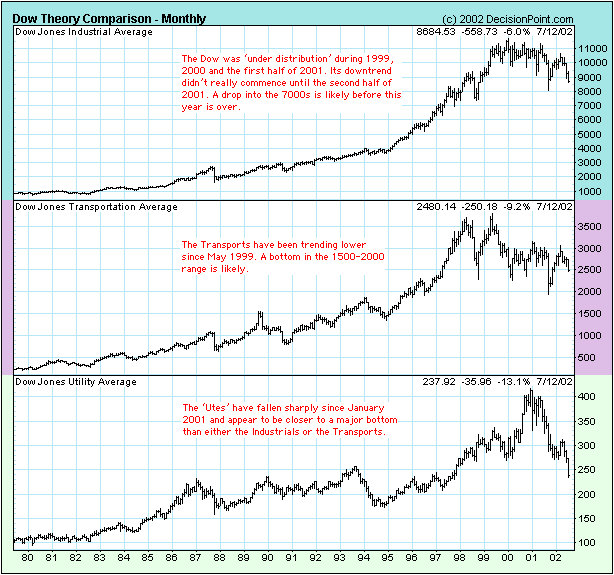
Below are monthly charts of the Dow
Industrials, the Dow Transportation and the Dow Utilities indices.
Current Market Situation
At the risk of sounding like a broken
record (whatever that means), we think the stock market is close to a short-term
bottom but it hasn't bottomed yet. Some parts of the market, such as the
beaten-down telecommunications and networking sectors, almost certainly
have reached short-term bottoms. As such, towards the end of last week
we suggested buying Lucent on a pullback and added Nortel Networks to the
Portfolio. However, we expect the Dow Industrials and the S&P500 to
make new lows over the coming week. Why? Because although the evidence
continues to build that we are close to a bottom, we haven't yet seen enough
capitulation to give us any confidence whatsoever that anything more than
a 1-3 day bounce is possible. When a downtrend has been as relentless as
the current downtrend has been it is unlikely to end until the vast majority
of participants have given up hope of a meaningful rally.
Here are 3 signs that hope has not
yet been abandoned. Firstly, the latest Commitments of Traders Report reveals
that small traders are still clinging to a large net-long position (74,000
contracts as at 9th July), despite the sharp fall in the S&P500 over
the past few weeks. Lower prices will obviously be necessary to prompt
some serious 'towel throwing'. Secondly, although we saw a healthy spike
in volatility over the past week the volatility indices did not come anywhere
near the levels reached last September. We don't expect volatility to reach
the extremes of last September unless another horrific and unforeseen event
occurs, but higher levels of volatility than occurred last week will probably
be needed before a sustainable upturn can eventuate. Thirdly, put-option
volumes have remained quite low. In fact, over the final 3 days of last
week the open interest in QQQ put options increased by only 60,000 contracts
while the open interest in QQQ call options increased by 300,000 contracts.
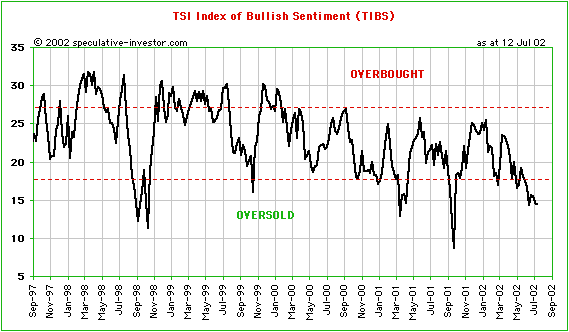
The TSI Index of Bullish Sentiment
(TIBS) is a weighted average of 6 different sentiment indicators. It is
currently well into oversold territory but has not yet reached the extremes
of October 1998 or March 2001 and is nowhere near the level reached last
September.
So, it's certainly not time to throw
caution to the wind as far as trading on the long-side of the market is
concerned. A reasonable approach, however, is to begin averaging-into one
or two of the most beaten-down telecom stocks. Traders should also look
to exit all remaining put option positions during any day when the VIX
moves above 45 or the VXN moves above 80.
A reasonable approach for longer-term
investors is to maintain a large cash position and to gradually accumulate
the stocks of commodity producers on weakness. Also, take small initial
positions in some of the hard-hit telecom stocks (our favourites are Nortel
(NT), LightPath Technologies (LPTH) and Lucent (LU) in North America and
Telstra (TLS) in Australia).
This week's important economic/market
events
| Date |
Description |
| Monday July 15 |
No significant events |
| Tuesday July 16 |
Industrial Production
Intel's quarterly results |
| Wednesday July 17 |
New Residential Construction |
| Thursday July 18 |
Leading Economic Indicators
Microsoft's quarterly results
Nortel's quarterly results |
| Friday July 19 |
CPI
Trade Balance |
Click
here to read the rest of today's commentary

|









