|
-- Weekly Market Update for the Week Commencing 15th December 2003
Big Picture
View
Here is a summary of our big picture
view of the markets. Note that our short-term views may differ from our
big picture view.
Bond yields (long-term interest
rates) reached a major low in June of 2003 and will trend higher until
at least mid 2004.
The US stock market will reach
a major bottom (well below the October-2002 low) during 2004.
The Dollar commenced a bear
market in July 2001 and will continue its decline during 2003 and 2004.
A bull market in gold stocks
commenced in November 2000 and will continue during 2003 and 2004.
Commodity prices, as represented
by the CRB Index, will rally during 2003 and 2004 with most of the upside
occurring in 2004.
Copyright
Reminder
The commentaries that appear at TSI
may not be distributed, in full or in part, without our written permission.
In particular, please note that the posting of extracts from TSI commentaries
at other web sites or providing links to TSI commentaries at other web
sites (for example, at discussion boards) without our written permission
is prohibited.
We reserve the right to immediately
terminate the subscription of any TSI subscriber who distributes the TSI
commentaries without our written permission.
China
China's trade surplus
According to some US politicians, China's
currency -- the Yuan -- is pegged to the US$ at an unrealistically low
rate. As a result China gains an unfair trade advantage because its exports
are much cheaper than they would be if the Yuan's exchange value were set
by the market. This, in turn, means that local US manufacturers can't compete
and US-based jobs are lost. At least, that's the way the argument goes.
As is almost always the case, though, the political spin bears little resemblance
to reality.
If China's currency were significantly
under-valued then China's trade surplus would be increasing. However, China's
trade surplus actually fell by 40% over the first 10 months of this year
and if the values of China's imports and exports continue to grow at their
current rates then China will be running a monthly trade deficit
within 12 months. Therefore, a reasonable argument could be made that the
Yuan is actually over-valued relative to a trade-weighted basket
of other currencies.
China is running a large and growing
monthly trade surplus with the US, but this surplus has not resulted from
an under-pricing of China's currency. For example, despite the sharp rise
in the euro relative to the US$ the US trade deficit with Europe increased
by 7.5% in October (the most recent month for which figures are available).
In the same month the US trade deficit with China increased by 10%. Clearly,
the current Yuan/US$ exchange rate is NOT a major driving force behind
the US trade deficit.
The primary driving force behind the
persistently-large US trade gap is the massive expansion of credit in the
US. The US continues to spend a lot more than it produces and the current
policies of both the Fed and the US Government are specifically designed
to promote increased spending and borrowing. That is, the policies are
designed to promote a higher trade deficit.
China, by the way, is experiencing
a massive credit expansion of its own and this is why its trade surplus
is shrinking at a rapid rate.
China, commodities, and US bonds
In a recent article at http://www.gold-eagle.com/editorials_03/field120503.html
Alf Field provides a good explanation of why the Chinese have been buying
loads of US Government bonds and why they will continue to do so. The key
section from this article is:
"China must know that it is selling
real goods to the USA and being paid in pieces of paper that will ultimately
be worth a lot less.
The Chinese understand they will
one day have to take a loss on their dollar reserves, but this is the price
that they are willing to pay to maintain the existing order. The longer
they perpetuate the system, the faster their industrial infrastructure
will grow and the greater the number of Chinese finding jobs. A fall in
the value of their accumulated foreign reserves is a price they are prepared
to pay in the interests of laying a foundation for their country's long-term
growth."
Alf Field thinks that the current situation
will only change when the US takes unilateral action to change it in order
to protect US jobs. However, as discussed above the Yuan/US$ exchange rate
has very little to do with the loss of US jobs and, despite what they say,
we suspect that senior members of the US Administration know it. And we
are sure that Alan Greenspan knows it because he said so last week (http://biz.yahoo.com/rb/031211/economy_greenspan_5.html).
Our view is that the situation will
change when China is forced to take definitive measures to slow its rate
of credit expansion and/or when it begins to suffer the negative consequences
of having a currency which is pegged to the US$. One important negative
consequence of pegging your currency to a faltering US$ is that you will
end up paying a higher price for much-needed commodities such as copper
and oil.
The above-mentioned article by Alf
Field is generally very good, but it contains two other comments that we'll
take issue with.
The first is the comment that the euro
is a viable reserve asset. In our opinion, as a reserve asset the euro
is no more viable the US$. The advantage that the euro has had over the
US$ during the past few years and continues to have at this time is that
it is relatively under-valued, which makes it a better investment than
the US$ for the moment but doesn't make it a more viable reserve asset.
The second is the comment that commodity
prices will plunge in an environment in which the US$ is imploding and
the US's trading partners are printing money like crazy in order to prevent
their currencies from getting too strong relative to the dollar. This makes
no sense at all because the price of every commodity is determined by its
own supply/demand as well as by the supply/demand of the currency in which
its price is denominated. In other words, if the currency is weak enough
then the price of any commodity can rise during a recession. In the above-described
environment the only currency against which commodity prices would likely
fall is gold.
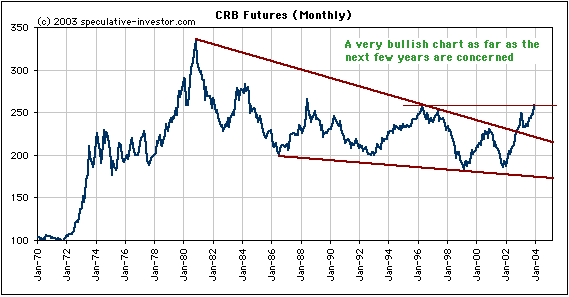
The idea that commodity prices will
experience a dramatic decline at some point over the next few years is
also at odds with long-term commodity-price charts. These charts generally
show prices turning higher from long-term bases and/or consolidation patterns.
For example, the below chart of CRB Futures shows a very decisive upside
breakout from a 20+ year consolidation pattern. This chart suggests that
the CRB Index will, at a minimum, challenge its 1980 high within the next
few years.
The bull market in commodities will,
of course, experience some gut-wrenching corrections along the way as all
bull markets do. In fact, one such correction will probably begin during
the next few months in response to a worldwide slowdown in credit growth
and consequential pullback in spending/investment.
The money-supply
growth slowdown continues
Transactions to buy/sell assets do
not affect the total money supply. For example, when a stock or a bond
or a house is purchased an amount of money is simply transferred from the
seller to the buyer, but the total amount of money in the economy does
not change. The only way the money supply changes is through changes in
the level of indebtedness. Specifically, the money supply increases when
the total mount of new debt coming into existence exceeds the amount that
is being repaid and it decreases when old debts are being repaid at a faster
rate than new debts are being created.
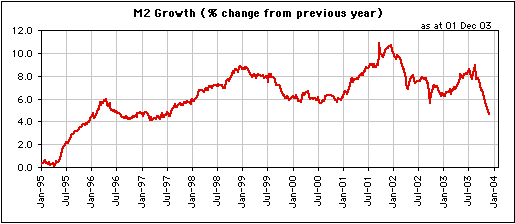
The recent sharp slowdown in the M2
growth rate illustrated on the below chart is therefore evidence that the
rate at which people are taking on new debt has been falling relative to
the rate at which they are repaying their existing debts. In other words,
it looks like US households might be making a decision to increase their
collective savings rate. In the long-term, saving more money is something
from which the country benefits. However, it must be aggressively discouraged
during the 12 months leading up to a presidential election.
The US
Stock Market
Speculating on a stock market decline
We added a position in USPIX -- a fund
that is designed to move by twice the inverse of the NASDAQ100 Index each
day -- to the Stocks List at last Thursday's price of $22.55.
We've mentioned in previous commentaries,
including last week's Interim Update, that leveraged bear funds such as
USPIX are high-risk speculations that should only be purchased with risk
capital (money you can afford to lose). Such speculations need to be actively
monitored and are not suitable for conservative investors. In this regard
the following comments from the 20th October Weekly Update are worth repeating:
"...once we get some clear evidence that the ultimate recovery high is
in place for the market most people will probably be better served by simply
retreating to the safety of cash and/or gold bullion as opposed to speculating
on the short side. After all, if stocks fall by 50% then the purchasing
power of your cash will have effectively gained 100% (the same dollar will
purchase twice as much stock)."
In our opinion, your overriding goal
during a major stock market decline should be to have substantial cash
reserves that can be put to work after the market has bottomed.
This is because it is a lot easier to make money on the long side during
a rally than it is to make money on the short side during a decline (for
the reasons explained in the 20th October Weekly Update). You could certainly
increase your cash reserves if you made some well-timed short-side bets
during the decline, but by making these short-side bets you also run the
risk that you will end up with less cash to invest near the bottom.
In other words, play defense during the declines so that you can be in
a position to attack during the advances.
By the way, over the past year we have
made a few small bearish speculations but have generally been heavily 'long'
the market via our exposure to gold stocks and commodity stocks. And, although
we have just added an initial position in USPIX to the Stocks List we remain
heavily long. If things go as planned we will cut back on our exposure
to the stock market over the next couple of months and add one or two more
bearish speculations, but the way we are positioned right now we will fare
much better if the market continues to advance.
No bear...yet
There is no doubt that the tech, telecom
and internet sectors of the stock market are immersed in major bear markets.
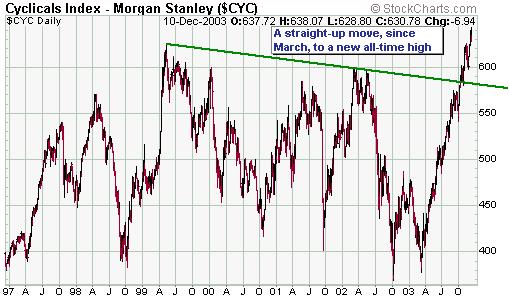
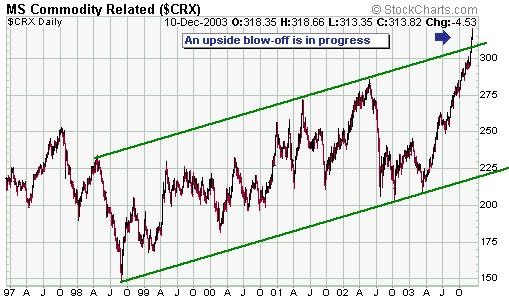
However, many other sectors are clearly NOT immersed in bear markets. We
say this because new all-time highs have been reached in many important
sectors of the market over the past few months and stocks that are in bear
markets simply do not surge to new all-time highs. For example, the Morgan
Stanley Cyclicals Index (CYC) and the Morgan Stanley Commodity-Related
Equities Index (CRX) have recently made decisive moves to new all-time
highs (see charts below). This is not, by the way, a longer-term bullish
argument because it means that the bear market, for many sectors, is yet
to begin.
Current Market Situation
There isn't much to add at this time.
As discussed in recent commentaries, the market appears to be setting itself
up for an important peak in early 2004.
This week's important economic events
| Date |
Description |
| Monday Dec 15 |
No significant events |
| Tuesday Dec 16 |
CPI
Current Account
Industrial Production
New Residential Construction |
| Wednesday Dec 17 |
No significant events |
| Thursday Dec 18 |
Leading Economic Indicators |
| Friday Dec 19 |
No significant events |
 Click
here to read the rest of today's commentary Click
here to read the rest of today's commentary

|









