|
-- for the Week Commencing 16th April 2001 (page 1 of 2)
Forecast
Summary
 The
Latest Forecast Summary The
Latest Forecast Summary
Bonds and
Inflation
Inflation - the Cornerstone of our
Monetary System
As is often the case, the financial
markets and the financial media are currently agonising over what the Fed's
next move will be and when it will occur, as if a change to official interest
rates will have a dramatic monetary effect. A Fed rate cut at this time
would certainly have a big effect, particularly if it was an inter-meeting
'surprise' rate cut, but the effect would be psychological not monetary.
The market has already taken short-term interest rates well below official
interest rates and the financial sector has been adding liquidity at one
of the fastest rates in decades, so a fully-fledged monetary easing has
already happened. Whether the Fed slices a few more basis points from the
Fed Funds Rate is neither here nor there. We don't, however, under-estimate
the psychological effect of an 'official' cut, especially as far as the
stock market is concerned. If enough people believe a Fed rate cut will
be good for the stock market and the economy, it will be good for
the stock market and the economy.
As far as the monetary environment
goes, US Government bond prices are more important than the Fed. As we've
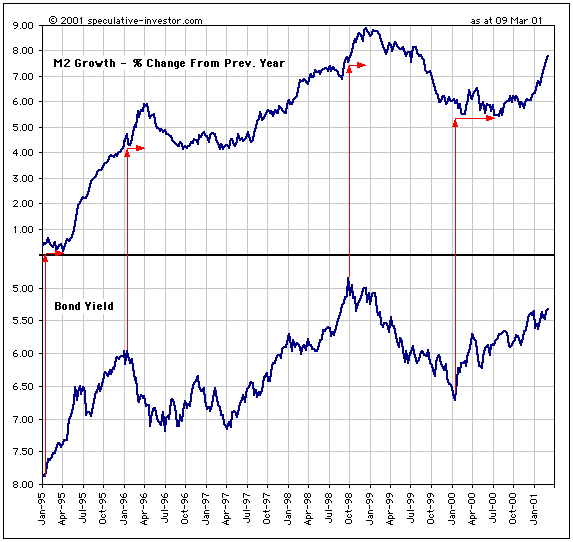
previously shown, the M2 growth rate follows the T-Bond such that major
peaks in year-over-year M2 growth occur a few months after major peaks
in the bond market. Below is a chart that illustrates this point.
Once the purchasers of long-term bonds
begin to anticipate higher inflation they will demand compensation in the
form of higher interest income. In other words, they will pay less for
the bonds. We think we are close to the point of realisation, the point
when the market begins to accept that one of the consequences of the explosive
growth in the supply of dollars is that a dollar will be worth less. Inflation
has
happened and is happening, all that is left for the market to do
is to account for the inflation in the prices of bonds.
Inflation is not only happening at
this time, it must continue to happen because that is the only way the
existing monetary system can survive. A 'ponzi scheme' collapses as soon
as the money coming in from new investors becomes insufficient to pay-off
the earlier investors. A system in which money comes into existence through
the creation of debt (our current monetary system) is similar. Firstly,
each new dollar brings with it a liability in excess of one dollar (due
to the obligation to pay interest). Secondly, the debt is backed by assets,
so the general level of asset prices cannot be permitted to fall lest gaping
holes appear in the balance sheets of the banks. The only way that old
debts can be paid and asset prices supported is through an increase in
the supply of money.
Getting back to the relationship between
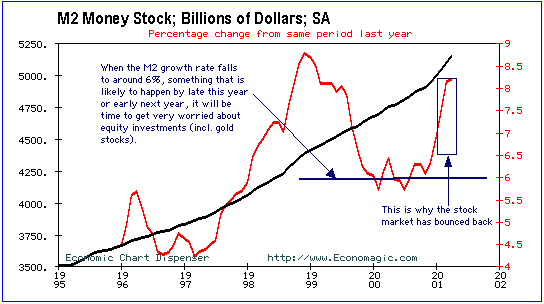
T-Bonds and the M2 growth rate, if we are right and bonds have either peaked
or are within a few weeks of peaking then the M2 growth rate will peak
by August this year. If recent history is anything to go by the financial
markets are going to run into difficulty whenever the M2 growth rate drops
to around 6% (like a junkie needing higher and higher doses of a drug in
order to get the desired effect, the US financial system now appears to
need
an M2 growth rate of at least 6%). The chart below shows the current situation.
Our guess is that it will probably take approximately 12 months of declining
bond prices for the M2 growth rate to drop to this level. Therefore,
around the middle of next year things will get very interesting because
the evidence of inflation will be obvious to everyone, yet more monetary
stimulus will be required at that time to keep the system ticking along.
Bond Market Update
We are going to cancel our short-term
bearish view on bonds. We have good reason to believe that bond prices
will be much lower in 6 months time than they are today (interest rates
will be much higher), but there is a distinct possibility that bonds will
experience a rally in the short-term.
Investing
in an Inflationary World
We are going to have inflation for
at least the next 12 months. Actually, the fact that inflation is a 'necessity
of life' for our present financial system means that we are highly likely
to have inflation for many years to come. The challenge, for we investors,
is to figure out where to put our money in order to profit from the inflation.
Firstly, cash and debt are generally
not good investments in an inflationary environment once the inflation
is recognised. The interest earned on cash sitting in savings accounts
will not adequately compensate for the loss of the currency's purchasing
power, and once people begin to anticipate future inflation the prices
of debt instruments will drop. A rapid increase in the supply of money
will tend to boost asset prices, but which assets will benefit the most?
During the years leading up to the NASDAQ peak in March 2000 it was the
'dot.coms' and anything remotely related to technology that benefited.
That particular asset-price bubble burst, but the underlying debt bubble
lives on. As long as the debt bubble remains in tact, the ability of the
US financial sector and the Fed to create another asset bubble should not
be under-estimated. What we want to know now is where the next bubble(s)
will be.
We think the next speculative mania
will be focused on the shares of resource-producing companies and that
the following sectors will be major beneficiaries:
1. Oil and Gas Producers
During a period when commodity speculation
is reaching a fever pitch we would expect to see the related equities move
way above their long-term trends and become expensive relative to the underlying
commodity. This is because the stocks of commodity producers offer leverage
(a change in the commodity price results in a disproportionately-large
change in the profits of the commodity producers).
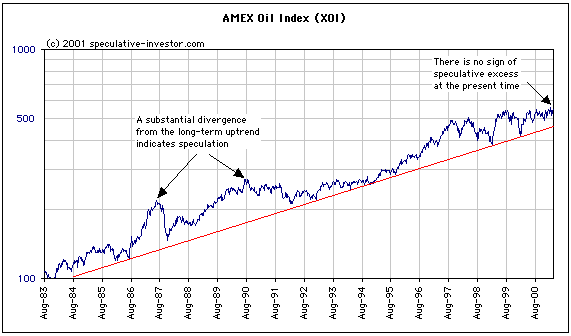
Below is a chart of the AMEX Oil Index
(XOI) with a logarithmic scale. Despite the surge in the oil price since
early 1999 the fact that the XOI has remained quite close to its long-term
trend shows that there has been no speculative bubble. Furthermore, the
present ratio of the XOI and the oil price is near its average levels of
the past decade, indicating that there is no speculative premium built
into today's stock prices.
This means that if the oil price moves
higher over the next 12 months, which we think it will, there is a reasonable
prospect of seeing a speculative premium built into the prices of oil (and
gas) stocks. Bull markets usually don't end until a speculative blow-off
occurs.
The best time to buy the oil stocks
would be during an XOI pullback into the 475-500 range (versus the current
level of around 550). However, there is no guarantee that it will drop
that low.
2. Palladium and Platinum Producers
This is a similar story to oil and
gas in that scarce commodities (the platinum-group metals) have experienced
impressive bull markets over the past few years, yet there has been very
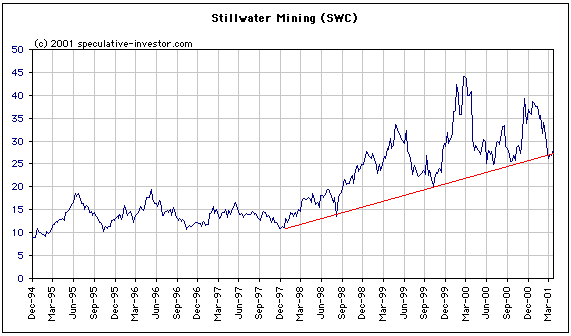
little speculation in the associated equities. Below is a chart of Stillwater
Mining (SWC), North America's largest PGM producer, showing that it has
spiked above its uptrend on a few occasions only to quickly drop back to
the trendline each time. Other PGM producers have fared better than SWC,
but considering the size of the rallies in the underlying commodities (the
palladium price rose by 960% from the beginning of 1997 to its January
2001 peak), the performances of the related stocks have been muted to say
the least. We should therefore see much more upside in the stocks of PGM
producers before this bull market ends.
Our favourite stock in this sector
is North American Palladium (PDL.TO). We've been hoping to add it to the
Portfolio at a sub-C$11 price, but since it is already exceptional value
we will bite the bullet and add it at the current price of C$12.55.
3. Uranium Producers
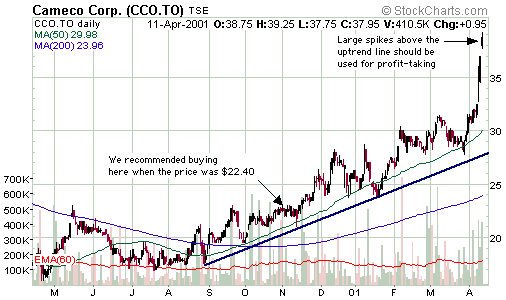
Below is a chart of Cameco (CCO.TO),
the Canadian uranium producer we added to the Portfolio last October. Uranium
producers are going to benefit from the increasing cost of other types
of fuel, and a less-restrictive energy policy from the new US Administration.
CCO should not be bought unless it pulls back to its up-trend line, but
other uranium producers that have not already experienced such large rallies
could be worthwhile investment prospects.
4. Gold Producers
Due to the extreme under-valuation
of gold stocks relative to almost everything else in the world, this is
the area that holds the greatest upside potential of all. Due to the size
of the above-ground gold supply and gold's monetary role, it also entails
more risk than the other opportunities mentioned above.
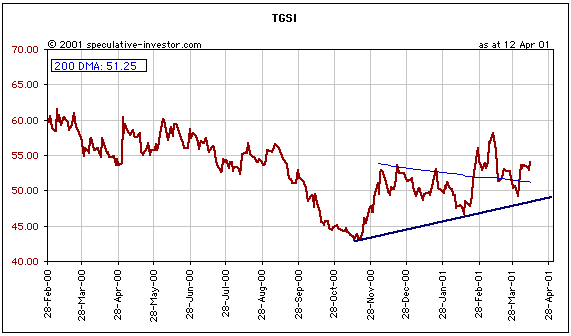
Below is a chart of the TSI Gold Stock
Index (TGSI). The gold price is presently trading below its levels of last
November, yet the TGSI has been in an up-trend since November. This is
a bullish divergence.
5. Technology
Technology doesn't fit into the inflation
theme because most technology companies do not have much pricing power,
but there is one area of technology that already 'bubbled' in 1999-2000
and has a good chance of 'bubbling' again in the years ahead. That area
is optical networking.
Global Crossing (NYSE: GX) has laid
thousands of miles of undersea fibre-optic cable such that its network
now links approximately 200 cities around the world. The physical construction
is almost complete, the challenge now is to sell capacity on the network.
The key points are that with the on-going developments in photonics the
capacity of GX's network is going to be effectively unlimited and the way
the capacity is sold is going to change. Rather than renting a physical
part of the network or a certain amount of bandwidth (capacity), GX's clients
(which will generally be multi-national corporations, stock exchanges,
governments, ISPs and other telecom carriers) will purchase wavelengths
of light. Each single strand of optical fibre will carry light that will
contain thousands of separate wavelengths (thousands of different frequencies
or colours), with each wavelength potentially carrying separate data (or
video or voice) belonging to different clients. Prices to transmit data/video/voice
signals around the world will plummet and traditional carriers will not
be able to compete. Companies such as GX that were able to build their
networks when capital was readily available will take the lion's share
of the market. And the market will grow because plummeting prices will
stimulate demand. If the GX management team can continue to execute its
business plan (the build-out of the network has certainly been well-executed),
the company will become a 'cash cow' in the years ahead as a large percentage
of each new dollar of revenue will become cash in the bank.
In the current market GX is being valued
at less than 1.5 times revenue, with the low valuation being mostly attributable
to the company's high level of debt. It is currently not part of the TSI
Portfolio, but we expect to add it during the next few months. At this
stage we have significant optical exposure via companies that design and
build the components that will maximise the potential of GX's (and its
peers') networks. We like Corning (GLW), LightPath Technologies (LPTH)
and Avanex (AVNX). We don't like Nortel, Cisco, Lucent (or its Agere spinoff),
or JDS Uniphase.
Click
here to read the rest of this week's commentary

|









