|
-- for the Week Commencing 17th June 2002
Forecast
Summary
 The
Latest Forecast Summary The
Latest Forecast Summary
Big Picture
View
Here is a summary of our big picture
view of the markets. Note that our short-term views may differ from our
big picture view.
Bond yields (long-term interest
rates) will move higher during 2002.
The US stock market will make
new bear market lows in 2002.
The Dollar commenced a bear
market in July 2001 and will continue its decline into 2003.
A bull market in gold stocks
commenced in November 2000 and is likely to extend into 2003.
Commodity prices, as represented
by the CRB Index, will rally during 2002 and 2003.
The oil price will resume its
major uptrend during the first half of 2002.
The Very
Big Picture
On a few occasions over the past 2
years we've reviewed long-term charts of the ratio between the Dow Industrials
Index and the gold price (the Dow/gold ratio tells us the number of ounces
of gold it takes to buy the Dow). The following chart shows where the ratio
currently sits relative to where it has been over the past 73 years.
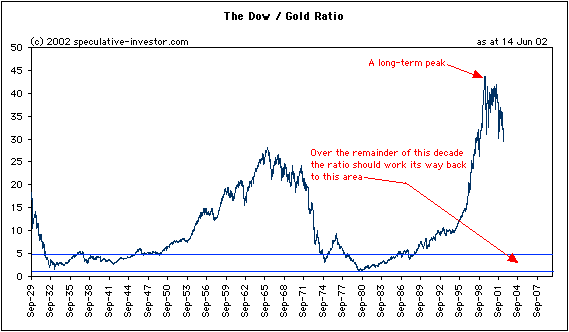
The Dow/gold ratio made what clearly
appears to be a major peak in August of 1999. The major peak of 1929 was
not exceeded until 1959 and the major peak of 1966 was not exceeded until
1998. Therefore, if history repeats itself the 1999 peak will remain unchallenged
until at least 2029. Furthermore, before embarking on a climb to its next
major peak the ratio will first drop below 5 and will perhaps fall as low
as 1. Past declines from peak to trough have occurred with greater speed
than the ascents from trough to peak, so a major bottom would likely be
reached before the end of the current decade.
It is all well and good to draw conclusions
based purely on historical data, but are there actual reasons (other than
the expectation that the cyclical pattern will continue) why the Dow/gold
ratio should plunge below 5 and subsequently soar to a new high?
We can come up with a good explanation
as to why the ratio is going to fall to a much lower level (see below),
but we can't explain why it will necessarily fall to the lows reached at
the bottoms of previous cycles. Also, we doubt that we will ever see the
Dow/gold ratio trade up to its 1999 levels again, even if we live to be
150. The distortions during the late-1990s were so great that even after
a 2-year readjustment period the Dow/gold ratio is still above where it
was at its previous major peak in 1966.
To understand why the ratio is almost
guaranteed to fall to a much lower level it needs to be understood that,
over the very long term, most of the gains achieved by investing in the
stock market stem from inflation and dividends. Actually, using the word
"most" here is a gross understatement. More than 99% of stock market returns
over the past 200 years have come from inflation and dividends. Since re-invested
dividends aren't included in the Dow Industrials Index, almost the entire
gain in the Dow over the past 200 years can be attributed to the effects
of inflation (the loss in the purchasing power of the Dollar). A
reduction in the Dollar's purchasing power will also, over the long term,
result in a corresponding rise in the dollar price of gold. Therefore,
the gold price and the Dow Industrials should move higher at roughly the
same pace (they should, over the very long-term, maintain a roughly constant
ratio).
We don't know, and it is not possible
to quantify, how many ounces of gold should be needed to purchase the Dow.
That is, it is not possible to calculate a fair value for the Dow/gold
ratio. What we do know is that a) the ratio periodically gets pushed way
above and way below its historical mean, and b) once the ratio has reached
an extreme and reversed course it tends to head in the opposite direction
until it once again reaches an extreme.
We can't be sure that the ratio will
once again return to the 1-5 range that marked the bottom in previous cycles
over the past 120 years, but the probability is very high that the ratio
will fall far below its present level over the next few years. Obviously,
the ratio can plunge as a result of a much higher gold price or a much
lower Dow or a combination of a higher gold price and a lower Dow. Our
view is that the gold price will do most of the work since we expect a
depreciating US$ to underpin the Dow.
The US
Stock Market
Stocks, Bonds and Money Supply Growth
Over the past 80 years or so major
bottoms in the US stock market have tended to occur at the same time as,
or a few months after, important bottoms in the bond market. Looked at
from a different angle we can say that major stock market bottoms occur
when interest rates are near multi-year highs, not when they are near multi-year
lows. This is one reason that last September's low in the stock market
has never looked like a long-term bottom (it occurred at around the same
time that interest rates were approaching a multi-year low).
So, if we are going to get a long-term
bottom in the stock market this year we will need to see a sharp fall in
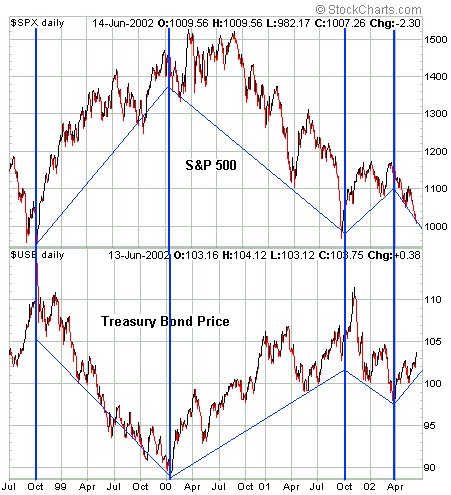
bond prices over the next several months. The problem is, bonds are continuing
to move in the opposite direction to the major stock indices. As has been
the case now for more than 4 years, substantial weakness in the stock market
is causing bond prices to rise (long-term interest rates to fall) and every
significant rally in stocks is accompanied by a sell-off in bonds (a rise
in long-term interest rates). The following chart illustrates this inverse
relationship.
Extreme weakness in the stock market
over the past 3 months has given bond prices a hefty boost and there is
every indication that bonds will continue to benefit from a falling stock
market over the short-term. One implication of this is that the stock market
bottom that appears likely to occur during the next 4 weeks will not be
THE bottom. Another implication is that the money supply growth rate is
being pushed higher.
Below is a chart that we've shown several
times over the past couple of years. It compares the year-over-year change
in the M2 growth rate with the T-Bond yield (the scale on the yield chart
is reversed so a rising line is indicative of a falling bond yield or a
rising bond price).
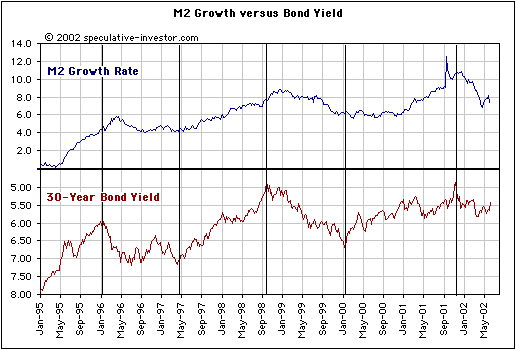
The above chart shows that the money
supply growth rate and the bond market have consistently moved together
over the past 7 years and that the bond market has led the money supply
growth rate at turning points. The typical lead-time has been around 3
months. In other words, over the past 7 years it has been the bond market,
not the Fed, that has controlled the money supply growth rate. Furthermore
it was this relationship that prompted us, in November of last year following
the peak in the T-Bond price, to forecast that the money supply growth
rate would begin trending lower by early-2002.
Periods of stock market weakness over
the past 4 years have resulted in rising bond prices and the higher bond
prices (lower interest rates) have, in turn, pushed the money supply growth
rate upward. The higher money supply growth has then given a boost to asset
prices and consumer spending.
Unless bonds do something we absolutely
do not expect and move above last year's peak, the recent recovery in the
money supply growth rate will be short-lived and its overall downtrend
will persist. However, we should be on the lookout for another ferocious
liquidity-induced rally in the stock market beginning from whatever low
is reached over the next few weeks.
Current Market Situation
With one exception all the sentiment
indicators we follow have either hit, or are rapidly approaching, bell-ringing
oversold extremes. For example, the 10-DMA of the total put/call ratio
has moved up to 0.93, the VIX hit a high of 36 on Friday before closing
at around 30, the 10-DMA of the Arms Index is 1.53, and all the major sentiment
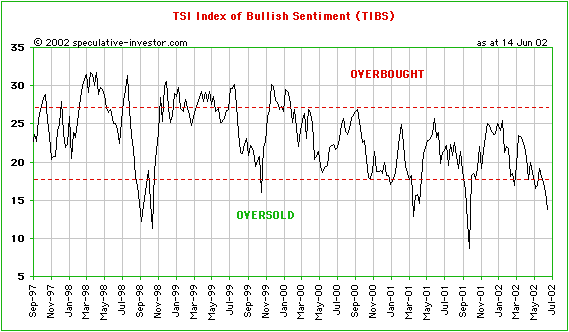
surveys are showing low bullish percentages. Also, the TSI Index of Bullish
Sentiment (TIBS), a weighted index of several sentiment indicators, has
dropped into extremely oversold territory (see chart below).
In addition to sentiment indicators
reaching the sort of levels that are normally associated with important
lows, it is getting very easy to find good value in the tech sector. We
now have Corning trading at less than one-times current depressed revenue,
Lucent trading at 0.7-times revenue and Sprint PCS trading at only slightly
more than 50% of this year's revenue. Unfortunately, there are also plenty
of stocks that are still grossly over-priced.
The one sentiment indicator that is
presently not confirming that a bottom is close at hand is the Commitments
of Traders Report. As at the 11th of June the net-long position of small
traders (the dumb money) was still near an all-time high. We would need
to see this net-long position fall from its current level of 105,000 contracts
to around 50,000 contracts before we would start to feel confident that
at least a multi-month low had been put in place. The Commitments of Traders
data could change from being bearish to being bullish within the space
of a few days, but it is probably going to take an additional drop of 50-100
S&P500 points to make this happen.
The bottom line is that we are probably
within a few weeks of reaching important lows in the major stock indices,
but these lows are likely to be well below Friday's closing levels. The
way we currently see things unfolding is that the market will either continue
to grind lower and reach a bottom within the next 2 weeks or there will
be a 1-2 week bounce followed by a sharp decline to new lows. Also, as
discussed under "Stocks, Bonds and Money Supply Growth" we do not think
that the low that is reached over the next few weeks will be the ultimate
bottom.
We may, at some point over the next
few weeks, exit all bearish positions and look to enter some long-side
trades in anticipation of a 1-2 month rebound.
A change in focus
Over the past 2 years the greatest
selling pressure has clearly been seen in the tech sector, but that might
soon change.
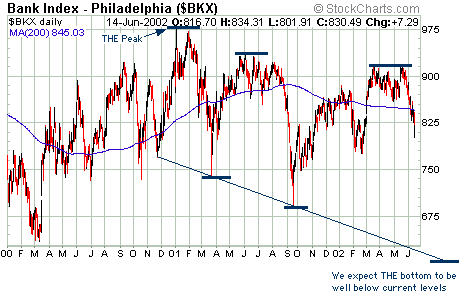
Below is a chart of the Bank Stock
Index (BKX). The banks have felt some pain as a result of corporate bankruptcies,
but the negative effects of problem loans have been largely offset, to
date, by widening profit margins as a result of the plunge in short-term
interest rates. As such, the BKX is currently less than 20% below its all-time
high (its all-time high was, by the way, hit within hours of the Fed's
first rate cut). It has, however, made a sequence of lower highs and lower
lows over the past 18 months.
The bubble in telecom debt has deflated,
thus creating significant problems for many banks, but the bubbles in consumer
debt and mortgage finance are yet to burst. We don't see any way that these
bubbles can continue to expand in a rising interest rate environment. Furthermore,
many of the banks' largest corporate customers outside the distressed telecom
sector are acutely vulnerable to higher interest rates. Since we expect
interest rates to be much higher at the end of this year than they are
now we think the primary focus of selling pressure in the stock market
could soon shift from the tech sector to the interest-rate sensitive stocks
such as the banks.
The Nikkei
Below is a chart comparing the Nikkei225
Index and the NASDAQ100 Index (NDX) since the start of last year. The Nikkei
has consistently led the NDX at important turning points over the past
18 months, although the relationship has recently become muddled.
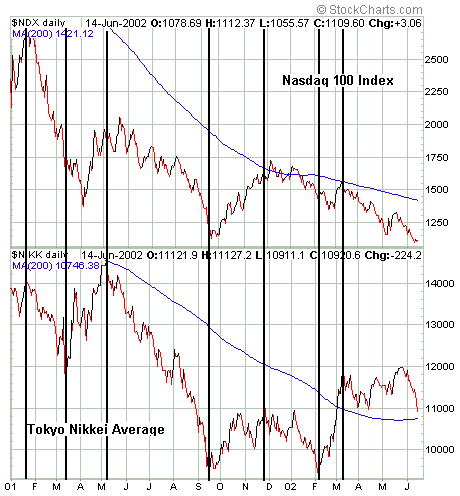
Since the beginning of April the Nikkei
has essentially traded sideways while the NDX has driven relentlessly lower.
The Nikkei actually looked like it was about to break out to the upside
about 3 weeks ago, but failed to do so and has since fallen quite sharply.
It is now nearing important support in the 10750-10900 range and must hold
above the bottom of this range to maintain a bullish posture.
One possible cause of the Nikkei's
recent weakness is that it has been dragged lower by the US market. This,
however, doesn't quite add up since the Nikkei had ignored the weakness
in the US market up until about 3 weeks ago. Another possible, and we think
more plausible, explanation for the Nikkei's sudden reversal is the BOJ's
concerted attempt to push the Yen lower against the US$.
With all government meddling in the
financial markets the one certainty is that there will be unintended negative
consequences. Up until the time the BOJ began to aggressively sell Yen
in an effort to prop-up the US$ the Yen and the Nikkei were trending higher
in tandem. By stopping the Yen's rise has the BOJ also stopped the Nikkei's
rise? When a central bank appears determined to weaken its own currency
it is certainly off-putting to existing and potential foreign investors
(central banks have an unlimited capacity to print their own currencies
and, therefore, an unlimited capacity to weaken their own currencies).
This week's important economic/market
events
| Date |
Description |
| Monday June 17 |
No significant events |
| Tuesday June 18 |
CPI |
| Wednesday June 19 |
No significant events |
| Thursday June 20 |
Current Account Balance
Trade Balance
Leading Economic Indicators (LEI) |
| Friday June 21 |
No significant events |
Click
here to read the rest of today's commentary

|









